
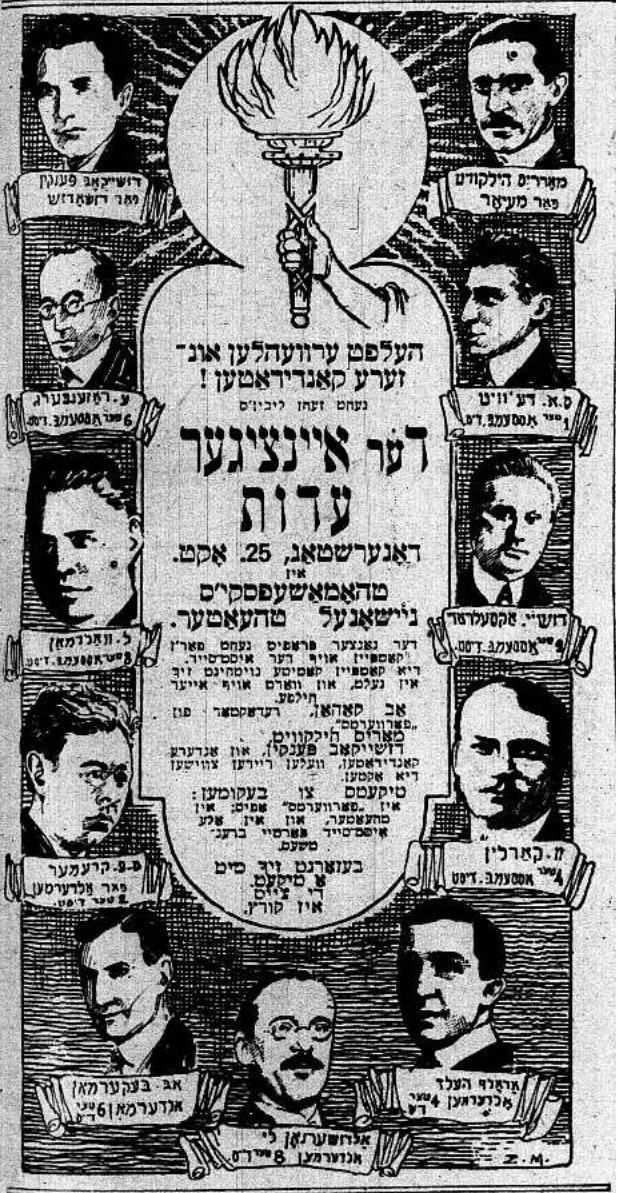
Image Source: National Library of Israel (Forverts Collection)
On November 7, 1917, New Yorkers went to the polls to elect their city’s government; their assemblymen, their aldermen (a now-defunct upper house to the City Council), and most importantly, their mayor. America has participated in World War I for seven months and the Tsar of Russia had been ousted for six months. As New Yorkers stood in line that very afternoon, the Bolsheviks were storming the Winter Palace in Petrograd. The Socialist Party of America (SPA) no longer exists, but it was a serious political force in the first decades of the 20th century. Buoyed by a coalition of organized labor, urban immigrants, and progressive reformers, the Socialist Party developed strongholds across the country; Milwaukee, the Mountain West, Oklahoma, and New York City. Protest against the war made the elections in 1917 crucial for the Socialists, and a record 21.7% of New York voters cast their ballots for the Socialist candidate for mayor, a Jewish immigrant from Latvia named Morris Hillquit. This would be the peak of Yiddish socialism’s influence in New York politics.
Born in Riga in 1869 as Moishe Hillkowitz, the son of a Jewish bourgeois family,1 Morris Hillquit arrived in New York at seventeen and took a job in a Lower East Side garment factory. He quickly fell in with the city’s Jewish working-class intelligentsia, learning Yiddish (a language his parents never taught him at home) to take a position at the Arbeiter Zeitung [Workers’ Newspaper], a Yiddish socialist weekly associated with the Socialist Labor Party. By his twenties he was already a founding organizer of the United Hebrew Trades, the federation of Jewish labor unions that would represent 200,000 Jewish immigrant workers across the Lower East Side in the coming decades.2 In 1901 he was a founding member of the Socialist Party of America. Over the next two decades rose to become the party’s leading theorist (largely being responsible for the party’s anti-war policy)3 and led its moderate wing, believing more so than anyone that American socialism could be won at the ballot box. Though Hillquit was a standard-bearer of socialism, he was also by 1917 a self-made man and became prosperous through corporate law and a portfolio of clever investments. He lived in a front apartment at the Chatillion, 214 Riverside Drive, on the Upper West Side4, a domicile considered at the time to be relatively extravagant for a man running to be tribune of the plebs.
This advertisement was published in the back page of the Forverts two weeks before the election, advertising a fundraising event for Morris Hillquit and other local Socialist Party candidates at Boris Thomashefsky’s National Theater. Sponsored by the Forvert’s editor-patriarch Abraham Cahan, this advertisement is tantamount to an official endorsement of the Socialist ticket for its readership. During this time, the Forverts was considered to be highly partisan in support of the Socialist Party, and multiple Forvertseditors and staff were running under the Socialist ticket. By harnessing anti-war sentiment, Hillquit increased the Socialist vote by nearly 500% in comparison to the 1913 mayoral election5 (where the Socialist candidate won 5% of the vote) and propelled the future’s most prominent Yiddish labor activists into public office for the first time. These Yiddish politicians who took office include; Municipal Justice Jacob Panken; Alderman Baruch Cheny Vladeck, the general manager of the Forverts; Alderman Adolph Held, Forverts editor and future founder of the Jewish Labor Committee; State Assemblyman William Feigenbaum, whose father cofounded the Workers Circle (at the time the Workmen’s Circle); State Assemblyman Louis Waldman, a prominent labor lawyer, State Assemblyman Abraham I. Shiplacoff, a prolific union organizer and Forverts editor; amongst other Jewish and non-Jewish local Socialist activists6. In 1920, the New York State Assembly voted to expel the five remaining Socialist State Assemblymen as part of the broader First Red Scare. Morris Hillquit served as their general counsel; ultimately, three Assemblymen were expelled, including Louis Waldman.
Translation
Help elect our candidate!
Go see Libin’s ‘The Only Witness
Thursday, 25th October
in
Thomashefsky
National Theater
The entire project includes the campaign on the East Side.
The campaign committee is in need of money, and is waiting for your help.
Ab. [Abraham] Cahan, editor of the Forverts, Morris Hillquit, Jacob Panken, and other candidates, will speak between the acts.
Tickets to get: at the Forverts office; at the theater, and at all East Side party branches
Worry yourself with a ticket. The time is short.
(Candidates from right to left, top to bottom)
Morris Hillquit
For Mayor
Jacob Panken
For Judge
S. A. De Witt (Sam DeWitt)
1st Assembly District
E. Rosenberg (Elmer Rosenberg)
6th Assembly District
J. Axelrod (Jacob Axelrod)
2nd Assembly District
L. Waldman (Louis Waldman)
8th Assembly District
W. Karlin (William Karlin)
4th Assembly District
S. P. Kramer (Samuel P. Kramer)
Alderman, 2nd District
Adolph Held
Alderman, 4th District
Algernon Lee
Alderman, 8th District
Abraham Beckerman
Alderman, 6th District
- EBSCO – Morris Hillquit ↩︎
- Records of the United Hebrew Trades ↩︎
- Britannica – Morris Hillquit ↩︎
- NY Times – RICH MR. HILLQUIT, POOR MAN’S CANDIDATE; Socialist Who Seeks Mayoralty Is a Corporation Lawyer, Owns Corporation Stocks, and Is Generally Different From What a Socialist Is Supposed to Be. WEALTHY MR. HILLQUIT ↩︎
- NY Times – HILLQUIT SAYS RESULT IS BIG PARTY VICTORY; Believes Socialism Is Established as Permanent Factor in the City’s Politics. ↩︎
- Wikimedia – Socialists elected in New York City, 1917 (Image) ↩︎

