
Through doing the Irene Kronhill Pletka YIVO fellowship this past semester, I have had the amazing opportunity to help with the YIVO archives. Because of my background studying Art History and Visual Arts, I am especially interested in the use of Yiddish language within Jewish art. Through this fellowship, with the help of Stefanie Halpern and Tom Tearney, I have gotten to work with materials such as Saul Raskin’s series of etchings from 1940 about Pirkei Avot (RG 1239) where each one of the works in this series represents one of the sayings. I have also got the opportunity to work with different postcards (RG 122) largely from the early 20th century.
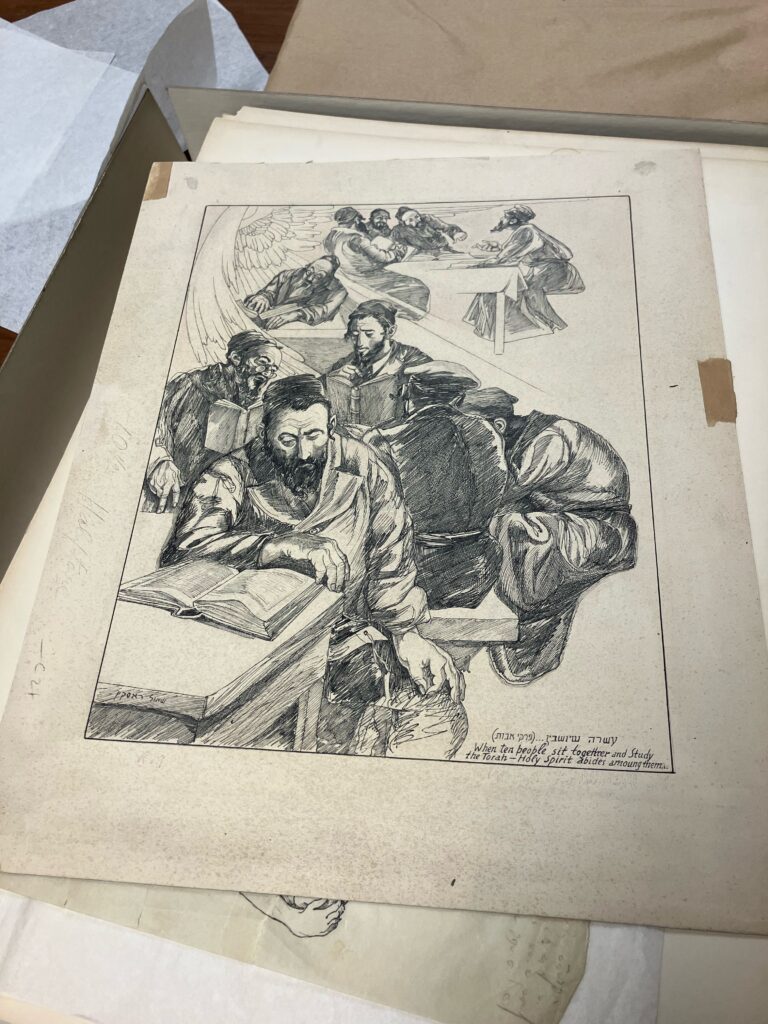
Saul Raskin, a Russian-American artist, was born in Nogaisk in 1878. He studied lithography, a type of printing, in Odessa, and continued his studies in art schools all across Europe—including in Germany, France, Switzerland, and Italy. He immigrated to the United States in 1904 and died in 1966 in New York City.
The postcards that I worked with in this fellowship were from a wide variety of places—Europe, Palestine, America—in a wide variety of languages—English, Yiddish, Hebrew, Russian, German—and about a wide variety of topics. One of these topics that stood out to me were the postcards inspired by religion—especially the ones with Yiddish on them.
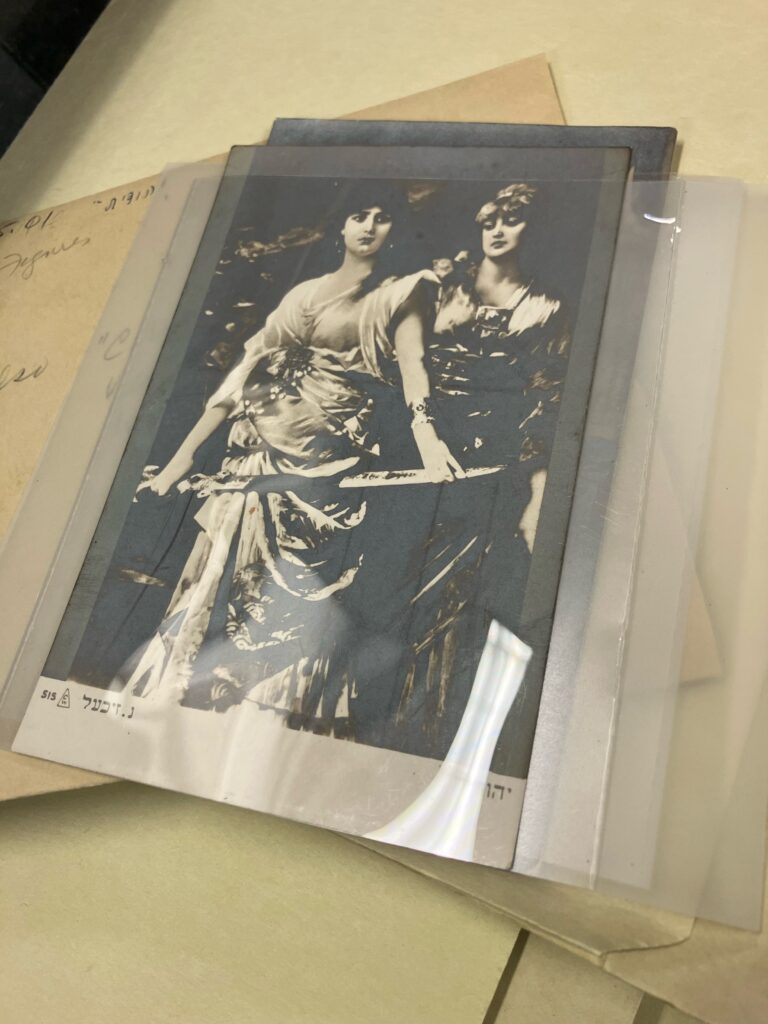
Two of these such postcards depict Judith from the Book of Judith and Delilah from the bible. Under one of them, Yudis is written in Loshn-Koydesh (יהודית), and the name of the publisher, N. Zichel, is written in Yiddish. The other postcard showcases Delilah, which is written in Yiddish under the photo along with the publisher H. Kaumans. Judith, or Yudis, is a feminist figure. Her story revolves around her seducing and subsequently beheading Holofernes, the Assyrian general, causing them to retreat. This postcard showcases her holding a sword. Delilah in the bible, falls in love with sampson, and later is used by the Philistines to learn the secret of his strength.
Another series of Yiddish postcards depicting religious life is from Warsaw. They have paintings depicting scenes of late 19th or early 20th century religious life in Eastern Europe, and are captioned in Yiddish. There are 11 of these such postcards. My favorite from this series is a painting of two boys learning in a Kheyder. The caption reads: In a gelitsianer kheyder, or “In a religious school in Galicia.” It shows a melamed, or a religious teacher, teaching two young boys, bokhers, about Judaism.
In looking through these materials, I became interested in when the creators of these objects decided to use or not use Yiddish. Though Saul Raskin spoke Yiddish, did a lot of work in Yiddish newspapers, and even wrote a book in Yiddish (An Oysgetrakhter Emes), his Pirkei Avot etchings have no Yiddish on them. Some of these etchings have only the Hebrew on them, while others have an English translation. Why would Raskin choose to translate these sayings from Hebrew into English but not Yiddish?
Both Saul Raskin’s etchings and the aforementioned postcards are deeply entwined in Judaism and Jewish themes. The difference is the use of Yiddish versus English as a common language. This could be from what era these different objects are from—Raskin’s work is from 1940 and created in America, while these Postcards were from all around Europe (it is unknown the exact time period they were made). It could also be that the audiences differ for these works. According to the Basic Facts About Yiddish packet from YIVO, Yiddish was the main language that Jews used before the Holocaust. Yiddish was mainly used as a language that everyone could understand, while Hebrew was more of a language for scholars. According to Modern Hebrew: The Past and Future of a Revitalized Language by Norman Berdichevsky, though no one in the late 19th century was “ a primary, habitual or native speaker of Hebrew,” it was still at that time a “prestigious language of religious observance and commentary.”
Postcards are a media for the masses—everyone has to get in contact with their loved ones, so everyone should be able to understand what is written on the postcards that they are sending. Using Yiddish meant that people from many different parts of the world could still understand what was going on. Etchings, on the other hand, might’ve been reserved for people who had access to exhibitions or art auctions. That could account for why the postcards have Yiddish, a common language, on them, while the etchings do not.

Image via YIVO Archives (RG 28)
Another art piece that exemplified the use of Yiddish as a common language was an advertisement poster from the 1920s by Issachar Ber Ryback. Ber Ryback was a Jewish-Ukranian artist who was greatly influenced by European Modernism. His poster, titled “Agriculture Provides Sustenance To The Individual And Makes the Community Healthier”, was a call to support ORT, an organization that provided occupational training programs. This poster specifically focuses on the program to provide Jews with agricultural skills. The poster, translated, reads:
Erd-arbet dem yokhed: Land-work member
Git parnose un makht gezunter: Good livelihood and become healthier
Dem klal: The people
Shtitst ort: Support ORT
Ort farshpreyt erd-arbet tsvishn yidn: ORT spreads farming among Jews
This piece uses imagery of powerful, strong, working Jews juxtaposed to frail, slouched, non-working Jews. Ber Ryback combines that with Yiddish vernacular to convince people to support ORT in their goal to train Jews to work on farms. Using Yiddish, a language for the masses, lets this message have the ability to be widely circulated among Jews looking for vocational training and Jews wanting to support ORT in their programming.
Throughout my art history courses at Barnard, we have learned very little about Jewish art. Through this program at YIVO, I have gotten to see and learn about how artists chose to incorporate their Judaism into their art practice. I also have gotten to see how they choose to incorporate language into their pieces—whether it be in English, Yiddish, Hebrew, and more. I hope to use what I’ve learned doing the Pletka fellowship at YIVO to inform not only how I incorporate my Judaism and Jewish culture into my art, but also how I incorporate language.
