
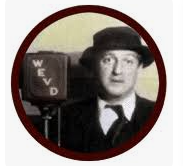
When discussing Yiddish culture in New York City, one would be remiss not to include WEVD, the quintessential Yiddish language radio station of the twentieth century. WEVD was initially created in 1927 by the Socialist Party as a medium for a wide range of political discussion and debate (Dolber 290). The station’s call letters were chosen as the initials of Eugene V. Debs, a prominent Socialist Party leader who had recently died. From its inception in 1927, WEVD’s mission was to provide not just entertainment, but education for the masses, specifically the working class, without fear of censorship or regulation by larger broadcasting companies. In 1932, management of WEVD was transferred to the popular socialist, Yiddish newspaper, Der Forverts, or The Forward. Even before The Forward’s takeover, WEVD was known as the “nexus of New York’s ‘Jewish working-class counterpublic (Dolber 290).” WEVD’s programming was known for its sponsoring of foreign-language and ethnic entertainment, serving a critical function in immigrants’ lives in American (Dolber 302-303).
After The Forward’s takeover of the station, WEVD became popular for its Yiddish-language programing, cementing its place as a primary form of Jewish and Yiddish entertainment for New Yorkers. At its height, the radio station broadcasted between 50 and 70 hours of Yiddish a week (Kelman), providing its Yiddish-speaking listeners a connection to their culture and a reflection of their own lives. The physical location of WEVD is important to note in relation to its connection to New York City. The transmitter was located in Woodhaven, Queens while the station’s headquarters were in Manhattan (Dolber 291, 296). WEVD was a radio station not only located in New York City, but one that catered specifically to the New York City community. The physical location of WEVD was one of its defining factors because it contributed to its crucial interaction with the urban, Jewish, working class immigrant community.
WEVD’s relationship to its environment is most strongly seen in the nature of its content. The station offered a variety of programming for its Jewish audience which aptly captured the popular culture of the time and the more niche interests of WEVD’s listeners. The most famous Yiddish radio show was created by The Forward. Titled The Forward Hour, it was a variety show that aired every Sunday at 11:00 AM (Yiddish Radio Project). Some other notable programing include Madame Bertha Hart’s Talent Show (Yiddish Radio Project), C. Israel Lutsky’s The Jewish Philosopher which was reminiscent of The Forward’s popular advice column, A Bintel Brief, Rabbi Rubin’s Court of the Air in which the rabbi would mediate family, business and other disputes (Merwin), The Chunky Program, Oddities in the News (a listing of “offbeat” news items from that week’s papers), and a sunday children’s hour (Commercials on Yiddish Radio). These programs are just a few of many, but represent the wide range of Yiddish entertainment made accessible to the public. The programing was heymish and incredibly specific to the New York Jewish community, perfectly encapsulating the time and place. One of the most profound impacts of WEVD and other Yiddish radio stations was the fact that they created some of the first Jewish celebrities in America.
Possibly even more revealing than the programing were WEVD’s advertisements. These are described well by a Story Corps profile on the subject matter: “Much to their listeners’ dismay, these stations often filled as much as 50 percent of the broadcast day with pitches. Often inspired, occasionally insipid, commercials from neighborhood stores were the lifeblood of Yiddish radio.” The fact of the matter is, commercials were just as much a part of WEVD’s programing than the shows themselves. As a small, private radio station, WEVD relied heavily on the income received from their advertisements. Both in Yiddish and in English, these commercials act as a vivid metaphor for Jews’ sociocultural position in New York City. The advertisements ranged from larger, national companies like Hebrew National and Campbell’s soup to local businesses in the Lower East Side such as Portnoy’s Trusses, Chunky Chocolate, and Meyer Mehadrin Kosher Herring Products (Commercials on Yiddish Radio). Together, the remnants of these commercials help historians piece together the lives of Jewish immigrants in New York City and demonstrate how much of their integration into American culture was accomplished through consumerism.
These commercials became as much a part of Yiddish culture in New York City as the formal entertainment, which is evinced by Aaron Chwatt’s (known by his stage name of “Red Buttons”) famous comedy routine, “Joe and Paul.” The sketch is based off of a real jingle recorded for Joe and Paul, a clothing store chain in Brooklyn, Manhattan, and the Bronx. Red Buttons’ skit was made famous by his performances in the Borscht Belt. The routine was a parody of a Yiddish radio station called WBVD whose commercials kept on being interrupted by more, progressively funnier commercials. After Chwatt was drafted into the army during World War II, the Barton Brothers comedy team picked up the routine, recording it in 1947 to incredible success (Commercials on Yiddish Radio).
One of the more interesting impacts of WEVD and Yiddish radio in general was its function of bringing Yiddish culture into the domestic sphere. In his essay, The Acoustic Culture of Yiddish, Ari Kelman delves into how Yiddish radio redefined the way in which Yiddish was understood and consumed. In his analysis, he describes the ways in which Yiddish radio played into individual’s religious routines:
“Ruth Glazer, ‘an occasional commentator on Jewish manners, morals, and cooking,’ observed in an article for Commentary that “Fridays and WEVD somehow belong together.” In her idiosyncratic account of WEVD’s Friday line-up, Glazer described WEVD’s accompaniment to her own process of cleaning the house, polishing candlesticks and skimming fat off the chicken soup, culminating ‘when things reach a real crescendo with a real balebosta [sic] [homemaker], we have a correspondingly heightened mood on WEVD.’”
Glazer’s account provides much insight into the gender dynamics present in Yiddish radio as a whole. It brought culture, politics, and news into the home, connecting women and those restricted to the domestic sphere to that which they may have not otherwise had access too. WEVD acted as an accompaniment to the feminine religious ritual of preparing for the Sabbath, elevating a woman’s routine as it underscored Yiddish’s presence in the private sphere. This function is notable in the context of the tenuousness of Yiddish’s gender, seeing as it has historically been pushed and pulled between the realms of the feminine and masculine. As one can expect, the majority of the producers and radio personalities were men. Even so, the highly personal nature of radio (a connection to wider society, yet one that is placed in the home) arguably subverts gender. As a connection to culture, it subverts the traditional idea that ‘culture’ is reserved only for men (Ortner 71-73), while also inextricably linking Yiddish to the domestic and private sphere.
As anyone clued into the general trajectory of the Yiddish language knows, the numbers of Yiddish speakers decreased as the twentieth century wore on. Eventually, WEVD had to come to an end. It’s last broadcast was on August 31st, 2001 before it was sold to ESPN (Yiddish Radio Project). The legacy of WEVD lives on in archivally preserved tapes, in the New Yorkers who grew up listening to WEVD, and in the wider New York and Jewish culture which it unquestioningly influenced. With the remnants of WEVD’s Yiddish programming and advertisements, we can gain a vivid image of the vibrant lives of New Yorkers, countering the oftentimes dismal depictions of Jewish immigrant life during the twentieth century.
Work Cited
“The Yiddish Radio Dial: History of Yiddish Radio.” Yiddish Radio Project, Sound Portraits Productions, 2002, www.yiddishradioproject.org/exhibits/history/history.php3?pg=1.
“Commercials on Yiddish Radio.” StoryCorps, NPR, 19 Mar. 2002, storycorps.org/listen/commercials-on-yiddish-radio/.
Merwin, T. “Yiddish Radio Project (Original Radio Broadcast) (review).” Journal of American Folklore, vol. 122 no. 2, 2009, pp. 210-212. Project MUSE, doi:10.1353/jaf.0.0073
Kelman, Ari Y. “The Acoustic Culture of Yiddish.” Shofar, vol. 25, no. 1, 2006, pp. 127-VIII, Ethnic NewsWatch; ProQuest Central; Research Library,
Dolber, Brian. “Strange Bedfellows: Yiddish Socialist Radio and the Collapse of Broadcasting Reform in the United States, 1927-1938.” Historical Journal of Film, Radio & Television, vol. 33, no. 2, June 2013, pp. 289-307. EBSCOhost, doi:10.1080/01439685.2013.798080.
Ortner, Sherry B., et al. Is Female to Male as Nature Is to Culture? Stanford University Press, 1974.
