
By Jordan Barry

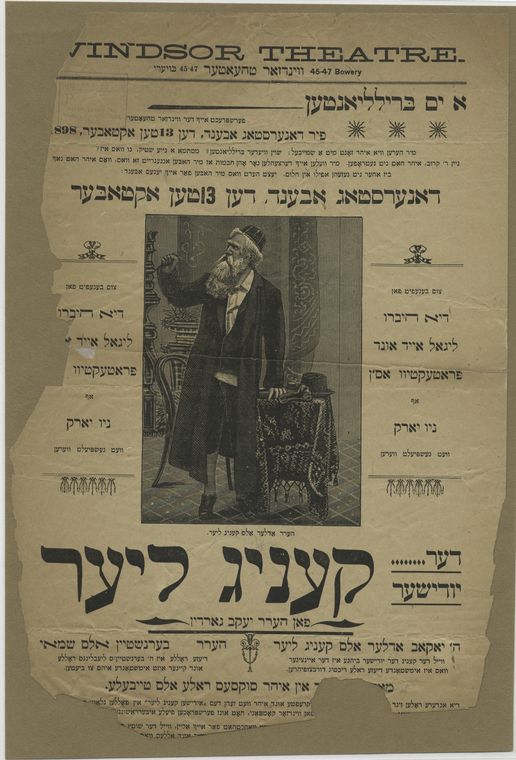
Translation:
Windsor Theater 45-47 Bowery
A brilliant (?)
The Windsor Theater Presents to You
On Thursday Evening, the 13th of October, 1898
We hear you say with a smile: Don’t you already have gems? This is probably a new play, isn’t it?
No sir, you don’t have it right. We will just tell you that we have for you that evening:
Thursday Evening, the 13th of October
To benefit the
The Hebrew
Legal and Prospective Law (?)
In New York will play
Mr. Adler as King Lear
The Jewish King Lear
By Mr. Jacob Gordin
Mr. Jacob Adler as King Lear
Because the king of Jewish theater is the only one that can play this role correctly.
Mr. Bernstein as the Steward
This role is Mr. Bernstein’s pet role (favorite role?) and no one does it better.
[…] In her role as the girl Taybele
The other roles are […] talent and you will see the “Jewish King Lear” […]
From Windsor Company, have our promise that the play is astounding […]
Choose for yourselves, because the […]
[…] and all […]
This poster advertises a production of דער יודישער קעניג ליער (The Yiddish King Lear) at the Windsor Theatre on Thursday evening, October 13th, 1898. It gives its viewers the location, general time, and actors in this play, highlighting the talents of actor Jacob Adler in particular. The דער יודישער קעניג ליער, while inspired by Shakespeare’s King Lear, is not simply a translation of Shakespeare’s work into Yiddish. This reinterpretation takes place in Vilna, Lithuania, and the patriarch (the King Lear parallel) is a wealthy Jewish merchant rather than an English king.
1 2 3
The play was staged in the Windsor Theatre, which was one of the theaters in Yiddish Broadway, also know as the “Yiddish Rialto.” In the late 19th century and early 20th century, the Lower East Side had a robust theater presence developed along Second Avenue. The Windsor Theatre, located on 45-47 Bowery, was just across the street from another Yiddish theater called the Bowery Theatre (and also the Thalia Theatre). These theaters showed operas, comedic musicals, melodramas, and Yiddish productions of plays that originated in other languages.
4 5 6 7 8 9
The role of King Lear (actually named Dovid Moysheles in the play) was played Jacob Adler, a well-known actor and producer of Yiddish Theater. The poster seems to use his renown and talent as a selling point for this particular production, which refers to him as דער קעניג דער יודישער ביהנע (“The King of Jewish Theater”). Adler sought to produce a more serious type of play to contrast the low-brow, melodramatic associations that many had with Yiddish theater of the time. He hired Jacob Gordin, a Russian-Jewish immigrant, to write דער יודישער קעניג ליער. Gordin’s writing, known for its realism, and Adler’s performance in the lead role, led דער יודישער קעניג ליער to be a successful milestone in both of their careers.
10 11 12 13 14
In addition to the subject matter of the play, the words on the poster itself represent the evolution and cultural trends in the Yiddish language. I noticed certain differences the spelling of words (in comparison to the more standardized Yiddish I have been learning). The diacritical marks weren’t as consistent as I am used to (the א’s in particular often didn’t have diacritical marks). Some words had extra letters in them, such as a ה that wasn’t making an “h” sound in its own, or double consonants (such as לל in ראָללע) that don’t seem strictly necessary from a phonetic standpoint. These spelling idiosyncrasies could be indicative of דײַטשמעריש, which was a style of Yiddish that emphasized the German aspects of the language (often used to sound more “cultivated,” which created an association with pretentiousness). Considering the poster in this lens, it’s interesting to think about how playwrights and producers were trying to actively change the language, but 122 years later, as a student, the goal is to try to preserve the language in its varied forms.
15 16Images:
Der Yudisher Kenig Lier. 1898. The New York Public Library Digital Collections, https://digitalcollections.nypl.org/items/510d47db-1487-a3d9-e040-e00a18064a99
Windsor Theatre Entrance, 43 Bowery. 1909. Museum of the City of New York, https://collections.mcny.org/Collection/[Windsor-Theatre-Entrance,-43-Bowery.]-2F3XC5UXVWEI.html
Jacob Adler in 1902. 1902. Wikipedia, https://en.wikipedia.org/wiki/Jacob_Pavlovich_Adler#/media/File:Jacob-Adler-1902.jpg
Jacob Mikhailovich Gordin. c. 1895. Wikipedia, https://en.wikipedia.org/wiki/Jacob_Gordin#/media/File:Jacob_Gordin.jpg
- “The Yiddish King Lear.” Wikipedia, 15 Nov. 2020. Wikipedia, https://en.wikipedia.org/w/index.php?title=The_Yiddish_King_Lear&oldid=988749659.
- Berkowitz, Joel. “Plotting Yiddish Drama: Der Yidisher Kenig Lir.” Digital Yiddish Theatre Project, Digital Yiddish Theatre Project, 2020, https://web.uwm.edu/yiddish-stage/plotting-yiddish-drama/der-yidisher-kenig-lir. https://web.uwm.edu/yiddish-stage/.
- “The Jewish King Lear.” Metropolitan Playhouse, 2018, http://www.metropolitanplayhouse.org/essayjewishkinglear.
- “Yiddish Broadway or Yiddish Rialto (Second Avenue in Manhattan).” Manhattan Jewish Historical Initiative, 4 Apr. 2017, https://manhattanjewish.org/2017/04/04/yiddish-broadway-or-yiddish-rialto-second-avenue-in-manhattan/.
- “Yiddish Theatre.” Wikipedia, 13 Nov. 2020. Wikipedia, https://en.wikipedia.org/w/index.php?title=Yiddish_theatre&oldid=988516607.
- “Bowery Theatre.” Wikipedia, 7 Dec. 2020. Wikipedia, https://en.wikipedia.org/w/index.php?title=Bowery_Theatre&oldid=992805534.
- “Fay’s Bowery Theatre.” Internet Broadway Database, 2020, https://www.ibdb.com/theatre/fays-bowery-theatre-1073.
- Berger, Joseph. “‘New York’s Yiddish Theater’ Explores a Fractious Heritage of Melodrama and Musicals (Published 2016).” The New York Times, 10 Mar. 2016. NYTimes.com, https://www.nytimes.com/2016/03/11/arts/design/new-yorks-yiddish-theater-explores-a-fractious-heritage-of-melodrama-and-musicals.html.
- Steinlauf, Michael C. “Theater: Yiddish Theater.” YIVO, 2010, https://yivoencyclopedia.org/article.aspx/Theater/Yiddish_Theater.
- “The Jewish King Lear.” Metropolitan Playhouse, 2018, http://www.metropolitanplayhouse.org/essayjewishkinglear.
- “Yiddish Theatre.” Wikipedia, 13 Nov. 2020. Wikipedia, https://en.wikipedia.org/w/index.php?title=Yiddish_theatre&oldid=988516607.
- Steinlauf, Michael C. “Theater: Yiddish Theater.” YIVO, 2010, https://yivoencyclopedia.org/article.aspx/Theater/Yiddish_Theater.
- “Jacob Pavlovich Adler.” Wikipedia, 5 Oct. 2020. Wikipedia, https://en.wikipedia.org/w/index.php?title=Jacob_Pavlovich_Adler&oldid=981967624.
- “Jacob Gordin.” Wikipedia, 14 May 2020. Wikipedia, https://en.wikipedia.org/w/index.php?title=Jacob_Gordin&oldid=956664196.
- Philologos. “Daytshmer Nightshmare.” The Forward, 2010, https://forward.com/culture/127096/daytshmer-nightshmare/.
- Fishman, Joshua A. “Language: Planning and Standardization of Yiddish.” YIVO, 2010, https://yivoencyclopedia.org/article.aspx/Language/Planning_and_Standardization_of_Yiddish.


