
Background
Gut Fun Nekome, or God of Vengeance, was written in 1906 by Sholem Asch in Poland and premiered in Berlin in 1907. Sholem Ash was born in Russian Poland on November 1, 1880, and wrote God of Vengeance at the age of 26 while vacationing in Switzerland in the summer of 1906. The premiere production was directed by Max Reinhardt, who had previously directed a production of Merchant of Venice that Asch admired1. God of Vengeance came out of a period of Asch’s work that explored themes of wrestling the call of modernity and emancipation with the tradition of religion and shtetl life2.

The writing and staging of God of Vengeance came at a time of rising anti-Semitism in Europe and the US. While God of Vengeance provided audiences with a window into shtetl life, it was also filled with anti-Semitic stereotypes that needed to be dealt with delicately. When it came to New York in 1923, Rabbi Joseph Silverman of Temple Emanu-El in NYC came out against it. After the Holocaust, Asch actually requested that the play not be shown anymore for fear that it would be used as anti-Semitic propaganda. The controversial themes of sex and prostitution were also unwelcome at a time of censorship and homophobia in the US.
God of Vengeance was the first Yiddish play to tour Europe and was widely received. It was first performed in Berlin, then Moscow, and recreated by amateur Yiddish theatre troupes all over Europe. The play was translated into Polish, Hebrew, English, Italian, French, Dutch, Czech, Swedish, and Norwegian soon after and even became the inspiration of movies and parodies. The play came to New York in 1922. A Yiddish work with heavily Jewish themes and eventually the first lesbian kiss on Broadway in the U.S., this play shook the Jewish and theatre worlds to their core.
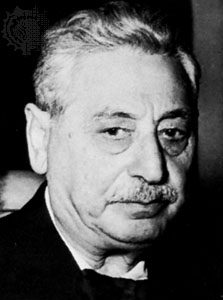
Gut Fun Nekome centers around a family living in a traditional eastern European shtetl with a very untraditional secret. The patriarch of the family, Yankl, and his wife, Sorah, run a brothel in their basement. While Yankl believes that their only child, Rivkele, is completely in the dark regarding her parent’s business, she is actually having a love affair with Manke, one of the prostitutes. Yankl is obsessed with ensuring the purity of his daughter and is even convinced by Rav Ali (a local matchmaker) that he can atone for his sins by purchasing a Torah scroll and placing it in Rivkele’s room. The play explores themes of lust, abuse, freedom, guilt and was groundbreaking in terms of humanizing some of the most marginalized people of its time3.
Gender and Sexuality in God of Vengeance
Gut Fun Nekome will go down in history as the first lesbian kiss on an American Broadway stage. The work’s exploration of queer female sexuality would be complex and groundbreaking for today’s standards; It was absolutely earth-shattering when it premiered in the early 20th century. It displayed not only moments of intimacy and lust between the female lovers- but also intense dialogues that painted vivid representations of the internal worlds of these women, which was also unprecedented. Paula Vogel, the playwright of Indecent about the history of God of Vengeance said in an interview with American Theatre, “He had such compassion for the plight of women. The way of life for everyone was so limited. And then there was the love scene between the two women. I still think it’s the greatest love scene between two women I’ve ever read”4.

The play also explored themes of male control over female sexuality, particularly through familial relationships. Throughout the play, Yenkl is obsessed with controlling his daughter’s sexuality and equates her value with her purity. The irony of his profession juxtaposed with his desire to control his daughter’s purity exposes and caricatures the hypocrisy of double standards against women in society in regards to sexuality. It also raises a powerful point- by obsessively objectifying women and glorifying their purity, patriarchy makes it impossible to understand what is really going on beneath the surface for women. While Yankl is busy focusing on Rivkele’s heterosexual purity, he completely misses what is going on beneath his feet as Rivkele and Manke fall in love. Overall, it was a landmark production for women and the queer community in particular.
God of Vengeance in NYC
In 1922, the play premiered in New York City in English. At the time, there were strict laws regarding the limits of what art could and could not portray, including guidelines on what could be considered too “indecent” for public viewing. Originally, it was performed in Greenwich Village (at the Greenwich Village Theatre and the Provincetown Playhouse), where it could fly under the radar and be performed for a more receptive, open-minded audience. After much success, it was moved to the Apollo Theatre on 42nd Street, where it would have its Broadway debut. However, it’s popularity brought newfound consequences. On March 6th, 1923 the producer, Harvey Weinberger, along with the rest of the cast were arrested charged with indecency. The Jewish community was divided over their response to the controversy, with notable voices on both sides. As noted above, Rabbi Joseph Silverman of Temple Emanu-El was firmly against the performance. However, Jewish Daily Forward editor Abraham Cahn came to Asch’s defense.

God of Vengeance has been revived many times all over the world. Most recently, the New Yiddish Rep theatre troupe performed it in its original Yiddish at La MaMa in NYC5, with English subtitles projected on the screen. The revival lasted from December 2016 to January 2017, and reopened again in March 2017 at the Theatre at St. Clements.
Indecent
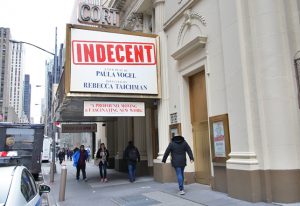
The history of God Vengeance served as the inspiration for Paula Vogel and Rebecca Taichman’s play, Indecent, about the writing, staging, and controversy of Sholem Asch’s work. Indecent was developed as part of Taichman’s graduate thesis at Yale after she happened to come across God of Vengeance in her studies and related to its themes and Yiddish culture due to growing up around her father who was a Yiddish poet. After its run with a Yale theatre troupe, it was performed at the Vineyard Theatre in NYC and moved to Broadway at Cort Theatre in April 2017 6. It was anticipated to end its run in June, but due to its popularity and two Tony wins, it was extended until August. It was nominated for best play, and won for best lighting and best directing. Indecent followed Asch from the writing of God of Vengeance, to its staging in Europe, to the cast arrest in New York and the eventual murder of many of the key players in the Holocaust. The play explored themes of Jewish identity in the diaspora, art, fame, and loss while unpacking the complicated and tumultuous history of God of Vengeance 7.
Conclusion
God of Vengeance, although set in a very specific time and in Eastern Europe, speaks deeply to the timeless Jewish diaspora experience in New York, particularly that of the Yiddishist community. The exploration of “purity” and “tradition” throughout the play speak to the tension between preserving one’s culture while being exposed to and benefiting from, both internal and external forces. Its groundbreaking representation of female sexuality and dynamic female characters caused a lot of controversy, but ultimately paved the way for future displays of the lives of women and the queer community.
Selected Bibliography
-
- Mazower, Davis. “10 Things You Need to Know about *God of Vengeance*.” Digital Yiddish Theatre Project, 28 Feb. 2017, yiddishstage.org/10-things-you-need-to-know-about-god-of-vengeance.
-
- The Editors of Encyclopædia Britannica. “Sholem Asch.” Encyclopædia Britannica, Encyclopædia Britannica, Inc., 3 Apr. 2017, www.britannica.com/biography/Sholem-Asch.
-
- Isherwood, Charles. “Review: In ‘God of Vengeance,’ a Nice Jewish Family Lives Above a Brothel.” The New York Times, The New York Times, 29 Dec. 2016, www.nytimes.com/2016/12/29/theater/god-of-vengeance-review.html?_r=0.
-
- Horwitz, Simi. “But Is ‘God of Vengeance’ Good for the Jews?” AMERICAN THEATRE, 5 Jan. 2017, www.americantheatre.org/2016/12/21/but-is-god-of-vengeance-good-for-the-jews/.
-
- Barone, Joshua. “‘God of Vengeance’ to Be Revived by New Yiddish Rep.” The New York Times, The New York Times, 28 Aug. 2016, www.nytimes.com/2016/08/29/theater/god-of-vengeance-to-be-revived-by-new-yiddish-rep.html.
-
- Paulson, Michael. “Prominent Producers Hope to Bring ‘Indecent’ to Broadway.” The New York Times, The New York Times, 25 Aug. 2016, www.nytimes.com/2016/08/26/theater/producers-hope-to-bring-indecent-to-broadway.html.
-
- Barone, Joshua. “Despite Tony Wins, ‘Indecent’ Announces Its Broadway Closing.” The New York Times, The New York Times, 14 June 2017, www.nytimes.com/2017/06/14/theater/despite-tony-wins-indecent-announces-its-broadway-closing.html.
