Molly Picon: The Petite Darling of Yiddish Musical Theatre
By: Deborah Pollack
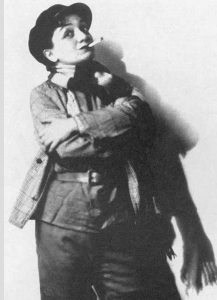
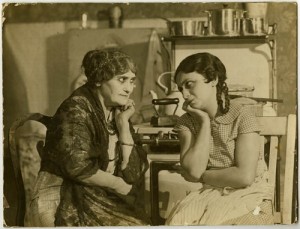
Above: Molly Picon
Molly Picon, the petite darling of Yiddish Musical theatre, was 4’11 and weighed only 95 pounds.((Power, Sharon. “Yiddish Theatre Actresses and American Jewish Identity.” Shofar: An Interdisciplinary Journal of Jewish Studies3 (2012): 84–107. muse.jhu.edu. Web.)) Yet, she was one of the biggest stars on the Yiddish vaudeville and Broadway stage. Some called her the Jewish Charlie Chaplin or the Jewish Helen Hayes.((Ganton, Sarah. “From Vaudeville to ‘Fiddler’: (Re)introducing Molly Picon, the ‘Jewish Charlie Chaplin.’” 16th Street. N.p., n.d. Web. 3 May 2016.)) Picon had many talents in the entertainment sector. Aside from being the star of many Yiddish and English speaking plays, she stared in motion pictures and became a radio and television personality. She wrote almost 100 songs and skits for the stage.((“Molly Picon | Jewish Virtual Library.” N.p., n.d. Web. 3 May 2016.)) Known from her geneyvishe oygen, mischievous eyes, and dark bob, she won hearts across the United States, Israel, Europe, South Africa, and Australia. She truly delighted audiences everywhere.((“Molly Picon | Jewish Women’s Archive.” N.p., n.d. Web. 3 May 2016.))
Picon’s Early Years
Picon was born as Margaret Pyekoon, in a tenement on Broome Street on the Lower East Side of New York. The date of her birth was always unclear. In her autobiography she writes that various records have listed her as being born on either February 28th or June 1st. Picon writes: “Naturally, I celebrate both dates.”((“Molly Picon | Jewish Women’s Archive.” N.p., n.d. Web. 3 May 2016.)) Her father, Louis Picon, was from Warsaw, Poland, and worked in the needle trades. Her mother, Clara, had come from Kiev, Russia, and worked as a seamstress. Louis was married to two women, Molly’s mother, Clara Ostrovsky, and his previous wife from Poland. This kept Louis busy and resulted in him not being very present for much of Molly’s and her younger sister Helen’s life.((“Molly Picon | Jewish Virtual Library.” N.p., n.d. Web. 3 May 2016.)) When Molly was 3, Clara, known as Mama Picon, picked up with her girls are moved in with her parents and eight of Molly’s cousins in Philadelphia. The house was packed.((Ganton, Sarah. “The Molly Picon Story, Part 2: A Star (and a Romance) Is Born.” 16th Street. N.p., n.d. Web. 3 May 2016.))
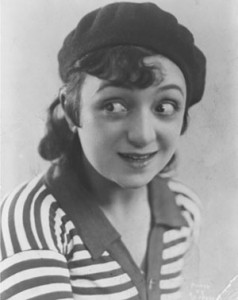
Above: Molly Picon
Molly described her childhood self as “a small skinny kid who loved to kibbitz with the neighbors.” While her mother sewed costumes for the Columbia Theatre, Molly would kibbitz away. She would learn song and dance routines from her neighbors and would perform duets with her mother in her living room. Molly’s talent remained private. Yet, one day, while on a trolly car with her mom, a drunk approached Molly to perform. Molly wrote: “I got up in the car and did my whole act…Then the drunk took off his derby and passed it around to the people in the car and collected two dollars in coins, which he gave to me. So I consider that my first professional performance.”((Ganton, Sarah. “From Vaudeville to ‘Fiddler’: (Re)introducing Molly Picon, the ‘Jewish Charlie Chaplin.’” 16th Street. N.p., n.d. Web. 3 May 2016.))
The Start of Her Acting Career
Mama Picon began to take Molly to perform at amateur nights. Clara sewed Molly a fancy new dress that was red with an elegant fake-fur muff,((“Molly Picon | Jewish Women’s Archive.” N.p., n.d. Web. 3 May 2016.)) and took her on the trolley to the Bijou Theatre, where every Friday night, children were given the opportunity to perform. Often times, scouts would be present and would look for talent. Molly won the competition in which she earned a five dollar prize and a new stage name: Baby Margaret. ((Ganton, Sarah. “From Vaudeville to ‘Fiddler’: (Re)introducing Molly Picon, the ‘Jewish Charlie Chaplin.’” 16th Street. N.p., n.d. Web. 3 May 2016.)) By the time she was 5, Molly had made singing at various amateur night for children part of her weekly routine.((“Molly Picon | Jewish Virtual Library.” N.p., n.d. Web. 3 May 2016.)) When an actor from the Columbia theatre troupe saw Molly, she convinced Clara to put her on stage.((Ganton, Sarah. “From Vaudeville to ‘Fiddler’: (Re)introducing Molly Picon, the ‘Jewish Charlie Chaplin.’” 16th Street. N.p., n.d. Web. 3 May 2016.)) There was an opening in Mike Tomashefsky’s Yiddish stock company and at the age of six, Picon began playing children’s parts for him.((“Molly Picon | Jewish Virtual Library.” N.p., n.d. Web. 3 May 2016.)) Molly sang in English and Dutch, danced traditional Russian dances, played whatever part she could find, such as playing Topsy in Uncle Tom’s Cabin in both Yiddish and German. Molly left high school after two years, and devoted her full time and attention to the Vaudeville circuit.((Ganton, Sarah. “From Vaudeville to ‘Fiddler’: (Re)introducing Molly Picon, the ‘Jewish Charlie Chaplin.’” 16th Street. N.p., n.d. Web. 3 May 2016.))
Finding a Business Partner and Love
Molly continued her fame in Boston, where she performed in an act entitled “The Four Seasons.” When a massive influenza epidemic hit, Molly went into various theaters looking for someone she would know who could lend her money. Instead, when she walked into the Grand Opera House, she met Jacob Kalich, her future husband.((Ganton, Sarah. “From Vaudeville to ‘Fiddler’: (Re)introducing Molly Picon, the ‘Jewish Charlie Chaplin.’” 16th Street. N.p., n.d. Web. 3 May 2016.))
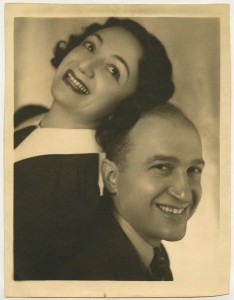
Above: Molly Picon and Jacob Kalich, 1923
Kalich came to America in 1914, and after meeting Molly, he cast her in one of his plays. Kalish saw Molly’s talent, especially in comedy. He famously told Molly: “Molly, that’s our job. Make them laugh!((Schumach, Murray. “Molly Picon, an Effervescent Star Of the Yiddish Theater, Dies at 94.” The New York Times 7 Apr. 1992. NYTimes.com. Web. 3 May 2016.)) Because of her success, Molly decided to stay in Boston. Molly and Jacob complimented each other well. Molly taught Jacob how to act in America and Jacob helped Molly with her Yiddish. They quickly fell in love and got married on June 29th 1919 in Molly’s childhood home.((Ganton, Sarah. “The Molly Picon Story, Part 2: A Star (and a Romance) Is Born.” 16th Street. N.p., n.d. Web. 3 May 2016.))
By 1920, Molly had hit it big in Boston. Yet, her and Jacob had their yes on an even bigger stage – Second Avenue in New York, “The Broadway of Yiddish theatre.” In order to help Molly prepare for this new venture, Jacob took her to Europe to work on her Yiddish. One news clipping stated that: “Kalich carried her off, not to New York, but to Europe, where she could perfect her accent, her acting, and her knowledge of Jewish life at its source.” The two traveled to Vienna, Budapest, Paris, Lodz, and various other European cities.((Ganton, Sarah. “The Molly Picon Story, Part 2: A Star (and a Romance) Is Born.” 16th Street. N.p., n.d. Web. 3 May 2016.))
One of the first plays that Molly stared in was Jacob’s Yiddish operetta, Yankele. Picon played the role of a small boy.((“Molly Picon | Jewish Virtual Library.” N.p., n.d. Web. 3 May 2016.)) Because of the show’s success, many Europeans wrote to their family members in the United States about “the greatness of Picon in Yankele.” ((“Molly Picon | Jewish Virtual Library.” N.p., n.d. Web. 3 May 2016.))
Molly Takes New York
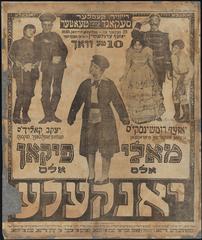
After being thrown out of Romania because of anti-Semitism, Picon and Kalich came to New York. With Molly’s perfected Yiddish, they were ready to take on Second Avenue. They teamed up with the composer Joseph Rumshinsky to create operettas scripted and directed by Kalich and lyrics by Picon. Molly’s debut in New York was her performance in Yonkele. The show was a hit! Because Molly was unknown in New York, the manager of the theater questioned why the show had such a large amount of advance ticket sales. Molly’s future audience told him that they had heard about her from relatives in Europe, who had seen her there and written to America to tell their relatives to see her. The success Molly had in Europe truly preceded her in New York. ((Ganton, Sarah. “The Molly Picon Story, Part 2: A Star (and a Romance) Is Born.” 16th Street. N.p., n.d. Web. 3 May 2016.))
Above: Poster for Yankele, 1924
Molly found that that the duo “never mingled with people outside the Yiddish theater. Yiddish was our center, our link, and I never felt like a complete stranger in Europe because I was always in the midst of a familiar language and heritage—the Yiddish world.”((Ganton, Sarah. “The Molly Picon Story, Part 2: A Star (and a Romance) Is Born.” 16th Street. N.p., n.d. Web. 3 May 2016.)) Molly not only perfected her Yiddish, but he found a home in the European Yiddish world. ((Ganton, Sarah. “The Molly Picon Story, Part 2: A Star (and a Romance) Is Born.” 16th Street. N.p., n.d. Web. 3 May 2016.))
In 1922, Picon and Kalich began building a small theatrical empire among New York’s growing immigrant audiences.((Molly Picon Biography – Life, Family, Children, Story, Death, School, Mother, Young, Old, Born.” N.p., n.d. Web. 3 May 2016.)) From the years 1922 to 1929, Molly would open 8 shows in New York, such as Yankele, Mamale, Raizele, Oy Is Dus a Meydl [Oh, what a girl], and The Circus Girl, in which Picon dangled by one foot from a rope. The show Mamale was such a success, that it later turned into a movie (featured in the video below). Many of Picon’s characters had ambiguous genders, where she either dresses as a tom boy, or as an actual boy.((“Molly Picon Biography – Life, Family, Children, Story, Death, School, Mother, Young, Old, Born.” N.p., n.d. Web. 3 May 2016.)) As Molly, Jacob, and Rumshinsky took control of the Second Avenue Theatre, America fell in love with Molly’s charm and laugh. ((Ganton, Sarah. “The Molly Picon Story, Part 3: Broadway Comes Calling.” 16th Street. N.p., n.d. Web. 3 May 2016.)) D.W. Griffith, known as the inventor of Hollywood, called Molly “the most interesting actress in America.”((Ganton, Sarah. “The Molly Picon Story, Part 2: A Star (and a Romance) Is Born.” 16th Street. N.p., n.d. Web. 3 May 2016.)) No matter what she did, Molly received race reviews. One reviewer wrote:
Above: Molly Picon in Mamale, 1938
One cannot say that Miss Picon is good looking as stage standards go and surely her simple and untrained cavorting counts for but a minor asset. As a singer she is damned by the faint praise of ‘adequate,’ and yet this skinny, undersized Jewish girl has developed one of the most valuable theatrical followings in New York through the sheer ability of adapting herself to the medium she wishes to present.((Ganton, Sarah. “The Molly Picon Story, Part 3: Broadway Comes Calling.” 16th Street. N.p., n.d. Web.3 May 2016.))
Soon after, Molly was offered $2,500 a week to headline at the Palace Theatre on actual Broadway. She would sing her original songs, tell stories, and do what she did best – kibbitz with the crowd. Molly once said: “[I] actually played to my own audience because all of Second Avenue came uptown with me to make sure their girl wouldn’t flop.”((Ganton, Sarah. “The Molly Picon Story, Part 3: Broadway Comes Calling.” 16th Street. N.p., n.d. Web. 3 May 2016.)) Molly again received wonderful reviews and fell in love with the Broadway stage.
Above: Molly Picon Staring In Yiddle with His Fiddle, 1936
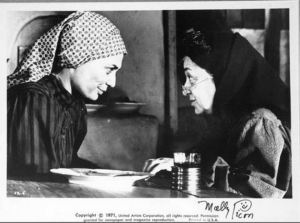
In 1936, Molly started to make films. Her earliest and most famous film, Yiddle Mitn Fidl, Yiddle with His fiddle, was filmed in Poland (featured in the video below). Molly played a young girl who dresses as a boy in order to play violin with his father. When it was released in 1947, it was named as “The Greatest Jewish Talkie Ever Produced.” ((Ganton, Sarah. “The Molly Picon Story, Part 3: Broadway Comes Calling.” 16th Street. N.p., n.d. Web. 3 May 2016.)) One of her most famous roles was in the 1971 film Fiddler on the Roof, where she played yenta the matchmaker.
Praise for Molly
Because of her athleticism, charm, good looks and humor, Picon was coined as the “All American maydl [girl].” Picon could both pack a theatre of Yiddish and non Yiddish speaking audiences. In the 1920s, the Second Avenue Theater in New York–the best known of all Yiddish theaters in America–was renamed the Molly Picon Theater in her honor.((“Molly Picon – My Jewish Learning.” N.p., n.d. Web. 3 May 2016.))
At the start of her career, Molly was told that she looked “too young, too small, [and] to blithe.”((Power, Sharon. “Yiddish Theatre Actresses and American Jewish Identity.” Shofar: An Interdisciplinary Journal of Jewish Studies 30.3 (2012): 84–107. muse.jhu.edu. Web.)) Yet, in 1943, 40 years into Molly Picon’s carrer, Louis Nizer wrote of Molly:
“I suspect she is the Joan of Arc of the Yiddish Theatre. She is the glorious, heroized personification of her people’s joy and tears, their song and dance, their versatility and charm. That is why she is their darling. They pay her tribute because she is a living tribute to them.”((Ganton, Sarah. “From Vaudeville to ‘Fiddler’: (Re)introducing Molly Picon, the ‘Jewish Charlie Chaplin.’” 16th Street. N.p., n.d. Web. 3 May 2016.))
Molly was not just praised for her talent, but for her empathy and charitable acts. She performed for the sick, the American troops during World War II, and to the surviving Jews in Europe. Jacob and Molly were one of the first entertainers to go to Europe after the war to entertain the surviving Jewish population. They even brought 700 gift packages of cosmetics and costume jewelry for women who had survived the concentration camps and candy for the children. Additionally, both her and Jacob worked for the United Nation Relief and Rehabilitation Administration, selling bonds for Israel and the Children’s Fund.((“Molly Picon | Jewish Virtual Library.” N.p., n.d. Web. 3 May 2016.))
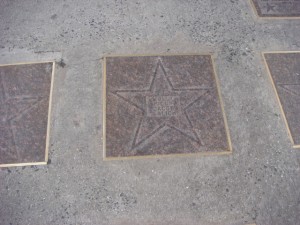
Molly was also known for frequenting many of the establishments on the Lower East Side. She used to eat at the second avenue Deli. Former owner Abe Lebewohl even named one of the dining rooms after Molly. ((Owner of Second Avenue Deli is Shot and Killed in Robbery, http://www.nytimes.com/1996/03/05/nyregion/owner-of-second-avenue-deli-is-shot-and-killed-in-robbery.html)) Additionally, right outside the old location of the Deli, is the famous Yiddish Theatre Walk of Fame. In one of the many stars lists the names of Molly and Jacob.
Above: Molly and Jacob on the Yiddish Walk of Fame
The New York Times considered Molly to be a “the comedic actress and singer who lightened and brightened the often dolorous themes of Yiddish theater.”((Schumach, Murray. “Molly Picon, an Effervescent Star Of the Yiddish Theater, Dies at 94.” The New York Times 7 Apr. 1992. NYTimes.com. Web. 3 May 2016.)) Picon used every one of her fifty eight inches to convey humor and passion for Yiddish performance.((“Molly Picon | Jewish Women’s Archive.” N.p., n.d. Web. 3 May 2016.))
Throughout her career, she had become a member of Picon was a member of: The Jewish Theatrical Guild, Hebrew Actors Union, Jewish Theatrical Alliance, American Actors Association, American Federation of Radio
Above: Molly Picon at Yente in Fiddler on the Roof, 1971
Artists, American Guild of Variety Artists,Yiddish Composers Guild, and Actors Equity. Her resume continued to grow as she continued to live up to the expectation of consistently making her audience laughs.((Schumach, Murray. “Molly Picon, an Effervescent Star Of the Yiddish Theater, Dies at 94.” The New York Times 7 Apr. 1992. NYTimes.com. Web. 3 May 2016.)) On April 6th, 1992, Molly passed away after suffering for many years with Alzheimer’s disease. Yet, she will forever be known as a performer who gave her audience both laughter and tears. Molly was truly “a girl who got older every year and younger every day.”((“Molly Picon | Jewish Women’s Archive.” N.p., n.d. Web. 3 May 2016.))
Molly on the Map!
Track Molly’s activity in New York. Click the image next to the title of the map. Under the “Arts” category of the map, you can see where 1. Molly was born (Broome Street) 2. Molly performed on Broadway (Palace Theatre) 3. The Molly Picon Theatre on Second Avenue and 4. Where Molly’s star is on the Yiddish Walk of Fame. Happy Traveling!
Bibliography
Contemporary Theatre, Film, and Television , volume 12, Gale, 1994. Picon, Molly, with Eth Clifford Rosenberg, So Laugh a Little , Messner, 1962. Picon, Molly, with Jean Bergantini Grillo, Molly! , Simon & Schuster, 1980.
New York Times , April 7, 1992; September 18, 2005. Times (London, England), April 16, 1992; April 24, 1992.
Contemporary Authors Online, Gale, 2007, reproduced in Biography Resource Center, Thomson Gale, 2007, http://www.galenet.galegroup.com/servlet/BioRC (January 19, 2007).
Green, Joseph, and Jan Nowina-Przybylski. Yidl Mitn Fidl. N.p., 1937. Film.
Perl, Lila. Molly Picon A Gift of Laughter. First Edition First Printing. Philadelphia, PA: Jewish Publication Society, 1990. Biblio.com. Web. 3 May 2016.
Picon, Molly, and Jean Bergantini Grillo. Molly!: An Autobiography. Simon and Schuster, 1980. Print.
DISCLAIMER:All images are linked to their original sources. Some original sources may have been deleted, in which case the images should redirect to wherever the curator pulled them from.