
By Hannah Rosenwein, Eliana Straus, and Erica Baruch
History
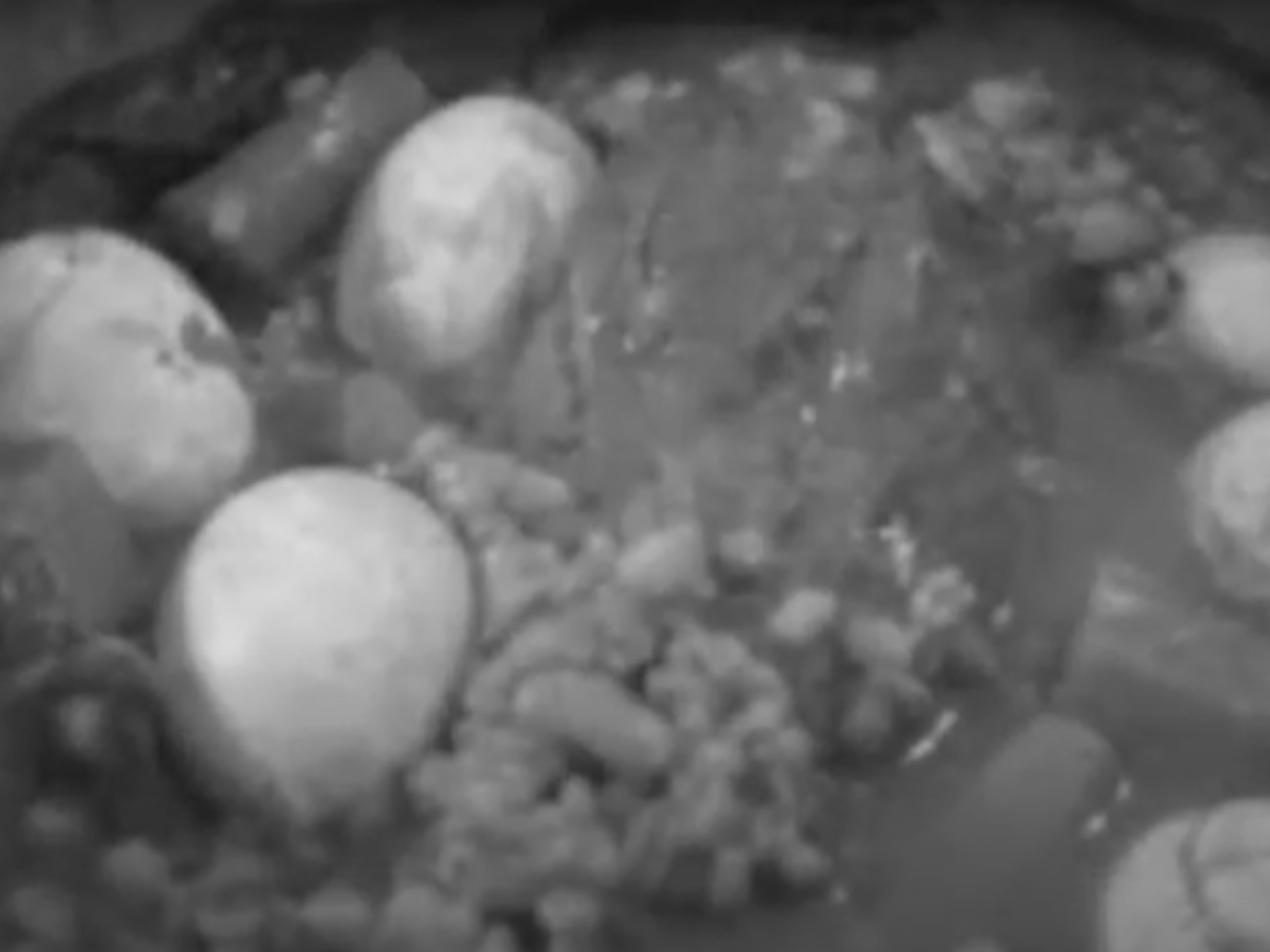
Cholent is a traditional Jewish stew of beans and meat 1. It was most commonly prepared on Friday morning by the wife of the house and left to cook very, very slowly so that it would be ready by the time lunch began on the Shabbos day. This process ensured that the Jews would have hot food on Shabbos without transgressing the halacha prohibition of cooking and kindling a fire 2
The Ashkenazi Jews from Eastern Europe make their cholent with beef, bones, barley, beans, potatoes, and onions; it is seasoned with paprika. This region’s Jews were known to bring their cholent to the baker’s oven and leave it there overnight, to be picked up in the morning. On the other hand, Sephardi Jews make their cholent with mutton and rice instead of beef and barley. Different regions had different takes on cholent, such as the Iraqi Jews who made their cholent inside a whole chicken and the Syrian Jews who made their cholent inside a pumpkin or squash. Despite these differences, many communities’ cholents were similar in that they were baked with a dumpling or kugel inside.3
Cultural Reception
Perhaps the most unique characteristic of cholent is its coupling of consistency with adaptability. “As Jews migrated to every corner of the world, they wisely adopted their host country’s available foods and modified their cholent.” 4 While sticking to the basics, each culture is able to add a taste of their own to the traditional combination of beans barley and meat.
In conjunction with its cultural essence, cholent has also adopted a recreational nature, as cholent competitions have become increasingly popular around the world. The first National Cholent Competition took place in Jerusalem in 1998, including 131 contestants and a variety of recipes. Esther Israel was named the winner for a Tripolitanian spinach cholent that included stuffed vegetables, chicken and beef, semolina dumplings, onion, garlic and a mélange of herbs and spices. 5
Aside from its competitive aspect, cholent can also be consumed in a more relaxed or personal way. After services in synagogue, for example, it is customary to have a kiddush or light meal to which the congregation is invited. [9] One of the most common foods served at this kiddush meal is cholent. Other times, people eat cholent for Shabbos lunch in the privacy of their homes.
Full Recipe:
6-8 Yukon gold or red potatoes.
2 strips Flanken.
Couple of marrow bones, if available.
1/2 bag barley.
Blanket of each of the following spices:
Salt, pepper, garlic powder, onion powder and paprika.
Pam the crock pot well
Place all in pot, in that order.
Water to cover.
Cook on high until Shabbos, turn to low before you light candles
Image Source
Figure 1. https://www.youtube.com/watch?v=Y7X88nyRdaM. Accessed April 15, 2021.
Works Cited
“Cholent”. Oxford Reference. Accessed July 22, 2021.
“Cholent.” Oxford Reference. Accessed July 22, 2021.
http://www.shabboshouse.org/wp-content/uploads/2014/03/CholentCookOff5774.jpg
http://forward.com/articles/103368/deconstructing-cholent/
http://www.jewishmag.com/43mag/cholent/cholent.htm
http://www.myjewishlearning.com/practices/Ritual/Shabbat_The_Sabbath/At_Home/Kiddush.shtml
Footnotes
- “Cholent”. Oxford Reference. Accessed July 22, 2021.
- “Cholent.” Oxford Reference. Accessed July 22, 2021. http://www.chabad.org/library/
article_cdo/aid/109214/jewish/ Cholent.htm [VIDEO-4- 0:43]. Accessed July 22, 2021. - http://go.galegroup.com/ps/i.do?action=interpret&id=GALE%7CCX2587504267&v=2.1&u=columbiau&it=r&p=GVRL&sw=w&authCount=1
- myjewishlearning.com/…_Home/Kiddush.shtml
- Ibid.


