
By Erica Baruch
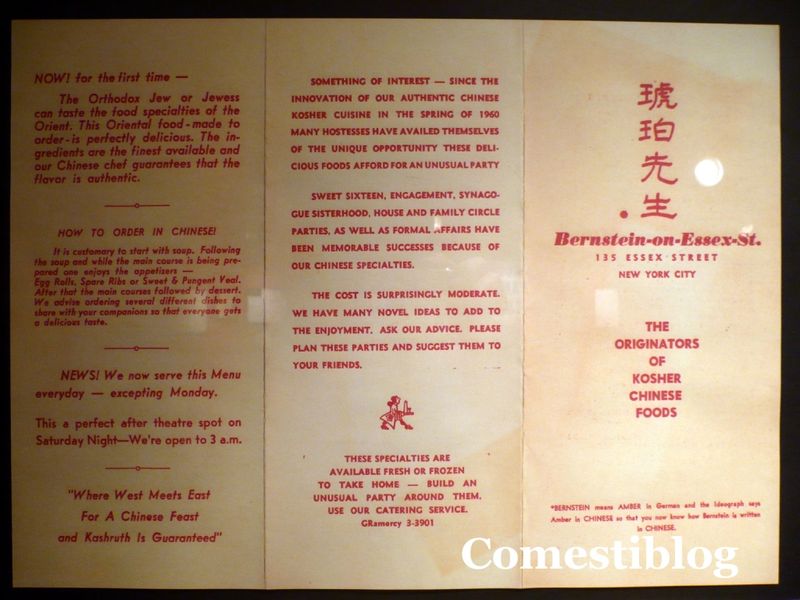
Schmulka Bernstein’s, also known as Bernstein on Essex, was a kosher deli and Chinese restaurant on Manhattan’s Lower East Side.
Located at 135 Essex Street, the eatery’s slogan was “Where kashrut is king and quality reigns” and was the first kosher Chinese restaurant in New York City. It was founded in the 1950s by Solomon Bernstein as a home to both specialized meats and the unique, kosher versions of Chinese delicacies. Substituting veal, beef, and chicken livers for pork, Schmulka Bernstein’s combined two cultures in a manner that had not been done before. Similarly, the waiters wore traditional tasseled Chinese caps instead of yarmulkes, and there was a popular dish named “lo mein Bernstein” made with chicken livers.1

As Shira Baruch, a New York Jew who frequented Schmulka Bernstein’s during its lifetime, explained, the juxtaposition of Chinese and Jewish, of the foreign and familiar, gave Schmulka Bernstein’s an exciting yet homey feel. She said in an interview with the author that Schmulka Bernstein’s “had a Chinese menu and a traditional Jewish food menu. It only occurred to me way after it closed that that was so strange…Jackie Mason [Jewish comedian] used to have a whole thing about how you never hear of an Asian person eating gefilte fish…”2
This combination of these two cultures was convenient to some extent because of the ingredients; “Chinese cuisine was both exotic and familiar” because it relied on chicken broth, garlic, onions, and culinary practices that were quite similar to those of the Ashkenazi Jews from Eastern Europe. Moreover, Chinese food aligned with Jewish practice because it does not include dairy products.3
Aside from its cultural fusion, Schmulka Bernstein’s was also a place of communal gathering for Jewish people of all ages. As Baruch relayed, “I feel very strongly that it was really about the social… even though the food was delicious… it was the place to be, especially Thursday night and Saturday night.”4 Another force that increased the communal feel was “the regulars.” Rabbi Joshua Lookstein, another faithful Schmulka Bernstein’s customer, remembers “This older single guy – a salesman, always sitting in the front room…he was just there, like a regular at any Manhattan diner.”5
Despite its successful reception by the Jewish food community, Schmulka Bernstein’s was sold by the Bernstein family in the early 1990s and closed shortly after.6 This was, as Lookstein explained, “devastating” for New York Jews and food lovers, who had created a community around the eatery. “It was an end of an era.”7
The closing of Schmulka Bernstein’s was not only a marker of the end of Kosher Chinese food on the Lower East Side, but was also part of a phenomenon that swept the area, described by Ari Goldman in his article entitled “Only the Subway Stop Remains” in The Jewish Week. Goldman relates his Jewish family’s history on the Lower East Side, starting with his four sets of great-grandparents who came to this neighborhood in the late 19th century from Europe. He also tells about schools, restaurants, shops, and the sense of community that he experienced as a child who visited frequently. Now, he writes, “A small Jewish enclave still exists on the southeastern tip of Manhattan island, but it is a far cry from what it once was” because the Jewish establishments have all been converted in some way or another.8


Despite the disappointment portrayed by Goldman and others, New York Jews still reminisce fondly about days at Schmulka Bernstein’s, demonstrating how pervasive its effect was. As Lookstein described, “Nowadays, so many kosher restaurants have a variety of styles – every restaurant has sushi, steak, Jewish-style… but this was way before that. This wasn’t that. It wasn’t in order to get people, in order to feed diverse families – they were just a Chinese and Jewish restaurant because that’s what they wanted to do.” And lastly, Schmulka Bernstein’s lovers remember the delicious food: “Chinese noodles and duck sauce. Tons of it. I had never had that before.”9
Image Sources
Figure 1. http://3.bp.blogspot.com/-tRr-UUo9bZU/TlH_rPPPbTI/AAAAAAAAAYI/fCgPZ3HTEUM/s1600/pansit%2Bcanton1.JPG. Accessed December 14, 2014.
Figure 2. http://www.comestiblog.com/weblog/2010/09/esn-jews-and-food-in-america.html. Accessed December 14, 2014.
Figure 3. http://www.comestiblog.com/weblog/2010/09/esn-jews-and-food-in-america.html. Accessed December 14, 2014.
Figure 4. http://www.comestiblog.com/weblog/2010/09/esn-jews-and-food-in-america.html. Accessed December 14, 2014.
Figure 5. http://jewishstudies.washington.edu/student-writing/rethinking-the-american-jewish-immigration-narrative/. Accessed December 14, 2014.
Figure 6. http://www.bkmag.com/2014/01/06/the-lower-east-side-now-cheaper-than-bushwick/. Accessed December 14, 2014.
Works Cited
Baruch, Shira. Personal Interview with the author. 14 December 2014.
Goldman, Ari L. “Only The Subway Stop Remains.” The Jewish Week, 26 Dec. 2012. Accessed July 19, 2021.
Goodman, Matthew. “Chinese Food and Beyond Exhibit.” Yiddish Book Center. N.p., 31 Aug. 2010. Accessed December 14, 2014.
Lookstein, Rabbi Joshua. Personal interview with the author. 14 December 2014.
Schneider, Daniel B. “F.Y.I.” The New York Times, 15 Apr. 2000. Accessed July 19, 2021.
Footnotes
- Schneider, Daniel B. “F.Y.I.” The New York Times, 15 Apr. 2000. Accessed July 19, 2021.
- Baruch, Shira. Personal interview with the author. 14 December 2014.
- Goodman, Matthew. “Chinese Food and Beyond Exhibit.” Yiddish Book Center. N.p., 31 Aug. 2010. Accessed December 14, 2014.
- Baruch.
- Lookstein, Rabbi Joshua. Personal interview with the author. 14 December 2014.
- Schneider.
- Lookstein.
- Goldman, Ari L. “Only The Subway Stop Remains.” The Jewish Week, 26 Dec. 2012. Accessed July 19, 2021.
- Lookstein.
