

The Second Avenue Deli: The Legacy of Uncle Abe
By Deborah Pollack
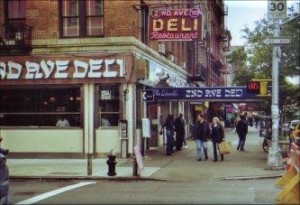
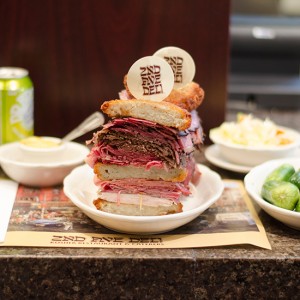
In the gridlock of Midtown or on the wide streets of Broadway, a white and blue truck can be found with the following slogan on the back: Follow us for the best chopped liver in town. Those famous trucks lead to the best deli in New York City, The Second Avenue Deli. The Second Avenue Deli is not just a Jewish staple, but also a New York City staple as well. The restaurant has a long and rich history and will continually to have a long line of customers waiting for the esteemed chopped liver. From the sky high stacked pastrami sandwiches to the appetizing corner, and of course, the noshes, the Second Avenue Deli has become the premier Jewish Delicatessen in New York.
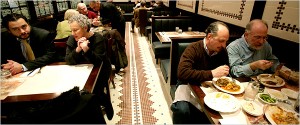
The History of the Deli
As a beacon of the American dream, the Second Avenue Deli represents perseverance. The eatery is rooted in deep immigrant traditions, as well as a love for charity, and a devotion to food. Abe Lebewohl, the founder of the Second Avenue grew up in Soviet Poland. After Abe and his family survived the Holocaust, they arrived in Italy to board a ship to Palestine. At the last minute, however, Ethel Lebewohl, mother of Abe, decided that she could not bear to risk her son’s life in the Israeli fight for independence. Abe, who was a strong Zionist, was hesitant but finally agreed, and the family decided to emigrate in America. ((http://www.2ndavedeli.com/about/deli-history/about-abe-lebewohl/))
Upon arriving in America in 1950, the Hebrew Immigrant Aid Society found the Lebewohl’s housing on Lafayette Street in heavily immigrant-populated Lower East Side of Manhattan. Becoming an American at age 19, Abe quickly learned English and went to work, embracing his new American culture, and was thirsty with the promise of a better life.
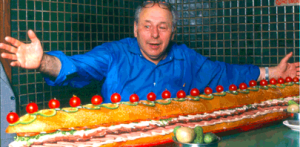
Abe worked in a Coney Island deli as a soda jerk but his tenacity quickly entitled him to a promotion: counterman. Abe worked in many deli kitchens, studying the art of traditional Jewish food, and learning the secret to the perfect pastrami. ((ibid.))
Scraping together the earnings from his many deli jobs, Abe took over a small 10-seat restaurant on East 10th Street in 1954. It was here that the Second Avenue Deli was born. ((ibid.)) Abe ran the entire establishment often playing the roles of cook, counterman, waiter and bus boy. And in the face of bankruptcy and economic failure, Abe took on more odd jobs and his drive guaranteed the success of the Second Avenue Deli. ((ibid.)) All customers in Abe’s deli were treated like family, his benevolent spirit was contagious, and his passion was palpable. Abe fed every homeless person who walked into the Deli hungry, which coined him the “Jewish Mother Teresa.” ((ibid.)) Abe would send food to any politician or workers that he supported, such as delivering free food to the local Ukrainian travel agency n the celebration of their independence from the Soviet Union. “Whenever anything moved or excited him, Abe sent food.” ((ibid.)) Uncle’ Abe Lebewohl’s legacy is celebrated by the Second Avenue Deli’s many regular customers, and its two successful storefronts that can be found on the East Side of Manhattan today.
The Second Avenue Deli and Yiddish NY
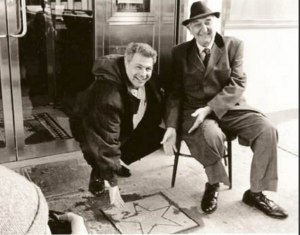
The Second Avenue Deli was a hot spot for celebrities like Muhammad Ali, Joan Rivers, and Joe DiMaggio. Since the deli was in the heart of the Lower East side, which at the time was the center of Yiddish culture, The Second Avenue deli became a second home for many of the Yiddish elite as it fostered and cherished a strong tradition of Jewish foods and yidishkite. The walls were covered with signed autographs from Yiddish singers, actors, and actresses. Even outside the restaurant, Yiddish culture could be felt. Similar to the sidewalks outside of the Chinese theatre in L.A., gold stars aligned the corner of 10th street and second avenue with names of Yiddish celebrities. What was considered the Yiddish Walk of Fame featured stars such as Yiddish comedian Fyvush Finkel, Yiddish actress Molly Picon, and the founder of Yiddish theater, Abraham Goldfaden. ((http://famousankles.com/2008/02/20/yiddish-theater-walk-of-fame-on-2nd-avenue/))
Tragedy Strikes the Lebewohl Family
In 1996, the Lebewohl family suffered heartbreak when Abe was tragically murdered in a bank robbery during his morning deposit run. The Second Avenue Deli, celebrating its 42nd year, lost the mastermind behind its chopped liver, extra sour pickles, and hot pastrami platters. The 1996 New York Times article, describes the Second Avenue Deli as a New York institution – a 12-seat diner that had grown into a 250-seat restaurant – attracting New Yorkers from all walks of life, and preserving the Yiddish tradition that had faded in the Lower East Side neighborhood. ((Owner of Second Avenue Deli is Shot and Killed in Robbery, http://www.nytimes.com/1996/03/05/nyregion/owner-of-second-avenue-deli-is-shot-and-killed-in-robbery.html)) Abe’s death affected not just his family and employees, but affected New Yorkers citywide. Anna Noblet, a Lower East side community member reflected on the tragedy: “He was one of us, part of the neighborhood’s history, one of the last old-timers. Why did they have to go after such a hard-working man?” ((ibid.)) Other Lower East Siders felt Ms. Noblet’s pain, an employee in the article described Abe’s benevolence. Chai Ruji, an employee of the deli of 25 years said: “When my baby was born premature and we couldn’t pay the hospital bills, he gave me $1,000. And when I was going through hell with my divorce, he paid for a counselor. And he never asked for the money back.” ((ibid.))
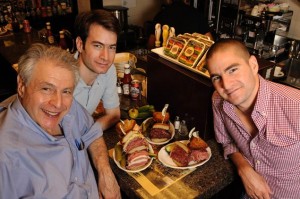
Despite Abe’s untimely death, the Deli remained open until January 2006 when it closed due to a landlord dispute. New Yorkers everywhere mourned the loss of the Second Avenue Deli. Abe’s nephews, Josh and Jeremy, inspired by their Uncle’s dedication, vowed to keep his tradition alive.Having spent the majority of their youth working in their Uncle’s restaurant, the nephews reopened the Second Avenue Deli in a new location. Its new location on 162 East 33rd Street received so much wild success that the nephews opened a second location at 1442 First Avenue. ((ibid.)) Though no longer located on the classic 2nd Avenue, the Second Avenue Deli embraces Abe’s legacy, and serves authentic Jewish delicacies to new and old customers alike. ((ibid.))
The Deli Today
Today, the menu combines the foods of Jewish past and present. You can find contemporary favorites such as Cholent, Matzah ball soup, potato latkes, and potato knishes. But you also find the older favorites, such as gribnes, ptcha, gefilte fish, and kreplach. The myriad of food offered is true to the deli’s motto that is printed on the bottom of the bottom of their menu, “Keeping Tradition Alive.” Yet today, the deli has included American favorites, such as meatloaf, French fries, hamburgers, and more. While the deli offers deals and special menus for Jewish holidays, such as for Rosh Hashanah, it also offers one for the Super Bowl. The deli has continued to evolve, combining both American and Jewish culture. ((Menu, http://www.2ndavedeli.com/deli-menus/dine-in/))

Though sometimes compared to Katz’s Deli, which is also located on the Lower East Side of New York, the Second Avenue Deli remains the leading kosher Jewish Delicatessen. When entering, customers can indulge in matzah ball soup that can definitely compete with Bubby’s old recipe. Customers can also try knishes, lox platters, sable, homemade challah bread, kasha,and the Second Avenue Deli of course would not be complete without an assortment of pickled cucumbers, tomatoes, and fishes. The Second Avenue Deli also has a cookbook, where families can bring the cooking of Abe Lebewohl into their homes. Abe’s legacy will continue to lives on, as The Second Avenue Deli is still home to authentic, kosher, and Jewish specialties. While it is indigenous to the Lower East Side, the deli now moved a little up the block, and is able to spread Jewish traditions throughout Midtown, the Upper East Side, and all across Manhattan.
Buy The Second Avenue Deli Here: http://www.2ndavedeli.com/store/cookbook/
DISCLAIMER: All images are linked to their original sources. Some original sources may have been deleted, in which case the images should redirect to wherever the curator pulled them from.
Originally posted by mb3437 on a previous iteration of this project.

One thought on “The Second Avenue Deli: The Legacy of Uncle Abe”