
My time doing archival work at YIVO was one of the most surreal experiences of my life. Being a Yiddish major can be kind of isolating. A lot of people don’t know what Yiddish is, and, even worse, most of the people who do know what it is fail to see any value in seriously studying it. They’ll take their shlep and shmir and leave the rest of the language and surrounding culture to the ages. YIVO is the opposite. The archivists and volunteers savor every morsel of Yiddishkeit, keeping the culture alive and sometimes seemingly raising the dead. The archival materials, from the groundbreaking to the banal, are all treated with the utmost respect. Even when at its least exciting, being able to sort through century-old documents never became boring. Each document provided insight into a Jewish life. I always found myself distracted for the rest of the day after leaving YIVO, wondering what became of each person whose life I had gotten a glimpse of, something I probably could have tracked throughout their hundreds of thousands of materials if my time there had not been cut short by the pandemic. Even sweeping the dust off of a table after rifling through a folder of envelopes felt like a shameful abandonment of history. Then, there were the hidden gems. The posters, the postcards, the stamps, the children’s drawings — I grew an affinity for the art most of all. These pieces had me enraptured. My favorite folder had a whole notebook of a kid’s drawings, many of which included birds, houses, people, and bright, vivid colors applied with the reckless abandon of any seven-year-old creative. There was no name on the folder, and the artist has ostensibly been lost to history. Is he alive? If he is, does he remember drawing these? If not, I will hold the information for him.So many moments were spent simply reveling in our finds. This is one of my favorite things about YIVO — the feeling that I, and the other people there, can keep pieces of history, small and large, alive in us.
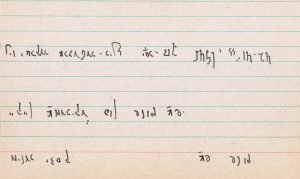
The research project I intended to do at YIVO surrounding Yiddish theatre was rendered impossible because I hadn’t started it by the time the pandemic hit. While I was initially upset about this turn of events, I was quickly assigned a collection of YIVO’s some 300,000 digitized library catalog cards to transliterate. The focus of the collection I was given? Yiddish playwright Sholem Asch, whose controversial work has fascinated me for years. It was bashert. Reading information on the hundreds of articles written about him throughout the early 20th century has given me a chance to improve my topical Yiddish, my research skills, and my understanding of the Yiddish theatre zeitgeist that surrounded Asch during his life. While the circumstances were far from ideal, being able to call a couple of the other research fellows so we could keep each other company while we worked on the transliterations every Friday (the same day we used to go to YIVO together), made me feel connected to the bustling Yiddish world that is YIVO, even while 3000 miles away from it.
