
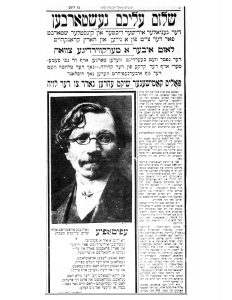
מאָרגן זשורנאַל, זונטיק, 14 מײַ, 1916, ז.1,5
שלום עליכם געשטארבען
דער געניאלער אידישער דיכטער און קינסטלער שטארבט פאר דער צײט פון א נירען און הארץ קראנקהײט
————
לאזט איבער א מערקװירדיגע צװאה
————
דער נפטר װעט בעערדיגט װערען מאָרגען אױף הר נבו סעמעטערי אױף דער קרקע פון דער קהילה.—נאך דער מלחמה װעט דער גוף איבערגעפיהרט װערען נאך רוסלאנד
————
פּאָליס קאָמישענער שיקט עהרען גארד צו דעו לויה
————
נעכטען אום 7.30 אוהר אין דער פריה איז נפטר געװאָרען, אין זײן װאָנונג 968 קעלי סטריט, בראָנקם, דער בעריהמטער אידישער שריפטשטעלער שלום עליכם, אין עלטער פון 57 יאָהר.
דער געניאלער שריפטשטעלער איז שױן לאנג געװען א קראנקער מענש, אָבער דיא לעצטע עטליכע װאָכען איז ער געװען צו בעט. ער האָט געליטען פון מעהרערע קראנקהײטען און הױפּטזעכליךּ פון נירען און הארץ קראנקהײט. דיא דאָקטױרים האָבען
דיא לעצטע עטליכע טעג ערװארטעט דעם טרױעריגען סוף.
דער נפטר איז געװען בעװאוסטזיניג ביז דער לעצטער מינוט.
אין דיא לעצטע מינוטען האָבען זיךּ גענומען בײ זײן בעט דיא פרױ, זײנע דרײ טעכטער, זײן זוהן, שװיגער־זוהן י. ד. בערקאָװיץ, זײן ברודער, אײניגע גוטע פרײנד און דיא דרײ דאָקטױרים װאָס האָבען איהם אטענדעט: דר. איסר גינצבורג, דר. רודיש, און דר. פריעדמאן.
נאָךּ א קורצע קאָנפערענץ צװישען דיא װאָס האָבען זיךּ געפונען ארום דעם גרױסען בר־מינן איז בעשלאָסען געװאָרען, אז א ספּעציעלע קאָמיטע זאָל האָבען דיא פעראנטװאָרטליכקײט פאר אראנזשירען דיא לױה צוזאמען מיט דער קהילה, און דיא פאָלגענדע זעקס זײנען בעשטימט געװאָרען אין דער קאָמיטע: דר. י. ל. מאגנעס, דוד פּינסקי, פּנחס רוטענבערג, ש. אײבעל, אברהם אליהו לובארסקי, און יהושע גאָרדאָן. דיא דאָזיגע קאָמיטע װעט שפּעטער אױךּ האָבען דיא אױפגאבע צו זאָרגען פאר דער פאמיליע.
דיא קאָמיטע האָב זיךּ גלײךּ נעכטען אבענד גענומען צו מאכען די ארענדזשמענטס, און זיא האָט בעשטימט דיא פאָלגענדע אלס נושאי המטה: יהואש, שלום אש, אברהם רײזין, פּרץ הירשבײן, דוד פּינסקי, י. אפּאטאשױ, מאני ליב, יואל סלאָנים, י. י. שװארץ, חנן יעקב מיניקעס.
עהרען נושאי־המטה: לעװין־עפּשטײן, בערנארד ראבינאָװיץ (דעם נפטר׳ס ברורער), באָריס גאָלדבערג (פון װילנא), לעאָן מאָצקין, מ. שענקין, זאב גלוסקין, יהושע גאָרדאָן, פּניחס רוטענבערג, יאָזעף באראָנדעס, א. א. לובארסקי, אב. קאהאן, הערמאן בערנשטײן, י. גאָניקמאן, י. זעװין, פּרץ װיערניק, א. ליעסין, דר. ח. ד. ספּיװאק, דר. י. ל. מאגנעס, ש. אײבל, דר. שמריהו לעװין, סאלאמאָן לובארסקי, דזשאָרדזש לובארסקי, דר. איסר גינצבורג, דר. ש. מלמד, הרב מאיר בערלין, רעװ. צ. ה. מאסליאנסקי, ב. צוקערמאן, דר. נהום סירקין, דר. ח. זשיטלאָװסקי, לעאָן חאזאנאָװיטש און מאָריס װינטשעװסקי.
דער גרױסער נפטר װעט בעערדיגט װערען אױף דער סעמעטערי הר נבו, סײפּרעס היל, אױף דער קרקע פון דער ניו יאָרקער קהילה.
דיא לויה װעט אָנפאנגען מאָרגען פריה אום 8.30 אוהר, פון דער לעצטער װאהנונג פון נפטר, 968 קעלי סטריט, בראָנקס (אינטערװײל סטײשאָן). פון הױז װעט דיא פּראָצעסיאָן זיךּ ציהען נאָךּ דער אוהב צדק שול, 18 װעסט 116טע סטריט, װאו דער ארון װעט פערהאלטען װערען און דער חזן ר׳ יאָסעלע ראָזענבלאט װעט פון דיא טרעפּ פון שול מאכען אן אזכרה.
פון 116טע סטריט װעט דיא פּראָצעסיאָן זיךּ ציהען דורךּ פינפטע עװעניו ביז 61טע סטריט, נאכהער דורךּ פּארק עװעניו ביז 44טע סטריט, דאן דורךּ פיערטע עװעניו ביז 23טע סטריט, פון דאָרטען דורךּ צװײטע עװעניו ביז הױסטאָן סטריט ביז׳ן עדיוקײשאָנעל אלײענס, װאוהין דער ארון װעט ארײנגענומען װערען און הספּדים װעלען געהאלטען װערען.
פון עדיוקײשאָנעל אלײענס װעט דער טרױער צוג געהן צום הכנסת אורחים, 229 איסט בראָדװײ, און װעט פערהאלטען װערען ביז אן אזכרה װעט נעמאכט װערען פון דיא טרעפּ. פון דאָרטען װעט דער ארון געפיהרט װערען דורךּ קלינטאָן סטריט צום װיליאמסבורג בריק, און איבער׳ן בריק צו דער סעמעטערי.
דיא מספּידים אין עדיוקײשאָנעל אלײענס װעלען זײן דר. י. ל. מאגנעס, פּראָפעסאָר איזראעל פרידלענדער, רעװ. מאסליאנסקי און צװײ שריפטשטעלער װעלכע װעלען בעשטימט װערען מאָרגען. אױף׳ן בית עלמין װעלען האלטען הספּדים דיא פאָלגענדע: דר. שמריחו לעווין, לעאָן חאזאנאָװיטש, מאָריס װינטשעװסקי און נאָךּ צװײ שריפטשטעלער.
דער חזן ר׳ יאָסעלע ראָזענבלאט װעט איבעראל מאכען אן אזכרה.
קינדער פון מחזיקי תלמוד תורה און פון נאָךּ א תלמוד תורה װערען געהן אין פאָראױס און זאָגען תהלים, און דיא קינדער פון דיא נאציאָנאל ראדיקאלע שולען װעלען זינגען פּאסענדע שירים.
אױף דער הר נבו סעמעטערי װעט דער נפטר זיך געפינען ביז איבער דער מלחמה. נאָךּ דער מלחנה װעט דער גוף איבערגעפיהרט װערען נאָךּ רוסלאנד. אזױ איז דער װאונש פון דער פאמיליע.
קאָמישאָנער װאודס האָט געמעלדעט דער אראנדזשמענטס קאָמיטע, אז ער װעט שיקען אן עהרען גארדע פון רײטער פּאָליסלײט צום הױז פון נפטר.
אלע נאציאָנאלע קערפּערשאפטען װעלען געלאדען װערען צו זײן פערטראָטען עידע דורךּ דרײ דעלעגאטן, דער אקטיאָרען קלוב און דיא אידישע שריפטזעצער יוניאָן װעלען אױך זײן פערטראָטען.
***
דורךּ דעם טױט פון שלום־עליכם האָט דאס אידישע פאָלק פערלאָרען אײנעם פון דיא זײנע גרעסטע קינסטלער, און דיא אידישע שפּראךּ איהר גרעסטערן דיכטער. מיט דיא אײנציגע אױסנאהמע פון מענדעלע מוכר ספרים איז שלום עליכם געװען דער װיכטיגסטער שעפער אין אידיש. ער איז געשטאנען אײנער אלײן אין דער אידישער ליטעראטור מיט זײן ארט שרײבען, מיט זײן מאכען דעם אידען לאכען. זײט שלום עליכם האָט בעשטיגען דיא ביהנע האָט זיךּ אין דער אידישער ליטעראטור געהערט דער קלאנג פון געלעכטער.
ער איז אױךּ געװען דער אײנציגער אין דער אידישער ליטעראטור װאָס האָט געהאט בכח צו פעראינטערעסירען אלע קלאסען אידען אין זײנע װערק. זײנע טיפּען האָבען אפּעלירט צו אלעמען. דער פּראָסטער מענש האָט געזעהן אין זײ א פערקערפּערונג פון דיא אונבעהאָלפענקײט, פון װעלכע זײ אלײן לײדען, און דער איד װאָס איז װײט פון אידישען לעבען האָט געזעהן אין זײ א מעגליכקײט צו בעקענען זיך גוט מיט׳ן אידישען לעבען.
שלום עליכס האָט געשאפען א רײהע טיפּען װאָס װעלען אימער לעבען. זיין מנחם מענדעל איז א פערקערפּערונג פון דעם אידישען װינט מענש, װעלכער האָט ניט קײן בעשטימטע בעשעפטיגונג און זוכט אָנצוכאפּען זיך אלע װײלע אן עטװאס אנדערם. זײן טוביה דער מילכיגער איז דיא פערקערפּערונג פון דעם אײנפאכען אידען אָהן חכמות, װעלכער האָט זיךּ זײן בעשטימטע בעשעפטיגונג און בױט ניט קײן לופט שלעסער.
זײנע טיפּען זיינען ניט דיא פּראָדוקטען פון א בעשטימטען פּלאץ, נאָר דיא פּראָדוקטען פון גלות. זײ מאכען אײךּ לאכען, אָבער זײ ערװעקען אױךּ אײער סימפּאטיע, דען איהר זעהט אין אלע זײערע לײדען און װידערשפּרעכונגען און לעכערליכע האנדלונגען, אז זײ זיינען גלות קרבנות, דיא אָפּפער פון געװיסע בעדינגונגען, װעלכע זײ זײנען מאכטלאָז צו בעקעמפּפען.
שלום־עליכם האט ארוםגענומען דאס גאנצע אידישע לעבען. ער שילדערט דעם פּראָסטען מענשען און דעם אינטעליגענט, דעם אידישען גביר און דעם קבצן, דיא גרױסע מענשען מיט קלײנע השגות, און דיא קלײנע מענשען מיט גרױסע השגות. איהר לאכט װען איהר בעקענט זיךּ מיט זײ, אבער צו דער זעלבער צײט שטעכט אײךּ אין הארצען פון זײער אונבעהאָלפענקײט.
ער האט אױךּ געשריבען מעשה׳לאךּ פאר קינדער, װעלכע זײנען אונפערגלײכליךּ אין דער אידישער ליטעדאטור. מיט א מערקװירדיגע פּאָעטישע קראפט און מיט א װאונדערליכען חן האט ער געשילדערט דאם אידישע קינדער לעבען אין דער פּאטריארכאלישער סביבה פון דיא אידישע יום־טובים, װען דאס אידישע קינד איז פרײ פון חדר און זײן איינגעבאָרענע זאָרגלאָזיגקײט בעקומט א פרײען אױסדרוק.
שלום־עליכם איז געװען מערקװירדיג אונטערהאלטענד אין זיינע שריפטען און ניט װעניגער אין פּריװאט געשפּרעךּ. זײן געשפּרעךּ איז געװען בעגאָסען מיט דיא פונקען פון זײן גרױסען הומאָר, װעלכער מאכט זײנע שריפטען אונשטערבליךּ. עהרע זיין אנדענקען!
שלום ראבינאָװיטש, אָדער ״שלום־עליכם״, װיא ער איז בעקאנט אין דער װעלט, איז געבאָרען געװאָרן דעם 18טען פעברואר (אלטען סטיל), 1859, אין א שטעדטיל נעבען פּערעיאסלעװ, פּאָלטאװער גובערניע. זײן פאָטער, װעלכער איז געװען א טאלנער חסיד און געכאפּט אױף השכלה, האָט געהאלטען פּאָסעסיעס.
מופט נאָך כתריאליװקע.
װען שלום עליכם איז נאָךּ געװען א קינד האָבען זיךּ זײנע עלטערען בעזעצט אין דעם שטעדטעל װאָראָנקא, װאו דער צוקינפטיגער געניאלער קינסטלער האָט געקראָגען זײן ערשטע אידישע ערציהונג און פערבראכט זײנע קינדער יאָהרען. װאָדאָנקא איז דאָס שטעדטיל, װעלכע דער פערשטאָרבענער װאָרטמאהלער האָט פעראײביגט אין דער ליטעראטור אונטעד דעם נאָמען כתריאליװקע.
קומט אָן אין סקול.
שפּעטער האָבען זײנע עלטערען געמופט נאָךּ פּערעיאסלאָװ (פּאָלטאװער גובערניע). מען האָט בײ זײ אױסגעדונגען דיא פּאָסעסיעס ארום װאָראָנקא, און זײ האבען אין דעם לעצטען שטעדטיל ניט געהאט װאָס צו טהאָן.
אין פּערעיאסלאָװ האָט דער קלײנער שלום בעזוכט דיא לאָקאלע אױעזדנע אוטשילישטשע (דיסטריקט סקול), פאָרטזעצענדיג צו גלײכער צײט דיא אידישע למודים אונטער דער השגחה פון זײן אײגענעם פאָטער.
פאנגט אָן שרײבען
דער יונגער שלום האָט ניט נאָר געלערענט די אָנגענומענע אידישע למודים נאָר ער האָט אױךּ זיךּ בעקענט מיט דער נײ־העברעאישער ליטעראטור. זײן פאָטער, װעלכער איז אױךּ געװען אן אנהענגער פון השכלה, האָט איהם דערײן ניט געשטערט. דיא העברעאישע ליטעראטור האָט געהאט א גרױסע װירקונג אױף דעם יונגען משכיל. זיא האָט ארױסגערופען אין איהס זײן שעפּפערישען גײסט, און צו 15 יאָהר האָט ער שױן געדרוקט זײנע ערשטע פרוכט אין ״המליץ״ און ״הצפירה״.
ער װערט ראבינער.
צו 21 יאָהר איז שלום ראבינאָװיטש נעװאָרען ראבינער אין שטעדטיל לובני (פּאָלטאװער גובערניע), װאו ער האָט פערבראכט צװײ יאָהר צײט, ביז 1883. צו יענער צײט געהערט דער אָנפאנג פון זײן ליטערארישע טהעטיגקײט אין אידיש מיט א רײהע ליעדער און ערצעהלונגען אין צעדערבױם׳ס “יודישען פאָלק׳ס בלאט״.
זײן שרײבען איז נושא חן.
אױסער זײנע רעגעלמעסיגע בײטרעגע און ערצעהלונגען אין ״פאָלק׳ס בלאט״, זײנען אין פערלױף פון דער לעצטער העלפט פון דיא אכציגער יאָהרען ערשיענען אלס בעזונדערע בײלאגע זײנע װערק “נאטאשא״, ״העכער און נידעריגער״, ״קאָנטאָר געשעפט” (א דראמא), ״דיא װעלט רײזע״, ״דיא בעסטע יאָהרען״, ״דאָס מעסערעל״, ״לג בעומר״, און אנדערע. דיא לעצטע צװײ אױסגערעכענטע זײנען קינדער ערצעהלונגען.
דיא דאָזיגע ערצעהלונגען האָבען איהם גלײךּ בעליעבט געמאכט בײם לעזענדען פּובליקום און אױךּ צוגעצױגען דיא אױפמערקזאמקײט פון דיא ערנסטע קריטיקער, און אײנער פון זײ, ש. רובנאָװ, האָט איהם אין אן ארטיקעל אין ״װאָסחאָד״, פּראָפעצײהעט א גלענצענדע ליטערארישע קאריערע.
קריעגט א גרױסע ירושה.
ענדע אכציגער יאָדרע; האָט שלום־עליכם זיךּ בעזעצט אין קיעװ, װאו ער איז געװאָרען א פינאנסיסט. זײן שװער, דער רײכער גוט־בעזיצער לאָעװ, האָט איהם איבערגעלאָזען א ירושה פון עטליכע הונדערט טױזענד דאָלאר, און דער יונגער שריפטשטעלער האָט זיךּ גענומען צו געשעפט. ער האָט געמאכט באנק אָפּעראציעס און געהאנדעלט אױף דער בערזע.
װערט רעדאקטאָר און פּאָבלישער.
דיא געשעפטען האָבען אָבער איהם ניט אװעקגעריסען פון שרײבען. שלום־עליכם האָט צו גלײכער צײט אױךּ פארטגעזעצט זײן ליטערארישע טהעטיגקײט, און אין יאָהר 1888 איז ער געװאָרען אלײן רעדאקטאָר און ארױסגעבער. ער האָט אָנגעפאנגען ארױסגעבען (אין קיעװ) דאָס יאָהרבוךּ ״דיא אידישע פאָלקס ביבליאָטהעק״. ער האָט געהאט דיא מיטװירקונג פון דיא בעסטע שרײבער, אידישע און העבעאישע. שלום־עליכם איז געװען דער ערשטער װאָם האָט געצאָהלט גוטע פּרײזען פאר שרײבען.
אױסער א רײהע ארטיקלען און ליעדער האָט שלום־עליכם געגעבען אלס בײלאגע צום יאָהר בוךּ צװײ ראָמאנען, “סטעמפּעניו״ און ״יוסעלע סאָלאָװעי״. מעהר װיא צװײ בענדער זײנען ניט ערשיענען פון דער ״פאָלקס ביבליאָטהעט״. צום דריטען באנד איז ער שױן געװאָרען אױס עושר. אונגעלונגענע בערזען ספּעקולאציעס און ביזנעס אָפּעראציעס האָבען געמאכט א סוף צו זײנע עשירות.
בעזעצט זיך אין אָדעס.
אין יאָהר 1890 האָט ער זיךּ בעזעצט אין אָדעס און זיךּ אָפּגעגעבען מיט ביזנעס. מיט צװײ יאָהר שפּעטער האָט ער ארױסגעגעבען א בלעטעל מיט׳ן נאָמען ״דער קול מבשר צו דער אידישער פאָלקס ביבליאָטהעק״, װאו ער האָט פערעפענטליכט דעם אָנפאנג פון דער שפּעטער בעריהמט געװאָרענער סעריע ״בריעף פון מנחם מענדעל מיעהופּעץ״. אין דיא דאָזיגע בריעף האָט ער געשילדערט דיא פּארשױנען װאָס דרעהען זיךּ ארום דער בערזע.
ער האָט אין זעלבען בלעטעל געדרוקט דעם אָנפאנג פון דער הומאָריסטישער דראמע “פּראָגרעס־ציװיליזאציע״, און דאָס װיעג ליעד ״שלאף מײן קינד״.
מופט צוריק נאָך קיעװ.
אין יאָהר 1893 האָט ער װיעדער זיךּ בעזעצט אין קיעװ, װאו ער האָט פאָרטגעזעצט זײנע ביזנעס און אױךּ אָפּגעגעבען זיךּ מיט שרײבען. ער האָט געשריבען פאר ספּעקטאָר׳ס ״הױז פרײנד״, װאו ער האָט פערעפענטליכט דעם אָנפאנג פון ״טוביה דעד מילכיגער״, און פאָרטגעזעצט דיא סעריע ״מנחם מענדעל׳ם בריעף״.
זײן בעסטע צײט.
ענדע נײנציגער יאָהרען האָט אין װארשא אָנגעפאנגען ערשײנען דיא װאָכענשריפט ״דער יוד״ און שלום עליכם איז געװאָרען דאָרטען אײנער פון דיא הױפּט מיטארבײטער. פון דאן פאנגט זיךּ אָן די פרוכטבארסטע עפּאָכע אין זיין לעבען. ער האָט זיךּ אפּגעגעבען אין גאנצען מיט שרײבען און ער האָט געשאפען מאנכע פון זײנע בעסטע װערק. עס איז דאן געװען א צײט פון גרױס טהעטיגקײט אין דער אידישער ליטעראטור און זשורלאליסטיק. באלד נאָךּ׳ן ״יוד״ איז ערשיענען ״דיא אידישע פאָלקס צײטונג״, אביסעל שפּעטער ״דער פרײנד״, נאכהער ״דער טאָג״ און דער ״װעג״. שלום עליכם האָט איבעראל געשריעבען און זײן יעדער בײטראג האָט פערגרעסערט זײן גאלעריע פון מערקװירדיגע אידישע טיפּען.
קומט נאך אמעריקא.
אין יאָהר 1905, באלד נאָךּ דיא קאָנסטיטוציאָנעלע פּאָגראָמען, האָט שלום־עליכם פערלאָזען קיעװ. זײן פאמיליע האָט ער איבערגעלאָזען אין דער שװײץ, און ער מיט זײן פרױ האָבען געמאכט א רײזע צוערשט נאָךּ לאָנדאָן און נאכהער, אין אָקטאָבער 1906, אהער קײן אמעריקא.
מעהרערע פון דיא לעזער װעלען געדענקען דיא שעהנע אױפנאהמע און דעם גרױסען כבוד װאָס ער האָט געקראָגען דאָ. שלום עליכם האָט זײענדיג דאָ פאָדטגעזעצט זײן ליטערארישע טהעטיגקײט. ער האָט אין ״אמעריקאנער״ פערעפענטליכט זײן בעריהמטע סעריע ״מאָטעל פּײסע דעם חזן׳ס״.
פאָהרט אָפּ נאָך אײראָפּא.
ער האָט דאָ פערבראכט א קארגען יאָהר און איז נאכהער אָפּגעפאָהרען צוריק קײן אײראָפּא, װאו ער האָט בעזוכט דיא אידישע צענטערס אין מעהרערע לענדער און איז איבעראל אױפגענומען געװארען מיט גרױס עהרע.
ער איז נאכהער אײנגעלאדען געװאָרען אױף פאָרלעזונגען אין רוסלאנד, און זײן בעזוךּ דאָרטען איז געװען א טריאומף־צוג. ער האָט בעזוכט װארשא, לאָדז, ריגא, אָדעס, מינסק, און אנדערע שטעדט.
דער ערשטער געפאהר סיגנאל.
אױף זײן צוריקרײזע פון מינסק האָט ער זיךּ אָפּגעשטעלט אין באראנאָװיטש, װאו ער האָט זיךּ צוגעקיהאט און איז געװאָרען געפעהרליךּ קראנק. עס האָבען זיךּ דאן בעװיזען דיא ערשטע סמנים פון דער קראנקהײט, װעלכע האָט איהם יעצט פריהצײטיג צוגענומען פון דער װעלט. דאָקטױרים האָבען איהם געראטהען גלײךּ צו פערלאָזן רוסלאנד, און ער איז אָפּגעפאָהרען נאָךּ איטאליען. זײט דאן האָט ער פערבראכט דיא גאנצע צײט אין אױסלאנד, טהײלװײז אין איטאליען און טהײלװײז אין דײטשלאנד. װען דיא מלחמה איז אױסגעבראָכען האָט ער זיךּ געפונען אין דײטשלאנר. ער איז געװען אָפּגעפאָהרען פון דאָרטען נאָךּ אמעריקא, װאו ער האָט געהאָפט צו פערברײנגען דאָס רעסט פון זײן לעבען אין רוהע און פריעדען און פאָרטזעצען זײן ליטערארישע טהעטיגקײט. אָבער דער גרױזאמער טױט האָט געמאכט א צו שנעלע ענדע צו זײנע האָפנונגען.
זײן יובילעאים
אין יאָהר 1908 איז איבעראל געפײערט געװאָרען זײן 25 יעהריגער ליטערארישער יובילעאום, און דער פערלאג ״פּראָגרעס״, אין רוסלאנד, האָט לכבוד דיעזער פּאסירונג אָנגעפאנגען ארױסגעגעבען זײנע געזאמעלטע װערק. בלױז אײניגע בענדער זײנען ערשיענען. דיא קאָמיטע װאָס האָט זיךּ יעצט אָרגאניזירט צו זאָרגען פאר זײן פאמיליע, װעט װאהרשײנליךּ אונטערנעהמען ארױסצוגעבען דיא איבעריגע שריפטען.
זײנע שריפטען אין אנדערע שפּראכען
דיא שריפטען פון שלום עליכם זיינען איבערזעצט אין מעהרערע שפּראכען, איבערהױפּט אין העברעאיש. דיא העברעאישע איבערזעצונג איז געמאכט פון דער קינסטלערישער פעדער פון י. ד. בערקאָװיץ, דער שװיגער זוהן פון נפטר.
װען שלום עליכם׳ס װערק איז ערשיענען אין רוסישער איבערזעצונג, האָבען דיא גרױסע רוסישע שריפטשטעלער זײ בעגריסט מיט גרױם ענטהוזיאזם.
————
צו אלע אידישע שרײבער!
אלע אידישע שרײבער װערען געבעטען צו קומען הײנט, זונטאג, 2 אוהר נאָכמיטאג, אין ״פאָרװערטס״ האָל, זיךּ צו בעראטהען װעגען דער לויה פון אונזער גרױסען פערשטאָרבענעם חבר און קאָלעגע שלום עליכם.
פּראָװיזאָרישע קאָמיטע:
אברהם רײזען, דוד פּינסקי, פּרץ הירשבײן, לעאָן קאָברין, אב קאהאן, הערמאן בערנשטײן, פּ. װיערניק, י. ענטין, י. גאָניקמאן, דר. ב. האָפמאן (צביון), י. זעװין (תשר״ק), אָלגין, יצחק ריטן, װ. עדלין, ב. װלאדעק, מ. כץ.
————
אױפרוף.
דיא מיטגליעדער פון דער שריפטזעצער יוניאָן לאָקאל 83, זײנען געבעטן זיךּ צוזאמענצוקומען אין 206 איסט בראָדװײ, מאָרגען, מאָנטאג, 15טען מאי, 10 אוהר אין דער פריה. פון דאָרט װעלען דיא מיטגליעדער מלוה זײן דעם גרױסען שריפטשטעלער שלום עליכם, צו זײן עביגער רוה.
א. װ. יאָזעפסאָן, פּרעזידענט.
————
עהרען װאך בײ שלום עליכם׳ס טױטען בעט
די עהרען װאךּ בײ שלום עליכם׳ס טױטען בעט איז געװען: נעכטען פון 3 ביז 6 פארנאכט:
י. אפּאטאָשו, ר אײזלאנד, משה נאדיר.
פון 6 ביז 9: ס. ליכטענשטײן, י. פּאָדרוזשניק, י. אדלער ח. גאָטעספעלד.
פון 9 ביז 12: מארק שװײד, אָסיפּ דימאָװ.
פון 12 ביז 3: מ. באסין, א. גלאנץ, ל. ע. מילער.
פון 3 ביז 6 אין דער פריה: א. ראבאָי, אלטער עפּשטײן.
הײנט
פון 6 ביז 9: מ. ל. האלפּערן, ד. איגנאטאָװ, ג. באדער. י. ל. דאלידאנסקי, ז. קאָטלער, פּראָפ. זעליקאָװיץ.
פון 9 ביז 12: י. י. שװארץ, מ. י. חײמאָװיטש, לײװיק האלפּערן, דילאָן, ניסענזאָהן, ל. קוסמאן, דר. קאָראלניק, ס. רעגאלסקי, ב. ריװקין, ב. באָרוכאָװ, א. בערגער.
פון 12 ביז 3: זרובבל, מ. װינטשעװסקי, י. גאָניקמאן, ליליפּוט, י. פישמאן, ל. לאקסאָן, מ. רובין, מ. דאנצעס, װלאדעק, דר. מ. גאָלדפארב, ב. באָטװיניק, ס. קרעמער, ב. לעװיטין, עוזיאל פלײשמאן, לעאָן עלבע (באשײן), א. ש. זאקס, דר. זאָלאָטאראָװ, לעאָנטיעװ־מאָיסעעװ, א. בוקשטײן, חכם עתיק.
פין 3 ביז 6: ה. רויזענבלאט, י. סלאָנים, ל. שאפּיראָ, יוסף באנק, א. ח. שעפּס, אָלגין, י. ראלניק, ישראל פריעדמאן, י. י. פריעדמאן, מ. מ. דאָליצקי, ח. ליבערמאן, ז. קאָטלער, פּראָפ. זעליקאָװיץ, ל. קאָבװײן, סאול ראסקין.
פון 6 ביז 9 (אבענד): יואל ענטין, מאני לײב, י. אפּאטאָשו, ר. אײזלאנד, משה נאדיר, ס. ליכטענשטײן, י. פּאָדרוזשניק, ס. מאָעד, מ. באסין, ח. גאָטעספעלד, ד. איגנאטאָװ, י. מארינאָװ, ז. קאָרנבליטה, ב. גאָרין, דר. ש. מלמד, א. ליטװאק, ליטװין.
פון 9 ביז 12 (בײנאכט): ח. גוטמאן, ב. ריװקין, מ. ציפּין, יוסף שלאָסבערג, הלל ראָגאָװ, ח. בורגין, מ. חאשין, י. מארגאָשעם, ז. ליבין.
פון 12 ביז 3: מנחם, ז. װײנפּער, י. שובין, ק. טעפּער, א. זעלדין, ב. שעלװין, י. פאלער, אפרים קאפּלאן.
פון 3 ביז 6 (פארטאָג): ש. יודסאָן, י. ציוני, מ. אָשעראָװיטש, גראָס, י. מאגידאָװ, ח. מאליץ, ש. כץ, י. קרעמען (בר יוסי), װ. פּאהאָצקי, דר. ח. זשיטלאָװסקי.
פון 6: אברהם רײזען, יהואש, מאָריס ראָזענפעלד, פּרץ הירשבײן, דוד פּינסקי, הנן י. מיניקעס, דר. נ. סירקין, דר. א. גינזבורג, יצחק אײזיק הורװיטש, דר. שמריהו לעװין, דר. ח. זשיטלאָװסקי, דר. ב. האָפמאן, שלום אש, אב. קאהאן, גדליהו בובליק, פּ. װיערניק, הערמאן בערנשטײן, ש. יאנאָװסקי, אב. גאָלדבערג, י. גאָניקמאן.
[Translation of “Sholem Aleichem geshtorben”, Morgen Zhurnal, Sunday, May 14, 1916, pp. 1, 5.]
Sholem Aleichem dead
————
The brilliant Jewish writer and artist dies prematurely from kidney and heart disease.
————
Leaves behind a remarkable will.
————
The deceased will be buried tomorrow at the Mount Neboh Cemetery in the [Jewish] Community’s section.—His body will be transferred to Russia after the war.
————
The Police Commissioner will send a guard of honor to the funeral.
————
Yesterday at 7:30 a.m. the famous Jewish writer Sholem Aleichem passed away at the age of 57, in his apartment at 968 Kelly Street, Bronx.
The brilliant writer had already been ill for a long time, but found himself confined to bed during the last few weeks. He suffered from several illnesses, most notably kidney and heart disease. His doctors had been anticipating his unfortunate demise over the past few days.
The deceased remained conscious until his last minute.
In his final moments, he was surrounded at his bed by his wife, his three daughters, his son, his son-in-law I[saac] D[ov] Berkowitz, his brother, several close friends and the three doctors who had attended him, Dr. Isser Ginzburg, Dr. Rudish, and Dr. Friedman.
After a brief conference among those gathered around the great man’s body, it was decided that a special committee should assume responsibility, together with the Community, for arranging the funeral. The following six were appointed to the committee: Dr. J[udah] L[eon] Magnes, David Pinski, Pinhas Rutenberg, Sh. Abel, Abraham Elijah Lubarsky, and Joshua Gordon. This committee will later also bear the task of providing for the deceased’s family.
The committee made the arrangements just yesterday evening, appointing the following as pallbearers: Yehoash, Sholem Asch, Avrom Reyzen, Peretz Hirschbein, David Pinski, J[oseph] Opatoshu, Mani Leib, Joel Slonim, I. J. Schwartz, Chanan Jacob Minikes.
The honorary pallbearers are: Levin-Epstein, Bernard Rabinowitz (the deceased’s brother), Boris Goldberg (from Vilna), Leon Motzkin, M. Shenkin, Zev Gluskin, Joshua Gordon, Pinhas Rutenberg, Joseph Barondess, A[braham] E[lijah] Lubarsky, Ab[raham] Cahan, Herman Bernstein, I[saac] Gonikman, I[srael] Zevin, Peretz Wiernik, A[braham] Liesin, Dr. Ch[aim] D[avid] Spivak, Dr. J[udah] L[eon] Magnes, Sh. Abel, Dr. Shmaryahu Levin, Solomon Lubarsky, George Lubarsky, Dr. Isser Ginzburg, Dr. Sh. Melamed, Rabbi Meir Berlin, Rev. Z[vi] H[irsch] Masliansky, B. Zuckerman, Dr. Nahum Syrkin, Dr. Ch[aim] Zhitlovsky, Leon Chasanowitsch, and Morris Winchevsky.
The great departed one will be buried in the Mount Neboh Cemetery, Cypress Hill, in the section of the New York [Jewish] Community.
The funeral will begin tomorrow at 8:30 a.m., at the last residence of the deceased, 968 Kelly Street, Bronx (Intervale Station). From the house, the procession will move to the Ohab Zedek Synagogue, 18 West 116th Street, where the casket will pause while Cantor Rabbi Yossele Rosenblatt performs a memorial service on the steps of the synagogue.
Leaving 116th Street, the procession will travel successively along Fifth Avenue to 61st Street, Park Avenue to 44th Street, Fourth Avenue to 23rd Street, and Second Avenue to Houston Street and then to the Educational Alliance, where the casket will be taken inside and eulogies will be held.
From the Educational Alliance, the funeral procession will continue to the Hebrew Immigrant Aid Society, 229 East Broadway, and pause for a memorial service to be held on the steps. From there the casket will be driven along Clinton Street to the Williamsburg Bridge and across the bridge to the Cemetery.
The eulogists at the Educational Alliance will be Dr. J[udah] L[eon] Magnes, Professor Israel Friedlander, Rev. Masliansky, and two writers who will be designated tomorrow. Eulogies will be held also at the Cemetery by Dr. Shmaryahu Levin, Leon Chasanowitsch, Morris Winchevsky, and two other writers.
Cantor Rabbi Yossele Rosenblatt will lead memorial services at all these locations.
Children from the Machzikei Talmud Torah and other Talmud Torah schools will march at the front of the procession and recite psalms, while children from the National Radical Schools will sing some fitting Hebrew songs.
At Mount Neboh Cemetery the deceased will remain until the war is over. After the war, his body will be transferred to Russia, according to the wishes of his family.
Commissioner Woods informed the organizing Committee that he would send an honor guard of mounted police to the house of the deceased.
All national associations are invited to be represented by three delegates each. The Actors Club and the Jewish Typesetters Union will also be represented.
***
With the death of Sholem Aleichem, the Jewish people have lost one of their greatest artists, and the Yiddish language, its greatest writer. With the sole exception of Mendele Mocher Sforim, Sholem Aleichem was the most important author in the Yiddish language. He stood unique in Yiddish literature with his manner of writing, with his way of making Jews laugh. Since Sholem Aleichem appeared on the scene, peals of laughter have resonated throughout Yiddish literature.
He was also the only figure in Yiddish literature who had the power to arouse the interest of all classes of Jews with his works. His characters appealed to everyone. The common man saw in them an embodiment of the helplessness from which he suffered, and the Jew otherwise aloof from Jewish life saw in them the possibility of getting to know it better.
Sholem Aleichem created a series of characters who will live forever. His Menachem Mendel embodies the Jewish luftmensch, who does not have any regular job but is always getting excited about something out of the ordinary. His Tevye the Milkman embodies the simple, artless Jew, who has his own specific job and does not build castles in the air.
His characters are not the products of a set place, but the products of exile. They make you laugh, but they also arouse your sympathy, since you see in all of their sufferings, contradictions, and ridiculous plots that they are victims of exile, sacrificed under particular circumstances that they are powerless to resist.
Sholem Aleichem embraced Jewish life in its entirety. He describes the common man and the intellectual, the Jewish patrician and the pauper, the great man with small ambitions and the small man with great ambitions. You laugh when you get to know these characters, but at the same time your heart aches at their helplessness.
He also wrote short stories for children, which are incomparable in Yiddish literature. With remarkable poetic power and marvelous grace he portrayed the life of Jewish children in the patriarchal milieu of the Jewish holidays, when they are free from the cheder and their innate carefreeness can express itself at liberty.
Sholem Aleichem was remarkably amusing in his writings and no less in private conversation. His conversation was sprinkled with sparks of his great humor, which makes his writings immortal. Honor his memory!
Sholem Rabinovich, or Sholem Aleichem as he is known to the world, was born on February 18 (O.S.), 1859, in a shtetl near Pereyaslav, Poltava Governorate. His father, who was once a Tolner Hasid and became involved in the Haskalah, was a landowner.
Moves to Kasrilevke. When Sholem Aleichem was still a child his parents settled in the shtetl of Voronko, where the future brilliant artist received his first Jewish education and spent his childhood years. Voronko is the shtetl which the late “word painter” immortalized in literature under the name Kasrilevke.
Starts school. His parents later moved back to Pereyaslav (Poltova Governorate). They had been forced to sell their property near Voronko at a bargain price, and did not have any work there.
In Pereyaslav, little Sholem attended the local district school while continuing his Jewish studies at the same time under his father’s supervision.
Begins writing. The young Sholem not only studied the traditional Jewish subjects but also became acquainted with modern Hebrew literature. His father, who was also a follower of the Haskalah, did not put any obstacles in his way. Hebrew literature greatly influenced the young intellectual. It awoke his creative spirit, and at the age of 15, he had already published the first fruits of his labor in Ha-Tsefirah (“The Epoch”) and Ha-Melits (“The Interpreter”).
Becomes a [crown] rabbi. At the age of 21, Sholem Rabinovich became a [crown] rabbi in the shtetl of Lubny (Poltova Governorate), where he spent two years, until 1883. This period marked the beginning of his literary activity in Yiddish with a series of poems and stories in [Aleksander] Zederbaum’s Yudishes folksblat.
His writing finds favor. Besides his regular contributions and stories in the Folksblat, his works such as Natasha, Hekher un nideriger (“Higher and Lower”), Kontor gesheft (“Office Business”, a drama), Di velt rayze (“The World Trip”), Di beste johren (“The Best Years”), Dos meserele (“The Pocket Knife”), and Lag b’Omer appeared as special supplements during the last half of the 1880s. The last two mentioned are children’s stories.
These stories made him an instant favorite with the reading public and also attracted the attention of serious critics, one of whom was Sh. Rubinov, who, in an article in Vosxod (“Dawn”), prophesied a shining literary career for him.
Receives a large inheritance. At the end of the 1880s, Sholem Aleichem settled in Kiev, where he became a financier. His father-in-law, the rich landowner Loyev, bequeathed him an inheritance of several hundred thousand dollars, and the young writer moved into business. He conducted banking operations and traded on the stock exchange.
Becomes editor and publisher. Business did not keep him away from writing, however. Sholem Aleichem also continued his literary activity at the same time, and in 1888, he himself became editor and publisher. He began to publish (in Kiev) the almanac Di yidishe folksbibliotek (“The Jewish People’s Library”). He had the cooperation of the best writers in Yiddish and Hebrew. Sholem Aleichem was the first to pay writers well.
In addition to a series of articles and poems, Sholem Aleichem also contributed, as a supplement to the almanac, two novels, Stempenyu and Yossele solovey (“Yosele the Nightingale”). No more than two volumes of the Folksbibliotek were published. When the time arrived for the third volume, he was no longer a rich man. Failed speculations on the stock market had put an end to his prosperity.
Settles in Odessa. In 1890, he relocated to Odessa and devoted himself to business. Two years later he published a newspaper called Der kol-mevaser tsu der yidisher folksbibliotek (“The Herald of the Jewish People’s Library”), where he published the beginning of his later famous series Brief fun Menakhem Mendel Miehupets (“Menachem Mendel’s Letters”). In these letters he described the people who frequented the stock exchange.
In the same newspaper he published the beginning of the humorous drama Progres-Tsivilizatsie (“Progress-Civilization”), and the lullaby “Shlaf mayn kind” (“Sleep, my child”).
Returns to Kiev. In 1893 he moved back to Kiev, where he continued his business and also devoted himself to writing. He wrote for Spektor’s Hoiz fraynd (“Family Friend”), where he published the beginning of Tevye der milkhiker (“Tevye the Milkman”), and continued the series Menachem Mendel’s Letters.
His best years. At the end of the 1890s in Warsaw, the weekly Der yud (“The Jew”) began publication and Sholem Aleichem became one of the newspaper’s leading contributors. This marked the start of the most fruitful period of his life. He devoted himself completely to writing, producing many of his best works. This was an era of great activity in Yiddish literature and journalism. Der yud was soon followed in publication by Di yidishe folkstsaytung (“The Jewish People’s Newspaper”), a little later by Der fraynd (“The Friend”), and then by Der tog (“The Day) and Veg (“The Way”). Sholem Aleichem wrote everywhere and each of his contributions enlarged his gallery of notable Jewish characters.
Arrives in America. In 1905, shortly after the constitutional pogroms, Sholem Aleichem quit Kiev. Leaving his family behind in Switzerland, he traveled with his wife firstly to London, and onwards to America in October 1906.
Many readers will remember the beautiful reception and the great honor that he received here [in New York]. In America, Sholem Aleichem continued his literary activity. He published in Amerikaner (“The American”) his famous series Motel, Peysi dem khazns (“Peysi the Cantor’s Son”).
Departs for Europe. After spending a few years in America, he returned to Europe, where he toured Jewish centers in many countries. Everywhere he went, he was received with great honor.
He was then invited to lecture in Russia, and his visit there was a victory march. He also visited Warsaw, Łódź, Riga, Odessa, Minsk, and other cities.
The first danger signal. On his return journey from Minsk, he stopped in Baranovichi, where he caught a cold and became dangerously ill. He was exhibiting the first signs of the sickness that has now prematurely taken him from the world. Doctors advised him immediately to leave Russia and he departed for Italy, after which he spent his entire time abroad, partly in Italy and partly in Germany. When the war broke out he was in Germany. From there he departed for America, where he hoped to spend the rest of his life in peace and tranquility, and continue his literary activity. But his cruel death put an end quickly to his hopes.
His jubilee. In 1908, his twenty-fifth literary jubilee was celebrated everywhere. In Russia, the publisher Progres (“Progress”) began, in honor of the occasion, to publish his complete works. Only a few volumes appeared. The committee that is now organizing the maintenance of his family will probably undertake the publication of his remaining writings.
His writings in other languages. The writings of Sholem Aleichem have been translated into several languages, above all Hebrew. The Hebrew translations are prepared by the artistic hand of I[saac] D[ov] Berkowitz, son-in-law of the deceased.
When Sholem Aleichem’s works appeared in Russian translation, the great Russian writers greeted them with immense enthusiasm.
————
To all Jewish writers!
All Jewish writers are requested to come today, Sunday at 2 p.m., to the hall of the Forverts building, to confer about the funeral of our great departed friend and colleague Sholem Aleichem.
Provisional committee:
Avrom Reyzen, David Pinski, Peretz Hirschbein, Leon Kobrin, Ab[raham] Cahan, Herman Bernstein, P[eretz] Wiernik, J[oel] Entin, I[saac] Gonikman, Dr. B[enzion] Hoffman (Zvion), I[srael] Zevin (Tashra’k), [Moissaye Joseph] Olgin, Yitshak Ritn, V. Edlin, B[aruch Charney] Vladeck, M. Katz.
————
Appeal.
The members of the Typesetters Union Local 83 are requested to assemble at 206 East Broadway tomorrow, Monday, May 15th, at 10 a.m. From there, members will accompany the great writer Sholem Aleichem to his eternal rest.
V. Josephson, President.
————
Vigil guard of honor at Sholem Aleichem’s deathbed.
The vigil guard of honor at Sholem Aleichem’s deathbed yesterday was as follows:
From 3 to 6 p.m.: I. Opatoshu, R. Eisland, Moyshe Nadir.
From 6 to 9 p.m.: S. Lichtenstein, I. Podruzhnik, I. Adler, Ch[one] Gottesfeld.
From 9 p.m. to 12 a.m.: Mark Schweid, Osip Dimov.
From 12 to 3 a.m.: M[orris] Basin, A[aron] Glanz, L[ouis] E. Miller.
From 3 to 6 a.m.: A. Raboi, Alter Epstein.
Today.
From 6 to 9 a.m.: M[oyshe] L[eyb] Halpern, D[avid] Ignatow, G[ershom] Bader, I. L[eon] Dalidansky, Z. Kotler, Prof. [Getzl] Zelikovitz.
From 9 a.m. to 12 p.m.: I. J. Schwartz, M[oshe] I. Chaimovich, Leivick Halpern, [Abraham Moses] Dilon, [Arn] Nisenzon, L[eon] Kusman, Dr. [Abraham] Koralnik, S. Regalski, B[aruch] Rivkin, B[er] Borochov, A. Berger.
From 12 to 3 p.m.: Zerubbabel, M[orris] Winchevsky, I[saac] Gonikman, Lilliput, I. Fishman, L. Lakson, M. Rubin, M[ordkhe] Dantses, [Baruch Charney] Vladeck, Dr. M. Goldfarb, B[erl] Botwinik, S. Kremer, B. Levitin, Uziel Fleischman, Leon Elbe (Baseyn), A. Sh. Sachs, Dr. [Hillel] Zolotarov, Leontiev-Moiseev, A. Buchstein, Khokhem Atek.
From 3 to 6 p.m.: H[enry] Rosenblatt, J[oel] Slonim, L[amed] Shapiro, Yosef Bank, E[liyahu] Ch[aim] Sheps, [Moissaye Joseph] Olgin, J[oseph] Rolnik, Israel Friedman, I. I. Friedman, M[enachem] M[endel] Dolitsky, Ch[aim] Lieberman, Z. Kotler, Prof. [Getzl] Zelikovitz, L. Kobveyn, Saul Raskin.
From 6 to 9 p.m.: Joel Entin, Mani Leib, I. Apatoshu, R. Eisland, Moyshe Nadir, S. Lichtenstein, I. Podruzhnik, S. Moed, M[orris] Basin, Ch[one] Gottesfeld, D[avid] Ignatow, J[acob] Marinov, Z[ishe] Kornblith, B[ernard] Gorin, Dr. Sh. Melamed, A. Litvak, [A.] Litvin.
From 9 p.m. to 12 a.m.: Ch[aim] Gutman, B[aruch] Rivkin, M[enachem Mendel] Tsipin, Joseph Schlossberg, Hillel Rogoff, Ch. Burgin, M. Khashin, I. Margoshem, Z. Libin.
From 12 to 3 a.m.: Menachem, Z[ishe] Vaynper, I. Shubin, K[olya] Tepper, A. Zeldin, B[ernard] Shelvin, Y[ankev] Faler, Ephraim Kaplan.
From 3 to 6 a.m.: S[olomon] Judson, I. Zioni, M[endel] Osherowitch, Gros, J[acob] Magidov, Ch[aim] Malitz, Sh. Katz, J[oseph] Kremen (Bar Yossi), V. Pahotski, Dr. Ch[aim] Zhitlovsky.
From 6 a.m.: Avrom Reyzen, Yehoash, Morris Rosenfeld, Peretz Hirschbein, David Pinski, Chanan J[acob] Minikes, Dr. N[ahum] Syrkin, Dr. I[sser] Ginzburg, Itzchok Isaac Hurwitz, Dr. Shmaryahu Levin, Dr. Ch[aim] Zhitlovsky, Dr. B[enzion] Hoffman, Sholem Asch, Ab[raham] Cahan, Gedalyahu Bublik, P[eretz] Wiernik, Herman Bernstein, S[aul] Yanovsky, Ab[raham] Goldberg, I[saac] Gonikman.
