
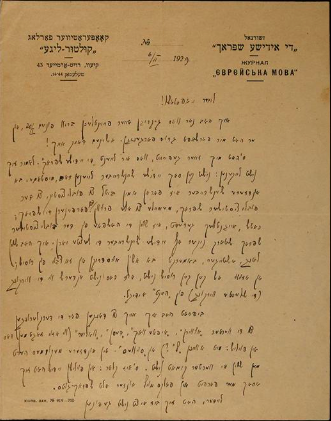
Nokhem Shtif wrote from Kiev to Yoysef Opatoshu in New York on February 6th, 1929, praising Opatoshu for reading Shtif’s journal, Di yidishe shprakh, and for not trying like other Yiddish writers to improve the Yiddish language [1]. Nokhem Shtif complains to Yoysef Opatoshu about the Russification of Yiddish and Yiddish linguistics and that Polish Yiddish is neglected despite most Yiddish scholars being “Litvaks.”
Nokhem Shtif was born in Rovno, Ukraine, in 1879 [2]. He was a linguist, literary historian, and political activist. He studied Yiddish and both religious and modern Hebrew literature. In 1918, Nokhem Shtif moved to Kiev to devote himself to journalism. He wrote about the Jews’ future in the postwar world and founded the philological journal, Di yidishe shprakh in 1931. While he published articles on the history of Yiddish literature and language, Nokhem Shtif concentrated on language planning. Shtif published his controversial article “Di sotsyale diferentsiatsye in yidish” in Di yidishe shprakh in 1929 in which he argued that most Yiddish words and forms derived from Hebrew and Aramaic were redundant in Soviet surroundings and could be discarded and excluded from the process of Yiddish lexical innovation.

Yoysef Opatoshu was a novelist and short-story writer from Mlave, Poland [4]. He immigrated to the U.S. in 1907, where he studied engineering at Cooper Union. Starting in 1910, Opatoshu contributed his stories to periodicals and anthologies. In 1914, Opatoshu edited an anthology of his own, Di Naye Heym (“The New Home”), which included his story of American Jewish life, “Fun Nyu Yorker Geto.” Opatoshu was one of the first Yiddish writers to depict the American Jewish experience in his works. Opatoshu was fascinated by the Jewish past and sought to revivify segments of it in his historical novels, based on extensive research by Simon Dubnov in his work on Jewish history. Opatoshu sought to describe a vital, interactive, and hopeful daily life among Jews.

In this letter, Nokhem Shtif asks Yoysef Opatoshu if he wants to contribute to Di yidishe shprakh by contributing additions or corrections to some folk expressions recently published in the journal from the town of Siedlce. The letterhead is in Russian and Yiddish: Di yidishe shprakh, Kultur lige cooperative press, Kiev, Red Army 43.
Works Cited
“DOCUMENT: Letter from Nokem Shtif to Yoysef Opatoshu, 1929,” The YIVO Encyclopedia of Jews in Eastern Europe. 2008-2020, YIVO Institute for Jewish Research https://yivoencyclopedia.org/popups/viewmedia.aspx?id=1393.
Estraikh, Gennady. “Shtif, Nokhem.” YIVO Encyclopedia of Jews in Eastern Europe 18 October 2010. 14 December 2020 https://yivoencyclopedia.org/article.aspx/Shtif_Nokhem.
“Joseph Opatoshu,” Wikipedia, The Free Encyclopedia. 6 November 2020. https://en.wikipedia.org/wiki/Joseph_Opatoshu
Joseph Opatoshu, 2008, www.jewishvirtuallibrary.org/joseph-opatoshu.
[1] “DOCUMENT: Letter from Nokem Shtif to Yoysef Opatoshu, 1929,” The YIVO Encyclopedia of Jews in Eastern Europe. 2008-2020, YIVO Institute for Jewish Research https://yivoencyclopedia.org/popups/viewmedia.aspx?id=1393
[2] Estraikh, Gennady. “Shtif, Nokhem.” YIVO Encyclopedia of Jews in Eastern Europe 18 October 2010. 14 December 2020 https://yivoencyclopedia.org/article.aspx/Shtif_Nokhem.
[3] “Joseph Opatoshu,” Wikipedia, The Free Encyclopedia. 6 November 2020. https://en.wikipedia.org/wiki/Joseph_Opatoshu
[4] Joseph Opatoshu, 2008, www.jewishvirtuallibrary.org/joseph-opatoshu.
[5] “DOCUMENT: Letter from Nokem Shtif to Yoysef Opatoshu, 1929,” The YIVO Encyclopedia of Jews in Eastern Europe. 2008-2020, YIVO Institute for Jewish Research.
