
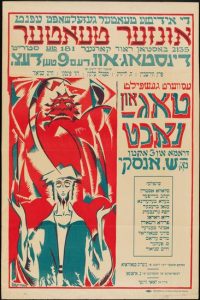
(1925)
Source: Museum of the City of New York
Translation:
The Yiddish Theater Society will open:
UNSER TEATER (Our Theater)
2135 Boston Road at (on the corner of) 181th street
Peretz Hirshbein, H. Leivik, Mendl Elkin, Dovid Pinski, Chaim Schnir
Shall present:
DAY AND NIGHT
A Drama in Three Acts
Written by S. Ansky
Tuesday, December 9
This poster advertises the premier of “Day and Night” at Unser Theater in the Bronx. This historical theater was located right across the street from the Bronx Zoo at 2135 Boston Road, in a building that was torn down in 1966. “Day and Night” premiered in 1925, when the Bronx was a vital hub for the Jewish diaspora. During the first waves of Jewish immigration to New York, major destinations were the Lower East Side, Crown Heights, Brownsville and the South Bronx. The Bronx came into favor at the turn of the 20th century, when the Lower East Side got overcrowded, and Bronx’s Grand Concourse thoroughfare was established. At one point, a quarter million Jews lived in the Bronx. There were live chicken markets and kosher butchers on every street. Located right at the south edge of Bronx Park, Unser Theater occupied prime real estate in the heart of the Jewish community. There was even a hit play devoted to this slice of Jewish life called Yoshke Musikant: “The Bronx Express,” which offered a slice-of-life portrait of Bronx Jews as they negotiated assimilating to the American consumerist and capitalist way of life. The play was revived at Unser Theater in 1925, with an incredible set by the same designer who had worked on “Day and Night” – Boris Aronson. The set featured a subway car from the white Plains Road subway line, whose terminus was in Bronx Park.
Boris Aronson was born in 1900 in Kiev as the son of the city’s chief rabbi. Aronson first hit the theater scene while still in the old world in 1921 with a Cubo-Futurist set designed in collaboration with Alexandra Exter for “Romeo and Juliet” at the Avant-Garde Kamerny Theater in Moscow. Aronson emigrated to New York in 1923 and worked intensely in the Yiddish theater circuit while slowly but surely, he ascended to mainstream Broadway. He was a regular contributor to Unser Theater and even designed a vast mural for its interior. The mural was unfortunately destroyed when the theater was torn down in 1966. His aesthetic of constructivist design was remarkable, and really shines in productions like Loy Sakhmoyd (“the Tenth Commandment”). Aronson eventually went mainstream but never jumped the shark. Even his designs for the Radio City Music Hall were breathtaking and bold. In 1964, he designed the set for Fiddler on the Roof on Broadway based on the color palette of Marc Chagall’s paintings.
“Day and Night” – the play promoted in this poster – was written by the playwright, folklorist, and social activist Shloyme Zanvi Rappoport, who wrote under the penname “S. Ansky.” He was born in Chasniki in today’s Belarus. S. Ansky is best known for his play “The Dybbuk” 1912-14. “Day and Night” was his last play, and the manuscript was never completed.
Works Cited:
“Preparing the Miracle: From the Bronx to Broadway, Boris Aronson, and the Yiddish Theater at Vallois America” (exhibition catalog, 2015), https://www.artforum.com/uploads/guide.003/id14336/press_release.pdf
Arnold Aronson (ed.), The Routledge Companion to Scenography, New York 2018
Barnaby Haran, Watching the Red Dawn: The American Avant-Garde and the Soviet Union, Manchester 2016
S. Ansky, The Dybbuk and Other Writings, New Haven 2002
