
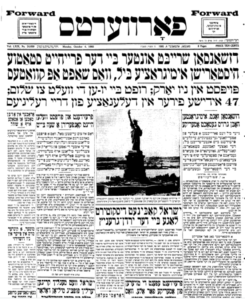
The Forward
October 4, 1965
Page 1
Johnson writes beside underneath freedom statue (Statue of Liberty) historical immigration bill, that called for the riddance of quotas
Pope in New York; called for world peace at the UN
47 Jewish leaders in delegation from three religions
Johnson says, immigrants make America great
The new bill wagers to fix a mistake by American justice system, declared the President while signing the bill; all of the Cabinet, Senators, Congressmen, Governors, and Mayors bring in a special ship to the ceremony; great number Jewish leaders among the prominent personalities in the historical event.
President and Pope want to confer today for an hour’s time
This is the first time, that a Pope visited the American Continent; A million people want to see the Catholic leader throughout the streets of New York and ten million on the television; 18 thousand police officers on guard; Reports say, a number of religious Jewish leaders are “not sure” whether they want to participate; they did not have an invitation.
Translated portions: title, lead, first paragraph in the first column, and first paragraph in the second column
On October 3, 1965 President Lyndon B. Johnson signed the Hart-Celler Immigration Act of 1965 alongside Ted Kennedy, brother of the formerly assassinated John F. Kennedy and Senator of Massachusetts, standing beside the Statue of Liberty. This act essentially ended immigration quotas that were based off of nationality.[1] For almost fifty years, the U.S.’s immigration policies instituted quotas on immigration that were blatantly discriminatory and restrictive in nature, elevating Western Europeans over all other nationalities. With this reform President Johnson ended the quota system and put the Statue of Liberty’s words, “Give me your tired, your poor, your huddled masses yearning to breathe free” into action. The quotas allocated tens of thousands of visas each year for immigrants from Northern and Western Europe, while many countries in Asia, Africa, and the Middle East were hardly even given 100 spots. This law provided the nation with an influx of immigrants from south of the U.S., Southern and Eastern Europe, and Asia and Africa, transforming America into the biggest melting pot of cultures the world had seen yet.[2] What’s particularly noteworthy, however, was how unanticipated the effects of the legislation were, even by the President himself. President Johnson considered the new law a primarily symbolic measure that would not significantly change the ethnic profiles or increase the number of immigrants, but it did both of those things. Curiously, opposition originally stemmed from the left (among others), specifically from those concerned about population growth, showing how different and complex the political landscape was at the time.[3] Fifty years after its establishment, it is even more evident how the law changed the face of the U.S. population. In 1965, Eighty-five percent of the population was white, and 7 out of 8 immigrants were coming from Europe. By 2010, however, the portion of the U.S. population born overseas tripled, with 9 out of 10 immigrants coming from places outside Europe.[4]
Under the new law, immigrants were allowed into country if they had family connections in the United States in addition to merely having skills they could offer, regardless of nationality. The unanticipated consequences of the law likely had what to do with some ways in which it was developed. The bill was initially introduced in the Senate by Philip Hart and in the House by Emanuel Celler, and favored people whose skills would be “especially advantageous” to the United States for immigration. In the end, Representative Michael Feighan, the conservative leaning chairman of the House of Immigration subcommittee agreed to endorse the bill, as long as preference was given to those immigrants who had relatives in the United States, rather than those possessing “especially advantageous” skills. The motivation behind this was actually the prediction that a family unification preference would favor those nationalities already represented in the U.S. population, namely Europeans. This plan clearly had the opposite effect, however, as the decline in the desire of Europeans to move to the U.S. went unaccounted for. Simultaneously, the motivation to move was steadily increasing in Asia, Africa and other non-European countries. Individuals from these areas were able to immigrate by getting student visas or employer sponsorships or through marriage to a legal resident and were subsequently able to have additional family members to join them. By 2010, family unification counted for around three quarters of all U.S. immigration, so the laws that were originally a ploy to prevent individuals from cultures seen as less than ideal into the country “naturally” ended up accomplishing just the opposite.[5]
The question of Jewish involvement in immigration policy is a very interesting one, and the article I chose, at least the portion of it that I translated, mentions it briefly. Besides for the basic interest Jews have had over time in bringing other Jews into the U.S. as a result of anti-Semitism, Jews tended to be invested in coming out against the ethnic and cultural status quo in societies in which they were minorities, and have taken many active roles in advocating for movements dedicated to breaking that uniformity in the United States, and promoting the immigration of non-European peoples. Throughout the entire period of almost 100 years before the triumph of the immigration law of 1965, Jewish groups fought for the reform of immigration policies tenaciously, and allied themselves, no matter how temporarily, with movements whose goals overlapped with those of the Jews. These groups were comprised of an ever-fluctuating range of ethnic groups, religious groups, pro-Communists, anti-Communists, those aligning themselves with presidents with specific foreign policies, those influential in populous states for the purpose of winning national elections, and more. One major example was the support of a liberal immigration policy from industries wanting cheap labor, before the quotas were instituted in 1924. With this tactic of maneuvering, Jews were constantly pushing the acceptance of Jewish immigrants and those from all over the world.[6]
During the House debates on immigration regarding the McCarran-Walter Act which passed in 1952, Representative Walter even personally noted the emphasis that Jewish groups placed on family unification rather than beneficial skill sets, for reasons I would imagine were quite different than those of Michael Feighan, for example. Jewish Senator Jacob Javits played a prominent role in the Senate hearings on the 1965 bill, and Emanuel Celler, who pushed for unrestricted immigration for over 40 years in the House of Representatives, likewise contributed significantly. Senator Jacob Javits declared before the Senate midst debate that “[b]oth the dictates of our consciences as well as the precepts of sociologists tell us that immigration, as it exists in the national origins quota system, is wrong, and without any basis in reason or fact for we know better than to say that one man is better than another because of the color of his skin.” Jewish organizations including the American Council for Judaism Philanthropic Fund, the Council of Jewish Federations and Welfare Funds, and B’nai B’rith Women presented briefs in support of the measure before the Senate Subcommittee, in addition to organizations such as the ACLU and the Americans for Democratic Action which had prominent Jewish participation. Between 1924 and 1965, the Jews did not see much success come of their political, intellectual, and social activity in this area, but the act of 1965 represented a very noteworthy and tangible victory for them, the effects of which can still be seen today.[7]
Just to focus some attention on the other portion of this translation, it feels almost fitting that while such a progressive step was being taken by the U.S. government, other monumental events for the sake of world betterment were occurring on U.S. soil as well. In the first Papal visit to America in 1965, Pope Paul VI went on a trip to New York to address the then relatively new United Nations and push for the message of peace, particularly during a time when tensions were rising between India and Pakistan.[8] While in New York, the Pope met with President Johnson for a grand total of forty-six minutes, who afterwards commented that the visit “may be just what the world needs to get us thinking on how to achieve peace.” With the assistance of interpreters, they discussed topics including world poverty, the pursuit of peace, disease and illiteracy, in addition to race relations and Vietnam.[9] The article seems to imply that the Jews were not particularly interested in engaging with the Pope’s visit, and while I didn’t find any information connecting the two events, I found it very interesting that the official statement of the Catholic Church declaring that the Jews did not kill Jesus was issued very shortly after the fact on October 28, 1965.[10] This is obviously just conjecture, but perhaps in the Pope’s quest for world peace and given his recent visit to the U.S., he was implored to give this statement on the Church’s relations to non-Christian religions.
Overall, this newspaper clipping was very interesting to explore, not only because it gave me a window into the historical events happening in New York at the time, but because it helped contextualize them within the frame of the Jews which would not have been intuitive for me otherwise. Being given this perspective also just gave me a general appreciation for considering the details of specific individuals and groups that lie behind the headlines but are not readily apparent. I was also not aware of the fact that the Forward used to publish in Yiddish, and realizing how prolific Yiddish was at the time makes me feel a bit wistful, but more than that, it makes me even more excited to continue in my Yiddish education and have better access to texts such like this in the future.
[1]Margaret Sands Orchowski, “The Law That Changed the Face of America,” Google Books (Rowman & Littlefield2015),https://books.google.com/books?id=K0hKCgAAQBAJ&printsec=frontcover#v=onepage&q&f=false, 39.
[2]LBJ Presidential Library, “The Acts of Legislation Passed during the Lyndon Baines Johnson Administration – LBJ Presidential Library,” Lbjlibrary.org, May 19, 2008, http://www.lbjlibrary.org/lyndon-baines-johnson/perspectives-and-essays/seeing-is-believing-the-enduring-legacy-of-lyndon-johnson.
[3]Jason DeParle, “How Stephen Miller Seized the Moment to Battle Immigration,” The New York Times, August 17, 2019, https://www.nytimes.com/2019/08/17/us/politics/stephen-miller-immigration-trump.html.
[4]Tom Gjelten, “NPR Choice Page,” Npr.org, October 3, 2015, https://www.npr.org/2015/10/03/445339838/the-unintended-consequences-of-the-1965-immigration-act.
[5]Ibid.
[6]MacDonald, Kevin. “Jewish Involvement in Shaping American Immigration Policy, 1881-1965: A Historical Review.” Population and Environment 19, no. 4 (1998): 309-310. www.jstor.org/stable/27503587.
[7]Ibid., 342-344
[8]Lily Rothman, “The First Time a Pope Visited the U.S. Was Much More Complicated,” Time (Time, September 21, 2015), https://time.com/4042433/paul-vi-lbj-1965/.
[9]International Herald Tribune, “1965: Pope and Lyndon Johnson Discuss Threats to Peace,” IHT Retrospective Blog, October 4, 2015, https://iht-retrospective.blogs.nytimes.com/2015/10/04/1965-pope-and-lyndon-johnson-discuss-threats-to-peace/.
[10]“Nostra Aetate,” Vatican.va, n.d., http://www.vatican.va/archive/hist_councils/ii_vatican_council/documents/vat-ii_decl_19651028_nostra-aetate_en.html.
