
By Eliana Straus

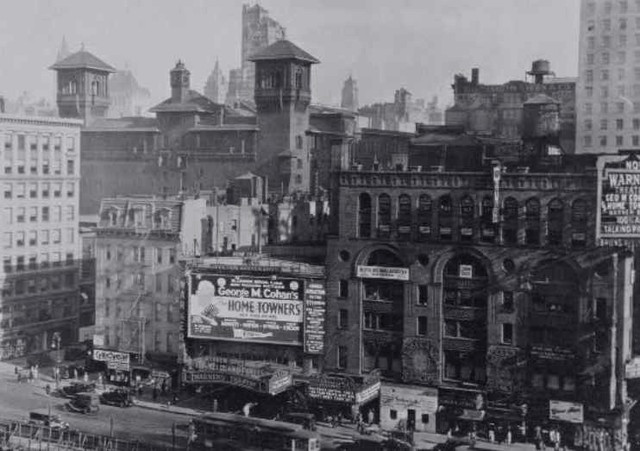
The Dybbuk, directed by Michal Waszynski and photographed by Albert Wywerka was filmed in 1937 in Warsaw, Poland and eventually premiered at the Continental Theater in New York in 1938. First known as the Warner’s Theater (because of the Warner brothers takeover), the Continental Theater was eventually demolished in 1952 and a hotel stands in its place today.1
Waszynski’s film was the first film adaptation of S. An-sky’s 1914 play, The Dybbuk, Or Between Two Worlds.
Waszynski was Ukranian born and thirty-three years old when he directed the film in 1937. He was known as “Polish cinema’s reigning wunderkind.”2 “Michal Waszynski, the director of The Dybbuk, was a talented man who knew Yiddish but didn’t know Yiddish,” said Leon Liebgold who played Channon in the film. What Liebgold meant was that Waszynski did not let it be known that he knew Yiddish.3
Often when converting a play to a film, there are aspects that must be compromised. Waszynski simplified the play’s dialogue for cinematic purposes, but the “salvage ethnography” of An-sky’s original play is still embodied in the film.4 Waszynski utilized An-sky’s rich ethnographic research, and was able to add to this research by exploring Jewish custom and belief, in a Jewish village. “The Dybbuk creates an evocative image of shtetl life.”5

The pervasive Jewish customs depicted in the film are indicative of a clinging to Jewish culture in prewar Poland. Contextually, The Dybbuk was filmed right before World War II preceding the “final solution”. At that time, there were over 3 million Jews in Poland and the Jewish population was pervasive both economically and culturally. In some cases, the anti-Semitism and push for assimilation had the opposite affect on many Jews causing them to further connect with and increase their dedication to Yiddish language and culture.6 This strong connection is a crucial aspect to the success of the film at this time.
In addition to being a story that reflects Jewish religion and Yiddish culture, The Dybbuk is also a love story featuring Leah and Channon, played by Lili Liliana and Leon Liebgold respectively. Perhaps what renders their love so tangible in the film is that Liliana and Liebgold were married in real life. The film, as opposed to the play, “accentuates actions that the audience only hears about in the play,”7 and it could do so even more so because the love between the protagonists was real. Liebgold remarks that “the picture was made on a grand scale with the best actors in Poland.”8

The cast of the film:
Rabbi of Miropol . . . . . A. Morewski
The “Messenger” . . . . . R. Samberg
Sender . . . . . M. Libman
Leah, his daughter . . . . . Lili Liliana
Frade, Leah’s aunt . . . . . Dina Halpern
Nisson . . . . . G. Lamberger
Channon . . . . . L. Libgold
Nuta . . . . . M. Bozyk
Zalman . . . . . S. Landau
Nachman . . . . . S. Bronecki
Menashe, his son . . . . . M. Messinger
Mendel . . . . . Z. Katz
Michoel . . . . . A. Kurc
Meyer . . . . . D. Lederman
While the film takes place in Poland it was “primarily fashioned for the American market.”9 The New York Times, in its review of the film after it premiered at the Continental Theater, was not as thrilled with the film as one might have hoped. In the review, the critics write, “The Dybbuk, made in Poland, is almost oppressively tedious, stricken by inadequate technical knowledge and hamstrung (excuse the sacrilege) by a frequently infantile groping after the mystic.” The critics recognized that one of the disadvantages of photography regarding film is that it “has to be cajoled out of reality.” Yet, the review concludes, for all its weaknesses it is an “interesting record.”10
During the 1950s, the film made its rounds throughout various Jewish communities, but so much of it had deteriorated. Years later, in 1989, The Dybbuk was restored by the National Center for Jewish Film, which was dedicated to “returning the neglected fragments of this cinematic artwork to its pristine glory.” It played for two weeks at the Festival Theater on West 57th Street.11
The fact that the film was restored and is still watched and studied today, shows the significance and power of the film and of the storyline at large. Aside from being an intriguing story, The Dybbuk is a way to connect to the Yiddish culture of the past and to preserve it for the future.
Image Sources
Figure 1. http://photos.cinematreasures.org/production/photos/16214/1 311262274/large.jpg?1311262274. Accessed November 6, 2014.
Figure 2. http://www.jewishfilm.org/Catalogue/images/dybbuk_02.jpg. Accessed November 6, 2014.
Figure 3. http://content7.flixster.com/movie/11/13/57/11135717_det.jpg. Accessed November 6, 2014.
Figure 4. https://www.youtube.com/watch?v=IjoCmYimeIo. Accessed November 6, 2014.
Works Cited
“2nd Avenue Archive: Yiddish Theater in New York.” NYU Faculty Digital Archive. Accessed July 28, 2021.
Konigsberg, Ira. “The Only ‘I’ in The World: Religion, Psychoanalysis, and The Dybbuk.” 1997.
Mazur, Daria & Maciej Smoczynski. “Waszynski’s The Dybbuk.” 2010.
Nugent, Frank. “The Screen: The Continental Brings In a Film of The Dybbuk, New Pictures at the Criterion and the Rialto.” The New York Times, January 28, 1938. Accessed July 28, 2021.
Rosenberg, Joel. “The Soul of Catastrophe: On the 1937 Film of S. An-sky’s The Dybbuk.” 2011.
Shephard, Richard, F. “FILM: The Dybbuk Rises from the Ruins.” The New York Times. September 10, 1989. Accessed July 28, 2021.
“Warners’ Theatre.” Cinema Treasures. Accessed July 28, 2021.
Footnotes
- “Warners’ Theatre.” Cinema Treasures. Accessed July 28, 2021
- “2nd Avenue Archive: Yiddish Theater in New York.” NYU Faculty Digital Archive. Accessed July 28, 2021.
- Shephard, Richard, F. “FILM: The Dybbuk Rises from the Ruins.” The New York Times. September 10, 1989.
- Rosenberg, Joel. “The Soul of Catastrophe: On the 1937 Film of S. An-sky’s The Dybbuk.” 2011.
- Konigsberg, Ira. “The Only ‘I’ in The World: Religion, Psychoanalysis, and The Dybbuk.” 1997.
- Ibid.
- Ibid.
- Shephard.
- Mazur, Daria & Maciej Smoczynski. “Waszynski’s The Dybbuk.” 2010.
- Nugent, Frank. “The Screen: The Continental Brings In a Film of The Dybbuk, New Pictures at the Criterion and the Rialto.” The New York Times, January 28, 1938. Accessed July 28, 2021.
- Shephard.

