
By Rachel Field
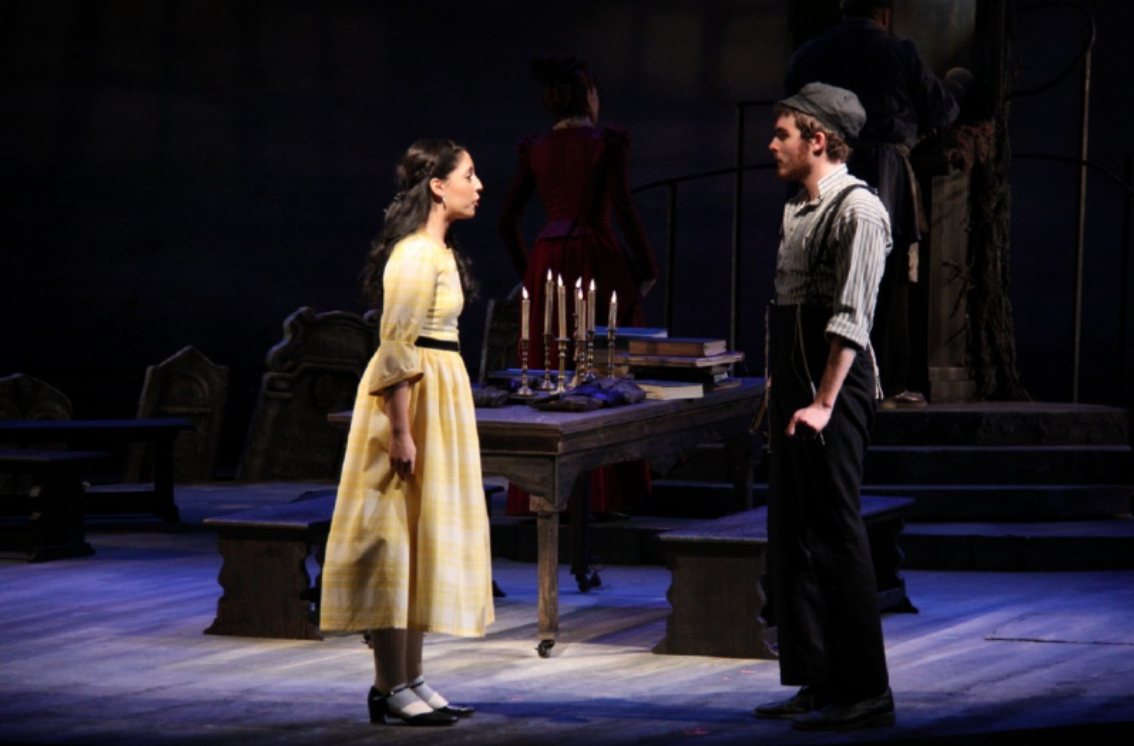
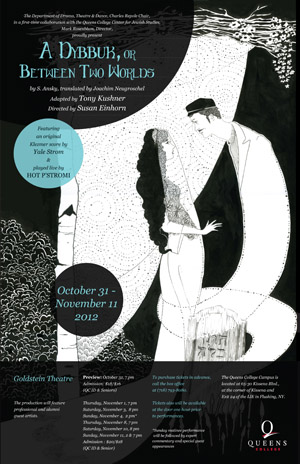
In 2012, the Queens College Department of Drama, Theatre, and Dance presented a brilliant and thought-provoking version of S. An-sky’s 1914 play The Dybbuk. Directed by Susan Einhorn, the production ran from October 31st to November 11th. The play was based on an adaptation by American playwright Tony Kushner, who in 1995 used Joachim Neugroschel’s English translation to write his own version of Ansky’s drama. The performance, which lasted nearly three hours, was followed by a panel discussion during which students, professors, and religious leaders discussed Jewish culture in Eastern Europe at the turn of the century. The production featured both professional actors and students and alumni of Queens College. Below is an image of the poster announcing the production, which took place in Queens College’s Goldstein Theatre.
A review of the production can be found here: http://macaulay.cuny.edu/eportfolios/artsandculture_theatre/2012/11/22/a-dybbuk/.
An-sky wrote The Dybbuk prior to the Holocaust when Eastern European Jews faced the constant threat of Russian pogroms. While Kushner’s adaptation honors the original play, it incorporates allusions to the Holocaust and presents a more cynical attitude toward religion that reflects the religious skepticism of many Holocaust survivors as well as Kushner himself. The fact that the Holocaust is never explicitly mentioned lends Kushner’s version a timeless quality. The suffering to which the play alludes could apply to Jews living at any given time.
This was Ms. Einhorn’s goal—to create a timeless work that remained faithful to the themes of the original play. In a phone interview conducted with Ms. Einhorn in November of 2014, Ms. Einhorn focused on the significance of depicting beggars stealing before the wedding ceremony of Leah and Chonon. Ms. Einhorn wanted “to juxtapose the splendor and opulence” of the wealthy with the desperateness and hopelessness of the poor, just as Ansky sought to shed light on the social tensions that he attributed to the rise of capitalism.1 She hoped to convey the message that even though Sender feeds the poor during this scene, “there is still hypocrisy involved.”
Costumes, designed by Amanda Shafran, were carefully planned out to highlight the play’s themes. The costumes were in period with the exception of The Messenger’s costume, which incorporated fashion styles from various time periods. In a phone interview, Ms. Shafran explained, “We chose to have The Messenger in a look that combined pieces from many different time periods to allude to the fact that The Messenger was mystical, spiritual, guiding the action along.”2
The timelessness of The Messenger’s character gives the “sense that there might be many spheres of storytelling operating at same time,” Ms. Shafran added.3 She then explained that Leah wore a yellow dress to symbolize that she is a “guiding hope” in the play.
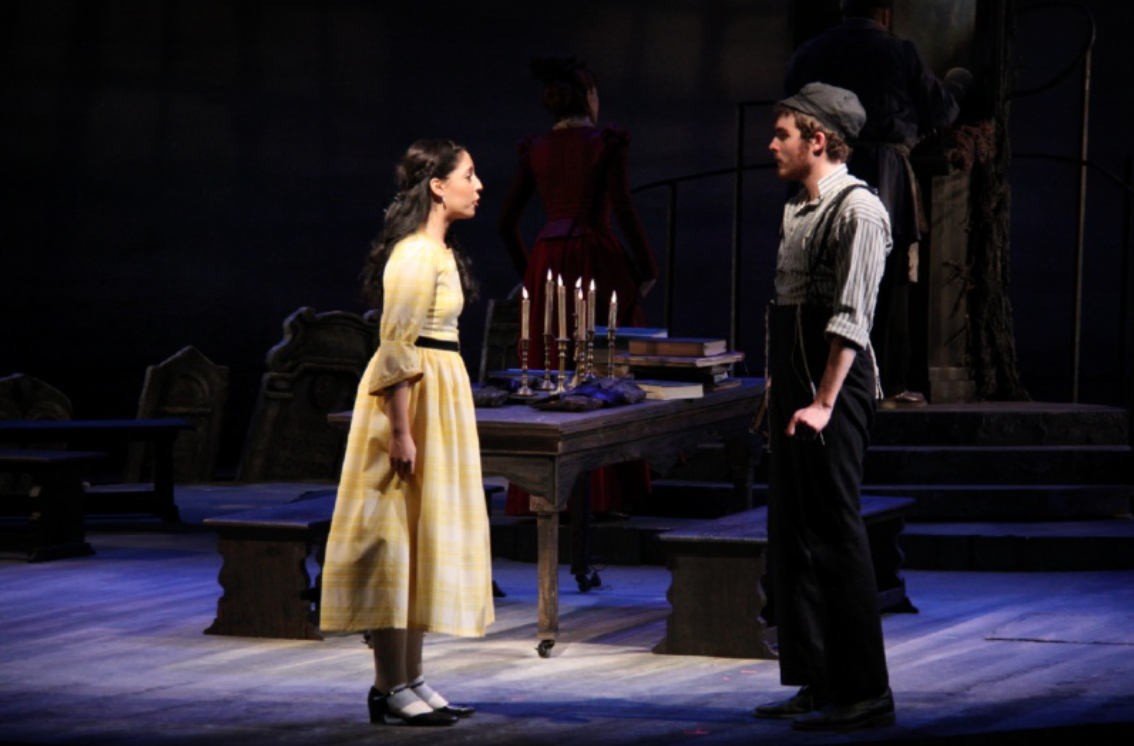
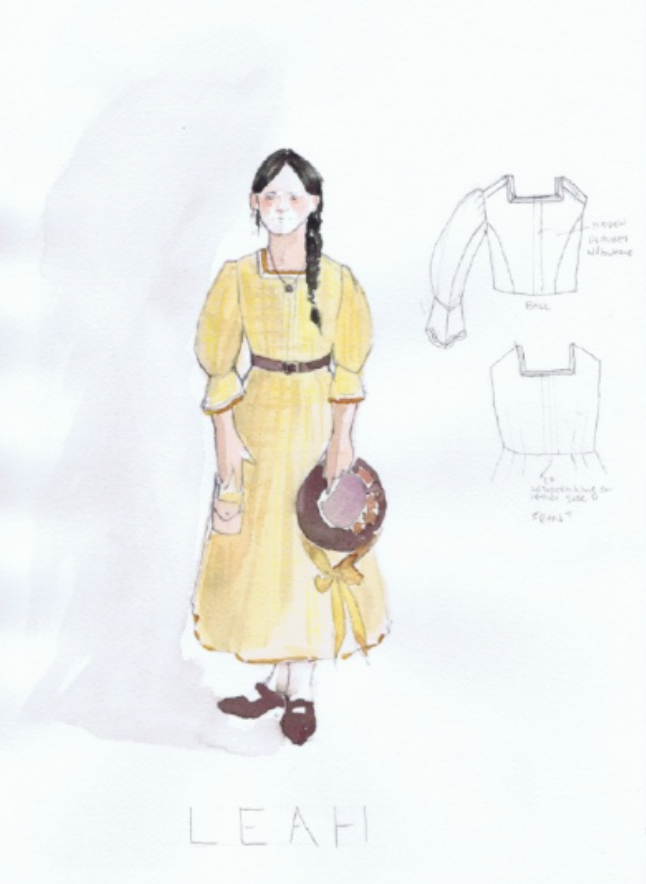
Ms. Shafran described how she was “initially inspired by photographs of Jewish cemeteries.” The curly script of the tombstones and the asymmetry of Eastern European cemeteries were mirrored in the asymmetry of the lace used for Leah’s dress. Ms. Shafran used real pieces of silver from prayer garments and tzitzis as trims for the ghost bride’s dress in order to present a sort of history of the Jews. The religious garments “hold a sense of mysticism and history,” explained Ms. Shafran.
The renowned Klezmer revivalist Yale Strom was commissioned to write a score for the production. The music, which featured voice, accordion, and saxophone, was performed live by the Klezmer group Hot Pstromi. Like An-sky, Yale Strom embarked on an ethnographic expedition of Jews living in Eastern and Central Europe, the result of which was a 400-page collection of songs and photographs.
Yale Strom’s webpage can be found here: http://www.yalestrom.com.
The production’s set was designed by Harry Feiner. Through the use of a rotating platform, the setting could be easily transformed. For courtyard scenes, the bimah and arc could be rotated such that the tree became prominent. The bimah could be positioned in two different ways depending on whether the scene took place in the town synagogue or in Reb Azriel’s synagogue. The archways on both sides of the stage resembled trees with the intertwining branches curved to create the Star of David, just as in the movie adaptation of the play, the symbol of the Star of David appears constantly as a reminder of Jewish unity.
Choreography was directed by Rachel Finerman, who, according to director Susan Einhorn, sought to capture, through “uncomfortable and awkward” movements, the “tragedy [and] poverty that the beggars represented.” Following the show, a panel consisting of Professor Elissa Bemporad, a professor in the history department at Queens College, Rabbi Shur, and Dr. Thomas E. Bird, a professor of Russian language and literature, was held. Professor Bemporad discussed An-sky’s life in Russia, his complicated relationship with Judaism, his socialist involvement, and his attempt to reunite the Jewish people by collecting and preserving Jewish folklore.
Image Sources
Figure 1. http://macaulay.cuny.edu/eportfolios/artsandculture_theatre/201 2/11/22/a-dybbuk/. Accessed November 7, 2014.
Figure 2. http://www.amandashafran.com. Accessed November 7, 2014.
Figure 3. http://www.amandashafran.com. Accessed November 7, 2014.
Works Cited
“Dybbuk.” Dybbuk. Accessed July 28, 2021.
Einhorn, Susan. Personal interview. November 3, 2014.
Kushner, Tony, and Joachim Neugrochel. A Dybbuk and Other Tales of the Supernatural. New York: Theatre Communications Group, 2012. Print.
Nebro, Marina. A Dybbuk (Review). Accessed July 28, 2021.
Shafran, Amanda. Personal interview. November 5, 2014.
“Yale Strom Klezmer Artist.” Yale Strom Klezmer Artist. Web. 5 Nov. 2014. <http://www.yalestrom.com>.
Footnotes
