
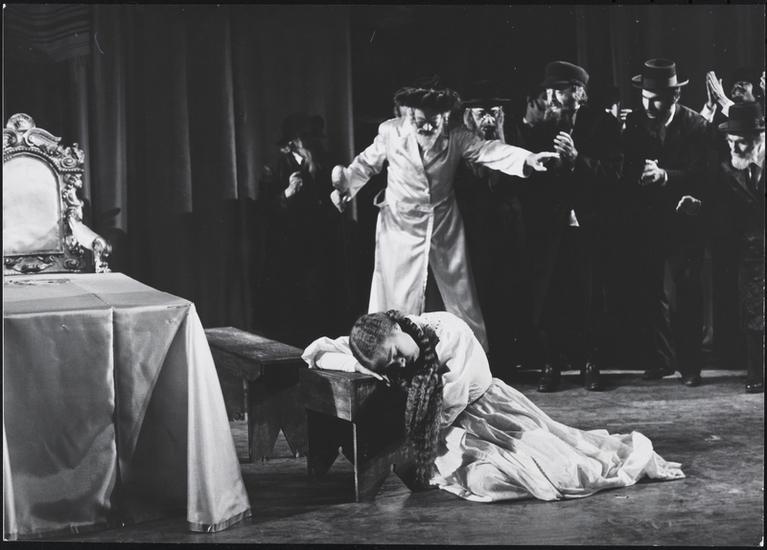
By Elizabeth Edelman
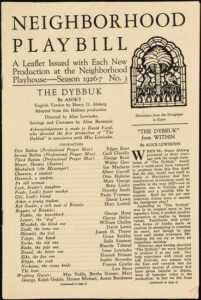
When Alice Lewisohn Crowley first read An-sky’s The Dybbuk, she was instantly spellbound, “the characters seemed to emerge from the pages, with irresistible appeals to become enformed.”1 Despite her instant connection with this play, Crowley, co-founder of the Lower East Side’s Neighborhood Playhouse theater, was intimidated by the prospect of putting such a play on her stage. She wondered if the play’s “atmosphere, so foreign, so strangely remote, be recaptured for the stage?”2
Regardless of her concerns, Crowley seemed determined to bring The Dybbuk to the Neighborhood Playhouse. Crowley and her team treated The Dybbuk as something quite special, almost fragile. Throughout the entire process each decision, whether it was the angle they would take or how the costumes would look, was made in a long, thoughtful process. Perhaps this is why The Dybbuk was one of the Neighborhood Playhouse’s most successful productions.3
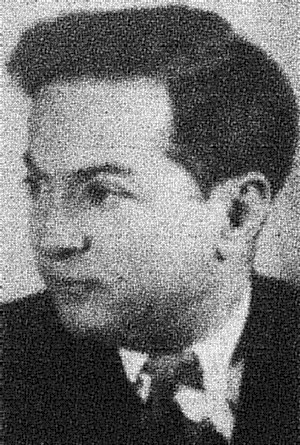
While Crowley loved the play, her apprehension about the Neighborhood Playhouse’s ability to produce The Dybbuk did not fully subside until she met David Vardi. Vardi performed as an actor in the early Habima production of The Dybbuk and was the assistant director of a later production. Crowley met him and seemed to be instantly comforted by his familiarity with the play, “The Dybbuk had become his religion, and the ecstasy of its characters was reflected in him.”4 Similarly, since Vardi was from a village similar to the one in which The Dybbuk takes place, Crowley felt like he could be a liaison to her theater, unfamiliar with the traditions and ways of Chassidic Jewry.5 Vardi seemed to be exalted as the true expert into a culture that the Neighborhood Playhouse felt it knew little about. The music they used, for example, came from unrecorded tunes which Vardi sang into a phonograph so it could be transcribed and composed by the theater’s music director.6 The authenticity which was so important to Crowley would not have been possible without Vardi’s invaluable contribution.
It seemed that a major goal for Crowley was to create a version of The Dybbuk that would truly create a link ‘between two worlds.’ It was, after all, the Neighborhood Playhouse’s “institutional role…[to] link the Lower East Side and the outside world.”7 The theater, therefore, chose to focus on the themes of youth rebellion over “the ancient traditions, which bound them to their parents and seek freedom and happiness.”8 Such themes were relevant to both Jews and non-Jews living in New York City at this time. The theater’s success in accomplishing these goals was evidenced by the production’s popularity, which was not limited to any one ethnic or religious group.9
Crowley also felt that, unlike the Habimah, the Neighborhood Playhouse group had less of a personal connection to the story of The Dybbuk. Therefore, while Habimah’s cast chose to distance themselves from the play’s themes of darkness and superstitions, the Neighborhood Playhouse embraced the dark and mystical side of The Dybbuk.10
To accomplish what felt to them like lofty goals, Crowley and Vardi were extremely particular about every detail related to the production of The Dybbuk. Casting, for example, took longer than usual. To Crowley, no one seemed qualified especially not the “Jewish actors of Broadway [who] proved themselves least suited, because their whole approach and emphasis was upon obvious values, and they had no relation to mystical feeling.11 Finally a cast of characters was agreed upon.
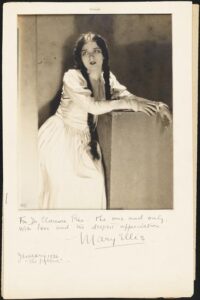
Mary Ellis, who was cast as the part of Leah, would later go on to be quite successful in the theater world.12 Many of the other actors came from “within the company and included amateurs.”13 Clearly this did not have a negative effect on the incredibly well received production. The theater was by no means cutting corners as evidenced by their many other lavish decisions.
Crowley notes that while her theater usually dedicated four or five weeks to rehearsal time, The Dybbuk was allotted ten weeks for rehearsals. Because the actors were quite removed and unfamiliar with Chassidic culture, it was insisted upon them that they connect with their characters beyond rehearsal time, “The beggars in The Dybbuk who are so convincing on the stage were put through a whole course of simulated begging…the Neighborhood Playhouse company…was relentlessly drilled by a Chassidic Jew who knew exactly how Chassidic Jews should behave.”14 Crowley similarly noted that her actors worked so hard to become ‘one’ with their characters that they were ultimately “haunted by the Dybbuk.”15 There were high emotional costs to this production, “we had strained, struggled, endured together, with faith in the experience we shared, even if at times we secretly doubted the result.”16
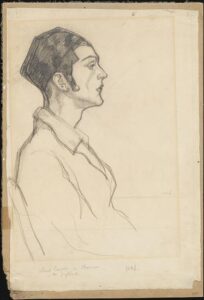
Financial costs were high as well. Not only were there extra weeks of rehearsals, but the company paid high costs to ensure that each character, from Leah to a minor chorus member, had the perfect costume. The rented wigs alone cost more than what a lead actor usually made in a week.17
This production of The Dybbuk was obviously highly regarded by all those who took part in its creation and development. The actors seemed possessed by their characters and the theater’s leadership similarly haunted by the significance they felt this production held. It was clear, however, that the extra effort devoted to this performance was worthwhile as its reception far exceeded all expectations.
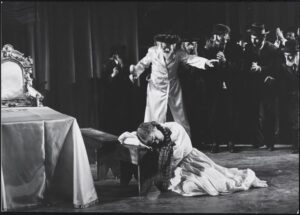
The New York Times exalted the Neighborhood Playhouse’s performance of The Dybbuk, “In the acting and atmosphere they brought to it, could cover the poor silly bones of this autumn of theatrical famine with a garment of true grandeur.”18 On the Neighborhood Playhouse, the Times noted that, “the highest point of acting and of production, the most faultless performance, taken all together, which the Neighborhood Playhouse, with all its highly creditable record, has yet managed.”19 Many more reviewers lauded the performance not only amongst theaters of similar size status but compared it favorably “to the entire New York season, uptown and down.”20 When the production’s closing date approached one concerned fan wrote that “I think its withdrawal would deprive the community of one of the finest things that has ever happened in the American theatre.”21
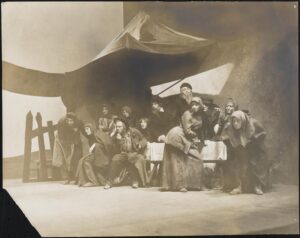
To say the Neighborhood Playhouse’s production of The Dybbuk had a positive reception would be an understatement. The small theater could barely keep up with its popularity, “Night after night increasing numbers of people were turned away.”22 Similarly, offers came from larger theaters trying to convince Crowley to recreate the performance uptown. One offer even suggested the production be moved to London.23
In the end, Crowley refused offers to move her production of The Dybbuk anywhere but the Neighborhood Playhouse. While such offers seemed like they would have only been good for the overall growth of the Neighborhood Playhouse, it seems that the theater’s leadership was truly committed to staying local and maintaining its strong connection with its Lower East Side neighborhood.
Crowley and Vardi’s choices throughout the development and production of The Dybbuk were consistent with their desire to create an authentic representation of An-sky’s play and the story and setting it described. From their struggle to find the perfect cast to overpaying for costumes and wigs the Neighborhood Playhouse did not miss a single detail in creating their perfect play. Finally, their polite rejection to move the production to a larger more renowned theater uptown shows that they were unwilling to sell-out like many other theaters might have done. Crowley, Vardi and the actors seemed to be truly committed to their principles. Their integrity is so surprising in a way that one might wonder whether they too were possessed by the dybbuk.
Image Sources
Figure 1. https://collections.mcny.org/asset-management/2F3HRG60270. Accessed July 28, 2021.
Figure 2.http://www.museumoffamilyhistory.com/yt/lex/V/vardi-david.htm. Accessed November 7, 2014.
Figure 3. https://collections.mcny.org/asset-management/2F3XC58AVQBN. Accessed July 28, 2021.
Figure 4. https://collections.mcny.org/asset-management/24U39YOYBEO. Accessed July 28, 2021.
Figure 5. https://collections.mcny.org/asset-management/2F3408RNRNR. Accessed July 28, 2021.
Works Cited
Crowley, Alice Lewisohn. The Neighborhood Playhouse: Leaves from a Theatre Scrapbook. New York: Theatre Arts, 1959. Print.
“David Vardi.” Lives in the Yiddish Theater. Museum of Family History. Accessed July 28, 2021.
Harrington, John P. The Life of the Neighborhood Playhouse on Grand Street. Syracuse, NY: Syracuse UP, 2007. Print.
“The Neighborhood Playhouse.” The Cambridge Guide to Theater. Cambridge: Cambridge University Press, 2000. Accessed November 7, 2014.
Footnotes
- Crowley, Alice Lewisohn. The Neighborhood Playhouse; Leaves from a Theatre Scrapbook. New York: Theatre Arts, 1959. Print, p. 199.
- Ibid.
- “The Neighborhood Playhouse.” The Cambridge Guide to Theater. Cambridge: Cambridge University Press, 2000. Accessed November 7, 2014.
- Crowley, p. 209.
- Ibid.
- Ibid., p. 214.
- Harrington, John P. The Life of the Neighborhood Playhouse on Grand Street. Syracuse, NY: Syracuse UP, 2007. Print, p. 216.
- Ibid., p. 212.
- Ibid.
- Crowley, pp. 214-215.
- Pp. 211-212.
- Harrington, p. 219.
- Ibid.
- Ibid., p. 221.
- Crowley, p. 215.
- Ibid.
- Harrington, p. 220.
- Quoted in Harrington, p. 223.
- Quoted in Harrington, p. 221.
- Harrington, p. 223.
- Ibid., p. 225.
- Crowley, p. 217.
- Harrington, p. 224.
