
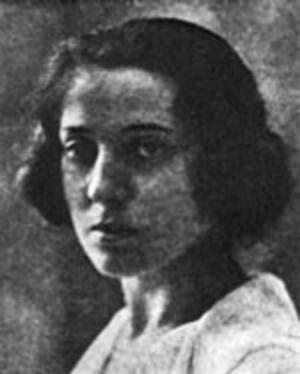
During her ephemeral writing career in the early twentieth century, Yiddish prose writer and poet Fradl Shtok was credited as one of the first to utilize the sonnet form in the Yiddish language (Finkin and Schachter 2022, xv; Schachter 2021). Aside from this attribution, and a handful of published poems and short stories, she had little more to her professional name. In fact, scholars believed she had died in a sanatorium in the 1930s (Gollance 2017; Kenvin 2015). Decades later, in 2002, translator Joachim Neugroschel discovered a letter Shtok had written to editor Abraham Cahan in 1942, in which she discusses the publishing of one of her stories in The Forward (Schachter 2021). Only then, thanks to the efforts of feminist scholars of Yiddish literature who felt newly inspired to uncover details of Shtok’s life and writing, did Fradl Shtok deservedly become regaled as a prolific contributor to the Yiddish literary canon (Finkman and Schachter 2021, xii; Kellman 2021; Schachter 2021).

Image 1. Fradl Shtok
Fradl Shtok was born in 1890 in Skala, Galicia, a small Jewish town located along Austria-Hungary’s eastern border with Russia (Finkin and Schachter 2022, xi). Coincidentally, or perhaps not so, Galicia was home to many a famed Jewish literary talent, being seen as the center of the Yiddish neo-romanticism movement and a popular breeding ground for Yiddish sonnets (Finkin and Schachter 2022, xiii). Shtok was a child of both musical and academic gifts, though her mother died when she was just two years old. The tragic death of her father, who had recently been sent to prison for being involved with a murder, followed only eight years later (Kellman 2021; Kenvine 2015). As a result, she was raised by her aunt and uncle, a period during which she also began engaging with European “high culture” (Finkin and Schachter 2022, xiii).
In 1907, when she was 17 years old, Shtok immigrated to New York, where she moved in with relatives (Finkin and Schachter 2022, xi; Kellman 2021; Schachter 2021). She began writing soon after getting settled in New York City, with her first works of poetry being published in 1910 (Finkin and Schachter 2022, xiii; Kenvin 2015). She quickly rose to notability in the Yiddish literary circles and cafés of Manhattan’s Lower East Side, such as Sholem’s Café or Café Europa, where Jewish intellectuals would convene (Schachter 2021). Café culture was dominated by men, but women could be present on the fringes, indicative of the more radical political leanings of these circles (Schachter 2021). That said, the fringes were where they would stay. In particular, Shtok became associated with Di Yunge (“The Youngsters”), a circle of early-twentieth century modernist Yiddish poets and writers living in New York who referred to themselves as a “new minyan” (“prayer circle”) (Finkin and Schachter 2022, xiii). Di Yunge writers took their modernist work to heart, touting that art should exist for its own sake, without the need for a pointed political agenda (Finkin and Schachter 2022, xiii). As is to be expected, however, Fradl Shtok and other Yiddish women writers who worked with Di Yunge were never fully welcomed into the fold as the result of their gender.

Image 2. Café Royal of the LES café scene, 1937
The bulk of Fradl Shtok’s publicly-known work was published in anthologies and journals. She began by foraying into poetry, putting out eight sonnets in 1914 as part of a collection entitled Di Naye Heym (“The New Home”), which she also co-edited. In 1915, Shtok authored an essay, “Vos Iz Poezye?” (“What is Poetry?”), which appeared in an anthology by Moyshe Leyb Halpern. Shortly after, in 1917, she contributed eleven poems–five of which were sonnets–to a preeminent Moyshe Bassin anthology, entitled Finf Hundert Yor Yidishe Poezye (“Five Hundred Years of Yiddish Poetry”) (Kellman 2021; Schachter 2021). Throughout, Shtok became mistakenly recognized as the first to ever pen a sonnet in Yiddish. It has since been confirmed that she was at least one of the first, and did so while bringing women’s issues to the fore (Finkin and Schachter 2022, xvi; Schachter 2021). Her poetry was met with high praise from critics, likely because women poets were not deemed threats to male Yiddish writers, and were therefore deserving of positive reviews. Historian Avrom Tabatshnik wrote that Shtok was the first poet at the same level as the male poets of her era (Kellman 2021). Though this is a well-meaning, if not misogynistic, opinion on Tabatshnik’s part, the statement is indicative of the impact of Shtok’s poetry on her literary contemporaries.
Eventually, Shtok made her way into the sphere of prose. She began publishing short stories in 1916, with her work being featured in New York Yiddish newspapers to the likes of Der Tog (“The Day”) and Der Yidisher Kempfer (“The Jewish Fighter”) (Schachter 2021). Shtok’s first and only major collection of 38 short stories, Gezamlte Ertseylungen (“Collected Stories”), was published in 1919 (Finkin and Schachter 2022, xiii; Kellman 2021). The stories were a combination of those set in the Galician shtetl–Shtok’s birthplace–in addition to a selection of stories taking place among enclaves of early twentieth century immigrants to New York City (Finkin and Schachter 2022). Shtok’s unique voice came through in her prose. Her frequent use of free indirect discourse, a combination of first- and third-person points of view, was a powerful mechanism through which to shed new light on the often-ignored daily musings and challenges of women in these European and American communities. Her stories contained bold themes such as female erotic desire, sexual repression, and class restructuring. Specifically as they relate to New York, Shtok’s short stories feature common gathering places for recently-migrated Jews, including parks, social clubs, and family-owned businesses (Finkin and Schachter 2022.
Unfortunately, the release of Gezamlte Ertseylungen marked a bitter turning point in Fradl Shtok’s career. The work prompted levels of attention from critics not often seen for a woman at the time, but the critics approached their reviews with skepticism, clearly biased by their preference towards male writers, and influenced by Yiddish literature’s new direction toward engaging with the socialist movement. Reception of Shtok’s collection went from indifference to harsh criticism (Schachter 2021). For example, poet Aaron Glanz-Leyeles and prominent Yiddish intellectual Shmuel Niger both commended Shtok’s talented writing style, but argued that the collection was “monogamous,” as most of her characters underwent a similar trajectory of facing a hardship they wanted to escape. Meanwhile, critic Moissaye Olgin went so far as to claim that Shtok took up a condescending attitude towards both her characters and her readers (Hellerstein, 2004; Kellman 2021). Altogether, these critics questioned the value or relevance of women’s stories (Lyubas 2020; Schachter 2021). Many presume that these unsympathetic reviews drove Shtok to remove herself from the Yiddish literary scene, some even surmising that the reviews are what drove her to an eventual hysteria (Gollance 2017; Kellman 2021; Schachter 2021).
Little evidence of Shtok’s life exists after 1920 (Kellman 2021; Schachter 2021). What scholars have found is that Shtok married a man named Samuel Zinn in 1918, though records indicate that the two divorced only four years later. Shtok then moved from the Lower East Side to Washington Heights, where she lived with Jennie Herzog, neé Bedrick, a fellow Galician-born Yiddish author (Schachter 2021). Shtok continued to write, albeit sparingly. She wrote and sold a play, Der Amerikaner (“The American”), in 1923, but it was never published or produced. In 1927, she wrote a novel entirely in English, called Musician Only, though it was received with negative reviews (Kellman 2021; New York Times 1927; Schachter 2021). Government documents suggest that Shtok stopped considering writing to be her profession (Schachter 2021). She moved back in with ex-husband Zinn on the Lower East Side, where she lived and ran a photo studio until at least 1940, when Zinn moved out and remarried. Shtok then moved to the Bronx, where she worked for her cousin in the garment industry. At a certain point, she may have also moved to Los Angeles (Finkman and Schachter 2021, xiv; Schachter 2021). The last known record of Shtok’s written work is from 1942, when her short story, “A Soykher Fun Fel” (“A Hide Merchant”) was published in The Forward (Kellman 2021; Schachter 2021).

Image 3. Letter from Shtok to editor Abraham Cahan, 1942
The end of Fradl Shtok’s life was uneventful. She was institutionalized at Rockland State Psychiatric Hospital in 1966, where she remained until her death in 1990. The melancholy and mysterious late life of Shtok intrigued many, including Yiddish author Irene Klepfisz, who wrote a poem that seeks to understand Shtok’s demise (Klepfisz 1990). Ultimately, while Fradl Shtok’s imaginative work broke ground as far as what was possible for highlighting women’s stories in Yiddish literature, she was encumbered by the fact that she, herself, was a woman. To have had major, staying success at her time and in her circumstance was an impossible task (Auerbach 1930). While her life slowly faded away into unknowns, however, Shtok’s writing is nothing but clear. Her use of free indirect style provides readers a unique chance to pull back the curtain on Jewish women’s aspirations and obstacles in the early twentieth century, giving voice to those who were silenced on many levels, including Shtok herself.
References
Auerbach, Rokhl. “Fradl Shtok.” Tsushtayer 2 (1930): 40
Finkin, Jordan D., and Allison Schachter. 2022. “Introduction.” In From the Jewish Provinces: Selected Stories, by Fradl Shtok, Jordan D. Finkin, and Allison Schachter. Northwestern University Press. https://doi.org/10.2307/j.ctv209xnb3.
Gollance, Sonia. “A Dance: Fradel Shtok Reconsidered.” In Geveb (December 2017).
Hellerstein, Kathryn. “Gender and the Anthological Tradition in Modern Yiddish Poetry.” In The Anthology in Jewish Literature, edited by David Stern, 259-280. New York: Oxford University Press, 2004.
Kellman, Ellen. 2021. “Fradel Shtok.” Jewish Women’s Archive, December 27. https://jwa.org/encyclopedia/article/shtok-fradel.
Kenvin, Helene. 2015. “Fradel Shtok: Author and Poet.” Jewish Gen, September 13. https://kehilalinks.jewishgen.org/skalapodol/FradelShtok.html.
Klepfisz, Irena. “Fradel Schtok.” 1990. In A Few Words in the Mother Tongue: Poems Selected and New (1971-1990), 228-229. Portland, Oregon: Eighth Mountain Press.
Lyubas, Anastasiya. “Gender, Language and Territory: the Tsushtayer Literary Journal in Galicia and the Contributions of Yiddish Women Writers.” Nashim 37 (2020): 163-184.
New York Times, February 6, 1927. https://timesmachine.nytimes.com/timesmachine/1927/02/06/issue.html.
Schachter, Allison. 2021. “Fradl Shtok’s Aesthetic Desire.” In Women Writing Jewish Modernity 1919-1939. Evanston, IL: Northwestern University Press.
Images
1. Found Treasures: Stories by Yiddish Women Writers, edited by Frieda Forman, Ethel Raicus, and Sarah Silberstein Swartz. Toronto: Second Story press, 1995.
2. Buzynski, Isabella. “Jewish Café Culture in New York City.” Storymaps. https://storymaps.arcgis.com/stories/91871ecdb0984ebaabf434c09df708d1.
3. YIVO Institute. RG 1139, Folder 278.
