
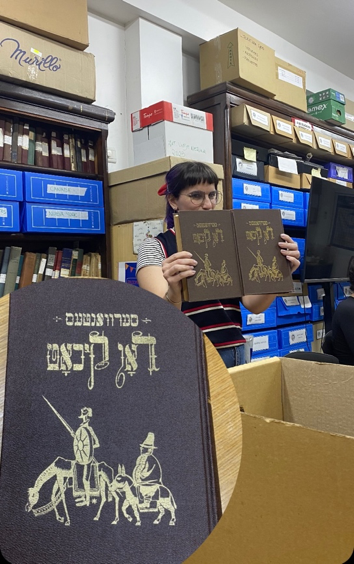
Visiting the ICUF archives the following day truly rounded up the feeling. The work of Nerina Visacovsky and team at the “Centro Documental y Biblioteca Pinie Katz” is fantastic -and revolutionary. We sat around the table and learned about the rich history of ICUF as the most astounding archive pieces circulated. Among the books translated into Yiddish that we got to see, Don Quijote (or rather דאָנ אַויײאָטע) which is currently being re-translated into English by one of the School of the Arts faculty members, Kimi Traube (https://magazine.columbia.edu/article/peculiar-perils-literary-translation.) I dreamed of a play adaption in Yiddish being staged right where we had been standing a day prior, at the teatro IFT. We took turns in using a Yiddish keyboarded writing machine (https://www.instagram.com/p/CuIGXZ4rni1/.) and looked at interwar fashion sketches annotated in Yiddish by their designers.
A few days earlier, we had another interactive and truly embodied archives experience, when visiting the IWO archives. There, archivist Silvia Hansman welcomed us and showed us to a table on which she had selected a few objects. Among them, long linen scrolls named “ווימפל” (wimpels) embroidered by hand, used as baby blankets for their bris milah. We learned that the blanket, or banner, could later be repurposed into a torah binder, thus connecting one’s own life to communal, Jewish life. Seeing old ritualistic objects as well as daily life objects really moved me. I always learn the most when I am able to come in physical contact with what I am learning, and visiting the archives gave me the opportunity to do so.
The last archives we visited was AMIA, a much bigger, known institution in Buenos Aires, sadly famous for the 1994 bombing that was devastating. 85 people were killed and 300 were wounded. Despite the grief and the loss of a consequent amount of resources, including the archives catalogue, we visited a really energetic, inspiring institution. We opened registers and looked for the names of the people whose tombs we had photographed the day before, in Jewish cemetery. We learned a little bit more about their lives -when and where there were born, what had taken their lives. It felt good to remember them and honor their memories in this small way.
