
June 7th was a busy day for the Naomi fellows. Not only did we have the honor to meet with US ambassador Mark Stanley (see this wonderful article written by fellow Naomi scholar Jacob (Yacha) Giner : Ghttps://forward.com/yiddish/550801/my-fellow-students-and-i-go-to-buenos-aires-to-research-its-rich-yiddish-history/?amp=1) but we somehow also found the time for an extensive and enriching visit of the Jewish neighborhood of Once, where Yiddish life was so rich specifically during the interwar (https://www.yiddishbookcenter.org/collections/oral-histories/excerpts/woh-ex-0002341/growing-once-jewish-neighborhood-buenos-aires.) Strolling the streets with the insightful Prof. Susana Skura and Rabbi Ernesto Yattah, we made our way to the old Jewish-communist Yiddish theater, the Yidisher folks-teater, better known as Teatro IFT. Since the theater does no longer host or stage Yiddish plays and seems to be only rarely in use these days, we were only hoping to take a peek at the building. But at the door, we ran into the current director of the theater, who kindly invited us in and gave us a grand tour. He let us use the stage for a feel of what it could have been like to be an Yiddish actor/actress in Argentina in the interwar ; he showed us to a backyard where a giant sculpted mural à la Galeria Pacifico (but make it sculpted!) was waiting for us to strike a pose. I loved being physically where Yiddish popular culture, activism and the arts used to intersect, to be thrown back to a time where secular Yiddish speaking community was thriving. Though the theater had a bit of a fall off and stopped staging plays in Yiddish in the 1950s (https://web.uwm.edu/yiddish-stage/rosa-rapoport-and-der-yidisher-folks-teater-in-buenos-aires) you could easily imagine a once lively crowd gathered there and feel the vibrancy of such a space.
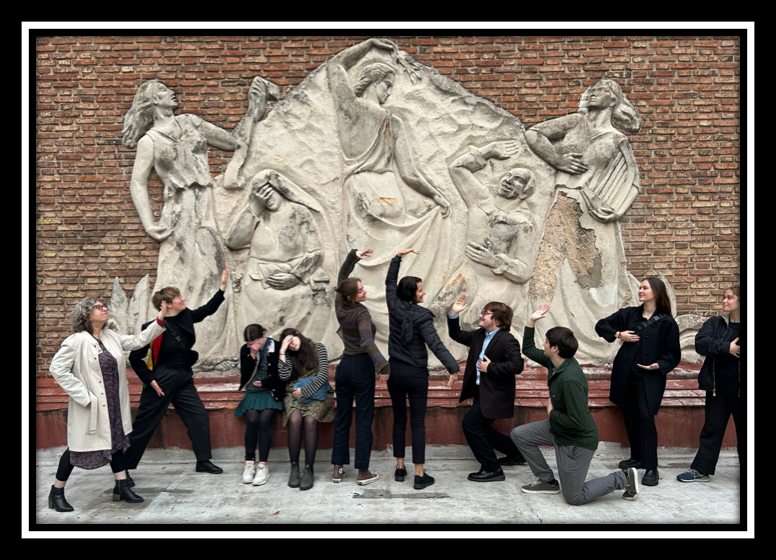
“[…] theatres and halls offered a space not only for the staging of works, but also for a particular type of non-religious community meeting. It constituted a social and symbolic field that accompanied and partly sheltered the processes of social, economic, cultural transformation and linguistic acquisition of the immigrants as they were blending their Eastern European roots with the customs of the new home.” -Skura, Susana. “Yiddish Theatre in Buenos Aires Between the Two World Wars.” Digital Yiddish Theatre Project, April 2019, https://web.uwm.edu/yiddish-stage/yiddish-theatre-in-buenos-aires-between-the-two-world-wars
