
I am majoring in Environmental Science at Barnard College.
At the Yiddish summer program I attended, some people were surprised that I was studying science. “How does Yiddish connect to environmental science?” they’d ask. I’d always shrug and say that they were separate parts of my life and didn’t need to be connected. But maybe they do intersect more than I was aware…
One day in class, we were learning vocabulary for describing the weather. Our teacher asked us a question: “What will the weather be like in 50 years?” Someone raised their hand and asked, “How do you say ‘climate change’ in Yiddish?” This started my wondering about Yiddish and the environment. The more I pondered, the more I saw the connections all around me.
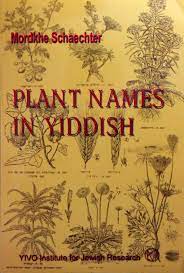
In a lecture I attended, Professor Justin Cammy discussed “what we need” in Yiddish literature. He highlighted specialized Yiddish dictionaries that have filled gaps in written literature, including Mordkhe Schaechter’s “Plant Names in Yiddish: A Handbook of Botanical Terminology.” This dictionary, along with others like it, challenges stereotypes about Yiddish, such as the belief that it lacks botanical terms. The many years and pages spent cataloging Yiddish plant names emphasize the fact that Yiddish is a complete, lived language with a rich vocabulary, including words for the botanical world.
These ideas made me think about Yiddish and environmentalism. As I researched using Verterbukh, I learned that Yiddish has many terms to describe the world around us. It has words for carbon dioxide, the solar system, and endangered animals. It has ways to talk about climate change, wind turbines, and tree rings. I couldn’t believe that I had fallen into the trap of thinking of Yiddish as disconnected.
I challenged myself to discover more about Yiddish words for the environment. While I sat on the beach watching the sunset, I wondered how Yiddish refers to the times of day we call dusk, sunset, twilight, and nightfall. I found a guide written in Yiddish by Phillip Krantz in 1918 called “Heaven and Earth: Astronomy for the People.” Later, while I read my book about bats with white-nose syndrome, I wondered what words I could use to describe invasive species and fungi.
I kept on finding connections even after I returned home. My friend had purchased a book called “Ashkenazi Herbalism” by Adam Siegel and Deatra Cohen. This book describes the ways that plants and herbs were used in Eastern Europe by Jews from the eighteenth to the early twentieth century. Similar to Phillip Krantz, who wrote the astronomy book, the authors give names in Latin, Hebrew, and Yiddish, along with several other languages when applicable. A few days later, my sister requested I tell her the names of her two favorite plants, hemlock and cedar, in Yiddish.
I’m aware that I am not the first person to study science and Yiddish. I’m not the first person to discover these Yiddish words. But I appreciate the way that asking these questions and learning these words has challenged me and my understanding. I have only just begun to delve into the world of Yiddish and the environment, and I am sure there are many more books, ideas, poems, and words to discover. My time at the program has already given me a new perspective. I no longer feel the need to separate science and Yiddish, as they intersect in both familiar and mysterious ways.
