

By Madeline Belloff
The Second Avenue Deli – not just a Jewish – but also a New York City staple, has a long and rich history. From the sky high stacked pastrami sandwiches to the appetizing corner, and of course, the noshes, the Second Avenue Deli is the premier Jewish Delicatessen.
As a beacon of the American dream, the Second Avenue Deli represents perseverance, and is rooted in deep immigrant traditions, as well as a love for charity and a devotion to food. ‘Uncle’ Abe Lebewohl’s legacy is celebrated by the Second Avenue Deli’s many regular customers, and its two successful storefronts on the East Side of Manhattan.

Abe, growing up in Poland, suffered much tragedy in his childhood. Having survived the Holocaust, pressured to flee to the new Palestine, and ultimately living in a UN-run displaced person’s camp, Abe and his family finally found reprieve in 1950. In 1950, the Hebrew Immigrant Aid Society found the Lebewohl’s housing on Lafayette Street in the Lower East Side of Manhattan.1 Becoming an American at age 19, Abe quickly learned English and went to work, embracing his new American culture, and thirsty with the promise of a better life.2 Abe worked in a Coney Island deli as a soda jerk but his tenacity quickly entitled him to a promotion: counterman. Abe worked in many deli kitchens, studying the art of traditional Jewish food, and learning the secret to the perfect pastrami.3
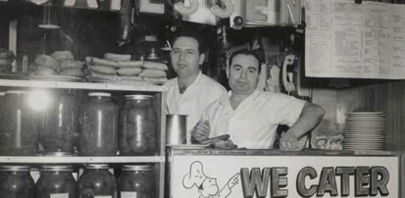
Scraping together the earnings from his many deli jobs, Abe took over a small 10-seat restaurant on East 10th Street in 1954 – it was here that the Second Avenue Deli was born.4 Abe ran the entire establishment often playing the roles of cook, counterman, waiter and busser. And in the face of bankruptcy and economic failure, Abe took on more odd jobs and his drive guaranteed the success of the Second Avenue Deli.5 All customers in Abe’s deli were treated like family, his benevolent spirit was contagious, and his passion was palpable. However, in 1996, the Lebewohls suffered heartbreak when Abe was tragically murdered in a bank robbery during his morning deposit run. The Second Avenue Deli, celebrating its 42nd year, lost the mastermind behind its corned beef sandwiches and hot pastrami platters. The 1996 New York Times article, describes the Second Avenue Deli as a New York institution – a 12-seat diner that had grown into a 250-seat restaurant – attracting New Yorkers from all walks of life, and preserving the Yiddish tradition that had faded in the Lower East Side neighborhood.6 The Second Avenue Deli was a hot spot for celebrities like, Muhammad Ali, Joan Rivers and Joe DiMaggio. The article talks about how Abe’s death affected not just his family and employees, but affected New Yorkers citywide:
“He was one of us, part of the neighborhood’s history, one of the last old-timers. Why did they have to go after such a hard-working man?”
– Anna Noblet, 64, community member7
Other Lower East Siders felt Ms. Noblet’s pain, an employee in the article described Abe’s benevolence:
“When my baby was born premature and we couldn’t pay the hospital bills, he gave me $1,000. And when I was going through hell with my divorce, he paid for a counselor. And he never asked for the money back.”
-Chai Ruji, employee of 25 years.8
Despite Abe’s untimely death, the Deli remained open until January 2006 when it closed due to a landlord dispute. New Yorkers everywhere mourned the loss of the Second Avenue Deli. Abe’s nephews, Josh and Jeremy, inspired by their Uncle’s dedication, vowed to keep his tradition alive. Having spent the majority of their youth working in their Uncle’s restaurant, the nephews reopened the Second Avenue Deli in a new location. Its new location on 162 East 33rd Street received so much wild success that the nephews opened a second location at 1442 First Avenue.9 Though no longer located on the classic 2nd Avenue, the Second Avenue Deli embraces Abe’s legacy, and serves authentic Jewish delicacies to new and old customers alike.10
Though sometimes compared to Katz’s Deli, located on the Lower East Side of New York, the Second Avenue Deli remains the leading kosher Jewish Delicatessen.
Figure 3
When entering the classic favorite, customers can indulge in matzoh ball soup that can definitely compete with Bubby’s old recipe.
Figure 4
Customers can also try knishes, lox platters, sable, homemade challah bread, kasha, and the Second Avenue Deli of course would not be complete without an assortment of pickled cucumbers, tomatoes, and fishes. Home of authentic, kosher, Jewish specialties, the Second Avenue Deli, indigenous to the Lower East Side, has now moved a little up the block, and is able to spread Jewish traditions throughout Midtown, the Upper East Side, and all across Manhattan.

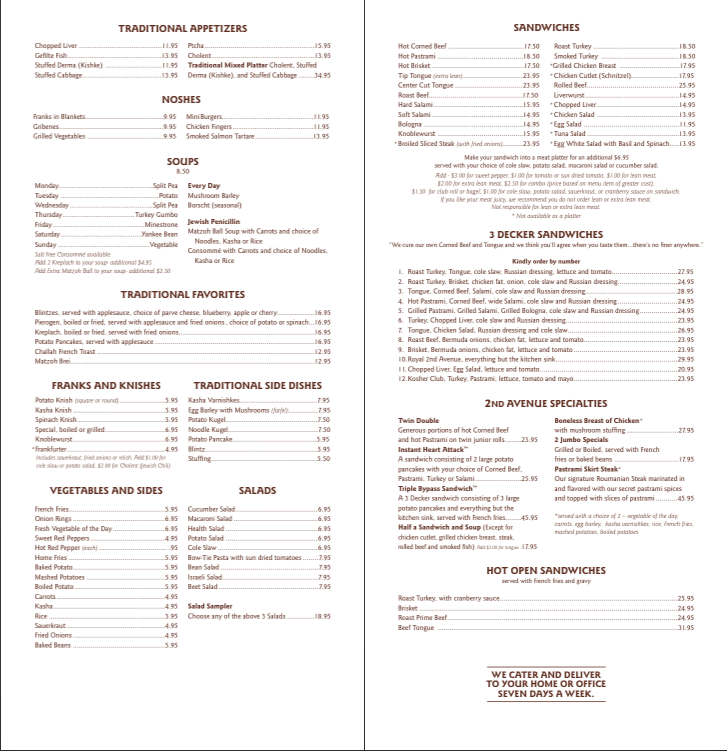
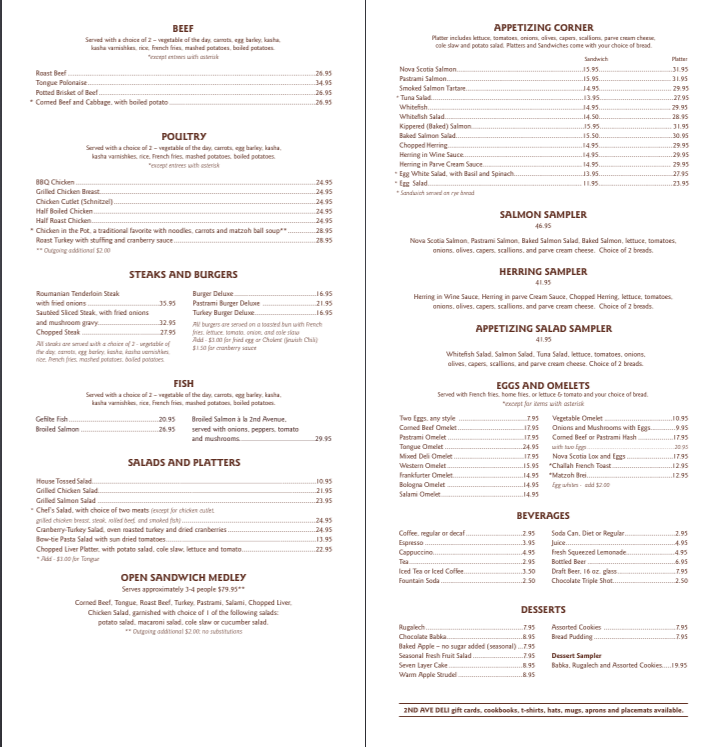
Image Sources
Figure 1. http://www.2ndavedeli.com/. Accessed December 16, 2014.
Figure 2. http://www.2ndavedeli.com/about/deli-history/. Accessed December 16, 2014.
Figure 3. https://www.youtube.com/watch?v=pqabB7gN5vs. Accessed December 16, 2014.
Figure 4. Created by Madeline Belloff with photos from the Second Avenue Deli, https://www.youtube.com/watch?v=Mc_rLHDOML8. Accessed December 16, 2014.
Figure 5. http://www.2ndavedeli.com/deli-menus/dine-in/. Accessed December 16, 2014.
Figure 6. http://www.2ndavedeli.com/deli-menus/dine-in/. Accessed December 16, 2014.
Figure 7. http://www.2ndavedeli.com/deli-menus/dine-in/. Accessed December 16, 2014.
Works Cited
“2nd Ave Deli – An Authentic Jewish Culinary Experience.” 2nd Ave Deli. Accessed July 16, 2021.
“Owner of Second Avenue Deli Is Shot and Killed in Robbery.” The New York Times, 5 Mar. 1996. Accessed July 16, 2021.
Footnotes
- “2nd Ave Deli – An Authentic Jewish Culinary Experience.” 2nd Ave Deli. Accessed July 16, 2021.
- Ibid.
- Ibid.
- Ibid.
- Ibid.
- Swarns, Rachel L. “Owner of Second Avenue Deli Is Shot and Killed in Robbery.” The New York Times, 5 Mar. 1996. Accessed July 16, 2021.
- Ibid.
- Ibid.
- “2nd Ave Deli – An Authentic Jewish Culinary Experience.” 2nd Ave Deli, Accessed July 16, 2021.
- Ibid.
