
By Luan Thieu To
The Yiddish Theater District was the center of New York City’s Yiddish life in the early 20th century. Located in the Lower East Side of Manhattan, the District was within the neighborhood of Jewish immigrants. The District was home of many plays, operas, shows and comedies. Lincoln Steffens, a renowned New York reporter in the early 20th century, even thought that the Yiddish theatre was livelier and more interesting than Broadway not only because of what was going on the stage but also the quality and passion of the audience responses.1
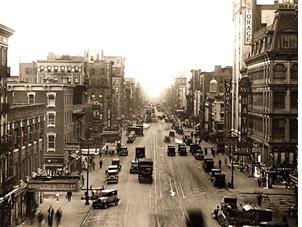
Among the conglomerate of theaters in the District, the People’s Theatre, which was located at 201 Bowery Street, stood out because of its distinctive history of being owned by many praised actors throughout time. 201 Bowery Street was originally occupied by the Hoym Theatre which was named after its founder Otto von Hoym, the co-owner of the Stadttheater. Hoym was also a well respected German actor who dominated the American stage in the late 19th and early 20th century.2
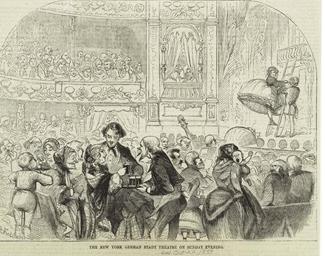
Tony Pastor, one of the fathers of the famous American vaudeville, purchased the theater in 1865 and renamed it to “Tony Pastor’s Opera House.” Tony Pastor performed in this theatre until 1875 when he decided to move his company uptown.3

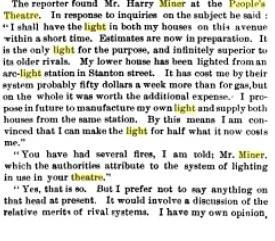
In 1883, Henry Clay Miner, a wealthy theatrical impresario and U.S. Representative purchased the lot and built a 2,500-seat theatre. The new theatre took its final name as the “People’s Theatre.” In the next decade, the People’s Theatre continued housing minstrels, sideshows, and more serious theatrical works such as Tom Sawyer. During this period, the People’s Theatre also became the first playhouse in New York to replace gas with electric light.4
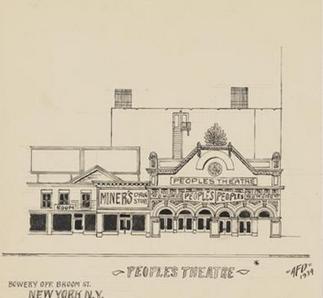
In 1899, Jacob Adler and Boris Thomashefsky took over the People’s Theatre.5 For the very first time, the People’s Theatre became a full Yiddish playhouse. Also during this period, the People’s Theatre truly experienced its golden time.
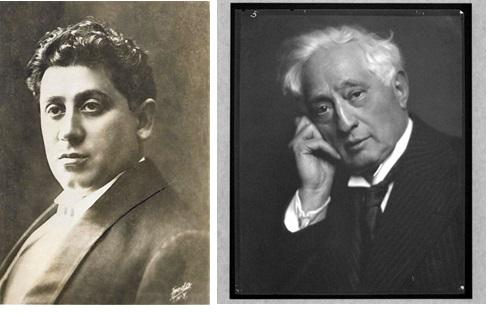
Jacob Adler and Boris Thomashefsky were two of the most important stars of the Yiddish theater. They, together with other Yiddish actors and actresses, “published their own magazine, The Yiddish Stage, wrote columns in the popular Yiddish newspapers of the day, sponsored and encouraged new generations of young artists, brought uncountable numbers of Yiddish artists to the United States, tirelessly raised funds for progressive social causes and, through it all, were adventurous trend setters.”6 Tilson Thomas, Thomashefsky’s grandson, called his grandparents mega-stars, who “found themselves smack in the public eye. They were subject to adulation and relentless scrutiny. Legions of crazed fans were obsessed with every detail of their work and their lives.”7
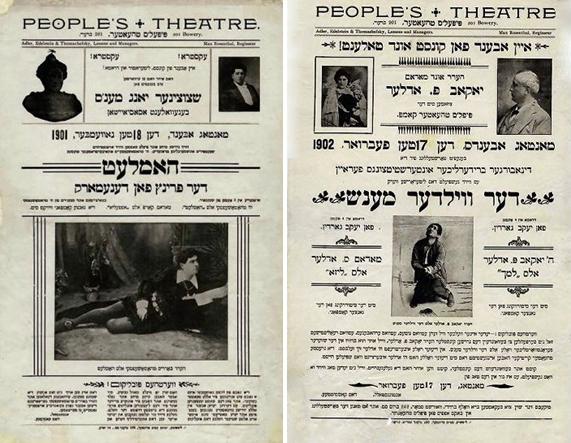
During this period the People’s Theatre also witnessed one the most important turning points in Adler’s career. In 1904, Jacob Adler staged a play by Leo Tolstoy, The Power of Darkness. The play was translated into Yiddish by Adler himself.8 The production was one of the greatest ambitions that few actors during this time would dare to try to stage because of the grand and laborious work involved. Moreover, this production was also considered to be the first successful production of a Tolstoy play in the United States.9
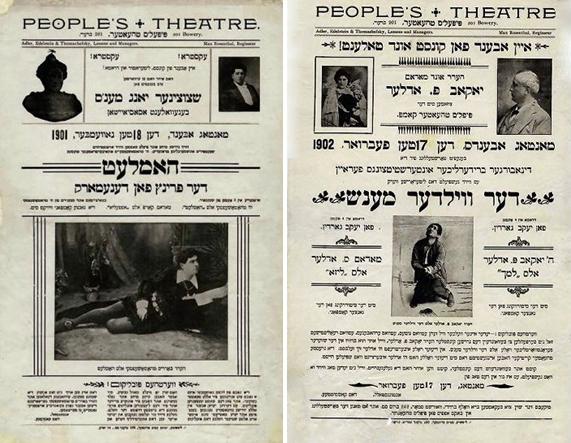
Few other important plays which were written or translated into Yiddish were also staged in the People’s Theater during this period. For instance, the Theater hosted William Shakespeare’s Hamlet. Or in 1902, the Theater staged a play named Der vilder mensh or The Wild Man by Jacob Gordin.
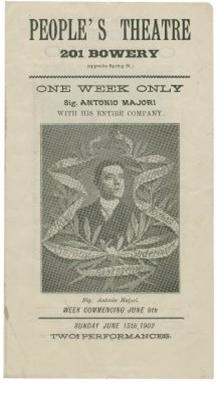
During the turn of the century, the People’s Theatre not only offered Yiddish plays but also hosted Italian theatrical works. For instance, in the early 1900s, Adler and Thomashefsky leased the space to Antorio Majori, an actor from the Italian theatre.10 The lease might have been motivated by both economic and theatrical reasons.
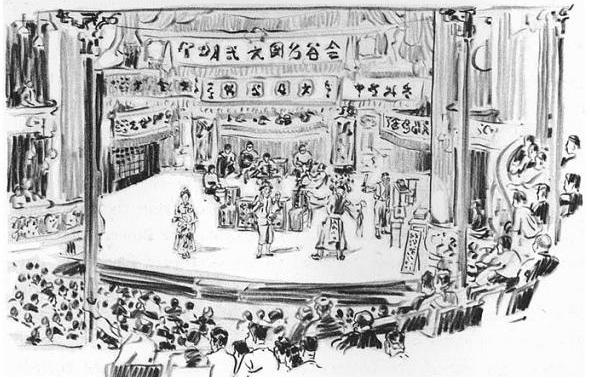
The People’s Theater lasted well into the late 1920s and was slowly transformed into a Chinese playhouse in the 1930s.
Nowadays, the People’s Theater no longer exists. The land is now occupied by a residential building.
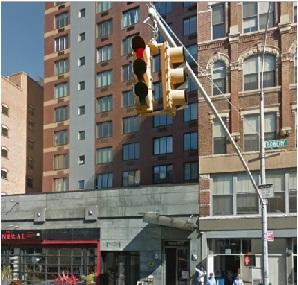
Image Sources
Figure 1. http://cinematreasures.org/theaters/13582. Accessed December 17, 2014.
Figure 2. http://digitalgallery.nypl.org/nypldigital. Accessed December 17, 2014.
Figure 3. http://xroads.virginia.edu/~ma04/wood/ykid/theater.htm; http://www.ashlandelks.org/html/history/corks/folks/tony_pastor.html. Accessed December 17, 2014.
Figure 4. http://collections.mcny.org/Collection/Peoples-Theatre-and-City-Theatre-2F3XC5XUT3Q.html. Accessed December 17, 2014.
Figure 5. https://books.google.com/books?id=icQhAQAAMAAJ&pg=RA1-PA148&lpg=RA1PA148&dq=Miner+people%27s+theatre+first+electric+light&source=bl&ots=Vpsb2DLyKL&sig=t9PIdDpK2MW0qlC6xaZkFCYNVXs&hl=en&sa=X&ei=9_WPVOqFCYjCsASrl4HwBw&ved=0CCoQ6AEwAg#v=onepage&q=Miner%20people’s%20theatre%20first%20electric%20light&f=false. Accessed December 17, 2014.
Figure 6. http://www.museumoffamilyhistory.com/jqp-wheatley.htm; http://eastlondonhistory.com/2012/09/03/jacob-adler-from-odessa-to-whitechapel-to-new-york/. Accessed December 17, 2014.
Figure 7. http://www.museumoffamilyhistory.com/yt-placard-peoples-03.htm. Accessed December 17, 2014.
Figure 8. http://luna.folger.edu/luna/servlet/detail/FOLGERCM1~6~6~370 653~ 131680:People%E2%80%99s-Theatre,-201-Bowery,-appos. Accessed December 17, 2014.
Figure 9. http://books.google.com/booksid=Vzv2DrzAL7UC&pg=PA94&lpg= PA94&dq=People%E2%80%99s+Theatre,+201+Bowery+yiddish&source=bl&ots=zEPZXFaefV&sig=1GIbfLxPPGnca9O32xKhYi31FI&hl=en&sa=X&ei=SJGVLTGAsuWNuq4gOAN&ved=0CEEQ6AEwCQ#v=onepage&q=People%E2%80%99s%20Theatre%2C%20201%20Bowery%20yiddish&f=false. Accessed December 17, 2014.
Figure 10. https://www.google.com/maps/@40.7210233,-73.9937017,3a,90y ,94.68h,91.73t/data=!3m4!1e1!3m2!1sTv_SfW0qNrkMEecGeGW6UQ!2e0!6m1!1e1. Accessed December 17, 2014.
Works Cited
Adler, Jacob. 1999. A Life on the Stage: A Memoir. Translated by Lulla Rosenfeld. New York: Knopf.
Ferrara, Eric. The Bowery: A History of Grit, Graft and Grandeur. Charleston, SC: History, 2011.
Koegel, John. Music in German Immigrant Theater: New York City, 1840-1940. Rochester, NY: U of Rochester, 2009.
Sanders, Ronald. The Lower East Side Jews: An Immigrant Generation. Mineola, NY: Dover Publications, 1999.
“The Thomashefskys Official Website – The Story.” The Thomashefskys Official Website – The Story. Accessed July 16, 2021.
Footnotes
- Sanders, Ronald. The Lower East Side Jews: An Immigrant Generation. Mineola, NY: Dover Publications, 1999.
- Koegel, John. Music in German Immigrant Theater: New York City, 1840-1940. Rochester, NY: U of Rochester, 2009.
- Sanders.
- Ferrara, Eric. The Bowery: A History of Grit, Graft and Grandeur. Charleston, SC: History, 2011.
- Ibid.
- “The Thomashefskys Official Website – The Story.” The Thomashefskys Official Website – The Story. Accessed July 16, 2021.
- Ibid.
- Adler, Jacob. 1999. A Life on the Stage: A Memoir. Translated by Lulla Rosenfeld. New York: Knopf.
- Ibid.
- Ferrara.
