
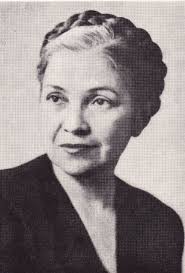
Roshelle Weprinksy was born in 1895 to an impoverished family in the small town of Ivankov, in modern day Ukraine. (Fogel) There she attended a religious elementary school and later attended a Russian Jewish school in Kiev. Around the age of 12, after her father’s death, she immigrated with her mother and her siblings to New York. At the age of 13 she began working in sweatshops where she was influenced by other “sweatshop poets” and at the age of 15 she started writing poetry and short stories. (Glinter)
Weprinksy had her poetry published for the first time in 1918, at the age of 23, in Di Naye Velt, a popular American Yiddish publication. She was then published in many other Yiddish publications including Shriftn, Fraye Arbeter Sthime, Dos Naye Lebn, Inzikh, Tsukunf, Frayhayt and Forverts and even published a few of her own books. (Fogel) Although Weprinksy’s publications include an autobiographical novel, there is not much accessible information about her life. However, a lot can be discerned about her experiences through her available writings.
Weprinksy’s experience working in sweatshops had a large impact on her life as she later became involved in the Trade Union Movement and became an executive of the International Ladies Garment Worker’s Union. (Fogel) In 1939, she published a short story titled “Annie”, in which she describes the life of a woman who never felt at home among the women working in the sweatshop. Describing her unease with the scene in the sweatshop, Weprinsky says, “And even later, when Annie had already grown accustomed to the peculiar din and noticed the other women around her, the sight of whom actually brought her a bit of comfort, she was still not able to form an intimacy with the shop.” (Glinter) Her mind was always at home with her family. The author describes the noises surrounded Annie in the sweatshop as “a foreign sound”. (Glinter)
When you juxtapose “Annie” with another short story of Weprinksy, By a Far Shore, it is clear to see how it wasn’t the only sweatshop which Weprinksy is describing to be a foreign land, but rather the New World as a whole. In this story, one character says to another “…wherever a person is used to living, that’s where she likes it” (Glinter). In her poem, “Snowflakes”, translated by Barnett Zumoff, Weprinsky describes the fleeting quality of her words. (Zumoff) This can be likened to the transience she must have felt as an immigrant, never truly having a place in the New World. It is clear from these stories, as well as other of the poet’s writings, that Weprinksy never felt at ease with the life of an immigrant in America and preferred to be surrounded by her companions from the Old World (Glinter).
Snowflakes
(translated by Barnett Zumoff)
First snowflakes fall upon my panes
as if that were their destined place.
I want to seek and find the words,
to hide them in my song.
What will become of hard-sought words,
with difficulty found at last?
Will they later melt just like
the snowflakes on my window-panes?
Perhaps emplaced within my song
a few bright words I’ve found will live,
not melt like snowflakes on my panes.
Perhaps my song’s their destined place.
(Zumoff)
In 1958, about 10 years after the Holocaust tore European Jewry apart, Weprinksy visited Israel. (Fogel) There is also a poem of hers, “My God”, which describes praying to God from a mountaintop in Tzfat – probably written during this visit. In this poem Weprinsky calls out to God, making a point to do so in Yiddish – the language of her brethren from the Old World. (Zumoff) She stresses the crucial importance of this language and its binding agency for the Jews from the ghetto. This was the language of Weprinksy’s home. And even after Europe began dangerous for the Jews, forcing many to immigrate to places like America, Weprinksy held onto Yiddish. Perhaps one of the reasons she felt such difficulty accommodating to the New World was due to her attachment to the Old one.
My God
(translated by Barnett Zumoff)
I clamber up the mountains of Tsfat–
somewhere there, I think, lives God.
I call Him with my Yiddish words,
and He answers me in Yiddish–and why not?
With His Jews there in the ghetto,
He sanctified the Yiddish word–
in bunkers He sang Yiddish lore.
Its life then hung upon a hair,
but He brought the remnants out of the camps.
There will be a people, so there must be a God.
I clamber up the mountains of Tsvad–
Somewhere there, I think, lives God.
I call Him with my Yiddish words,
and He answers me–in Yiddish.
And why not?
(Zumoff)
While centered around themes of language, belonging, home, and her Jewish values; Weprinky’s writing is characterized with a female voice and often expressing sexual themes. (Zumoff) However, more noticeable in her writing seems to be her feminine identity. In “Annie”, the protagonist of the stories often thought of her husband and described the shame he must have felt that his wife was earning the wages to support the family while he remained unemployed. (Glinter) This begins to show Weprinsky’s views of a woman’s role in the world which can later be seen in her poem “Frum”. This poem describes the importance and significance Weprinsky feels in her mother’s lighting of the shabbat candles, what has often been considered to be a women’s tradition in Judaism. She describes learning her mother’s pious ways of connecting to God through this feminine ritual. (Zucker) As seen through these writings, Weprinsky seems to highly value a woman’s role family, society, and religion. She believes it to be crucial, however slightly different from a man’s.
PIOUSLY
(translated by Sheva Zuker)
Piously my mother blessed her candles,
I – light the wicks of songs –
Eyelashes covered, fingers grow luminous,
Lips once again trembling in awe.
For joy and for sorrow,
For aging wit.
God, put the word of your mouth
Into mine.
The word not yet bloomed,
That sleeps in the stone, in the dust down below,
Wake it up, let it blossom forth anew
As if in the flowerbed,
In the line-harvest of my poems.
And the pain and the woe, and the grief of the world,
I put before you, in your presence –
Piously as my mother the waxen wicks,
I light my candles of song.
Di Palitre, 1964
(Zucker)
Another thing that is known about Weprinksy which might help us understand her thoughts on gender and gender roles is her relationship to the famous poet Mani Leyb. From the 1920s until his death in 1953, Weprinsky lived with Leyb as his companion and possibly his wife. After his death, she published a compilation of his poems and letters with her own letter of introduction. (Fogel) Leyb’s works are far more popular and well known than Weprinksy’s are and it is questionable whether this occurrence was dictated by chance, by the society in which the poets lived, or by Weprinsky’s own choice. Did Weprinksy perhaps think that her role was more spiritual while her male partner’s role was more substantial and physical? And did she put more effort into publicizing his works than her own?
[1] Glinter, Ezra, and Dara Horn. “Section One: Immigration and Its Discontents” Have I Got a Story for You: More than a Century of Fiction from the Forward, W.W. Norton & Company, 2017. np
[2] Fogel, Joshua. “Yiddish Leksikon.” RASHEL VEPRINSKI (ROSHELLE WEPRINSKY), 1 Jan. 1970, yleksikon.blogspot.com/2016/06/rashel-veprinski-roshelle-weprinsky.html.
[3] Zucker, Sheva. “Candles of Song.” Jewish Currents, 1 Mar. 2012, jewishcurrents.org/sheva-zucker-candles-of-song/.
[4]ZUMOFF, BARNETT. “Rashel Veprinski.” YIDDISH LITERATURE IN AMERICA 1870-2000: Volume 1, XLIBRIS, 2016. np

Thank you so much for this wonderful project.
Bless you!