
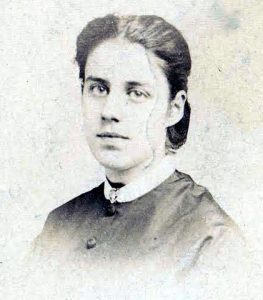
For decades, the Statue of Liberty has welcomed immigrants and visitors into America as a symbol of hope, taking form in a torch-holding woman and the inspiring plaque beneath her. Here, Emma Lazarus’ “The New Colossus” is printed, rife with themes of freedom, liberty, and acceptance- causes Lazarus herself struggled with as both a Jew and a woman 1. While “The New Colossus” is Lazarus’ most famous work 2, and so widely appreciated one might assume the existence of gender equality in the 20th-century, the poetess was condescended in the literary sphere for both her gender and religious identity 3. As Lazarus comes to ascendancy, however, her works begin to feature a more pessimistic view toward her gender role, which can be seen through the evolution of the woman’s poetry.
Born into a high-brow Sephardic Jewish family in 1849, Lazarus began her life in New York 4, an urban upbringing which influenced her work. Saturated with the idea of the American dream, Lazarus’s poem, “The New Colossus”, invites any man or woman into the Land of Opportunity. Most famously, Lazarus writes “Give me your tired, your poor,” 5 a message which reflects the ideas of her “melting-pot” home-city. While her earlier works are less popular, the poet began writing decades before, as the woman used her classical education to write poetry in proliferation 6. Lazarus’ father began publishing her poems when she was only seventeen, and literary success followed the poetess not long after 7. Following the publication of her second anthology and a full novel in the 1870’s, Lazarus began to move in elite literary circles and write for popular magazines like The Century 8. Despite the poet’s obvious privilege, Lazarus, like Jewish women from all woks of life, felt discriminated against for both her religious and gender-related identities. The poet’s struggle can be seen more conspicuously in her varying works, as her growing Jewish pride eventually influences her poetic content 9.
From the beginning of Lazarus’ literary career, her connection to Judaism is made apparent. As early as 1867, Lazarus contemplates the immortality of Jewish tradition in her poem, In the Jewish Synagogue at Newport 10. Standing in the oldest US synagogue, Lazarus marvels at the “relic of the days of old,” 11, an image which encompasses Lazarus’ early works, as she is preabsorbed by the rich Jewish past 12. However, after Russian pogroms worsen in the 1880’s, Lazarus begins to focus her lens on the Jewish present, rallying against the current disaster. In Epistle to the Hebrews, Lazarus encourages worldwide Jewish solidarity amidst Russian pogroms, explaining that “Until we are all free, we are none of us free.” 13. The woman travelled to Europe many times in order to advocate for the Jewish population and ultimately, for a Jewish homeland 14.
While Lazarus’ involvement in Jewish causes greatly influenced her work, the woman’s gender identity exhibited similar effects on her poetry. Earlier in her career, in 1883, Lazarus’ “The New Colossus” portrays a strong female ideal, explaining that unlike the macho Colossus of the Greeks, America is represented by “a mighty woman with a torch” 15. This “mother of exiles” reflects Lazarus’ female pride, as the Statue of Liberty is described as a kind yet awe-inspiring figure. Although, as Lazarus’ career continues, she is constantly minimized by the men around her 16. For example, in Dr. Gottheil’s Eulogy at Temple Emanu-El in 1887, Gottheil states Lazarus “spoke like a man, but felt like a true woman” 17. Evidently, even Lazarus’ contributions to the Jewish community were “gendered” by those within it, as she was condescended for her “womanly” feelings even amidst her written contributions.
This condescension ultimately affects Lazarus’ gender identity as a few years later, the poet portrays womanhood through a more pessimistic lens. In her 1889 poem “Echoes”, Lazarus’ discards the Statue’s optimism in the first line, declaring “Late-born and woman-souled I dare not hope” 18. More notably, the “might” of “The New Colossus” fades away, as Lazarus doubts that “the might, Of manly, modern passion shall alight” in her female self. After a few short years, Lazarus reserves the word “might” for men alone, explaining that she is “veiled and screened by womanhood”. Clearly, Lazarus struggles with the gender bias around her and feels concealed by her womanhood, not liberated 19.
As the complexities of Lazarus’ identity are considered, the variance of her work can be looked at through several lenses: that of the poet’s urban upbringing, gender, and Jewish connection. Lazarus’ New York background enriches “The New Colossus”, as the poem is truly a “welcome mat” into the poet’s own home; her long-standing connection to her people further clarifies her advocacy for Jews worldwide. Most notably, Lazarus’ gendered lens greatly influences her work, as she becomes more cynical about her “veiled” gender role and expresses this negativity in poems like ‘Sympathy’ and ‘Echoes’. As the poet is forgotten amongst lionized male authors, one must wonder what becomes of her most famous words: has American welcomed the “the mighty woman” Lazarus described long ago?
Works Cited
Jewish Women’s Archive. “Emma Lazarus.” N.D,
https://jwa.org/womenofvalor/lazarus
Lazarus, Emma. “Echoes”, Academy of American Poets, N.D, https://www.poets.org/poetsorg/poem/echoes-0
Lazarus, Emma. “Epistle to the Hebrews”, Jewish Women’s Archive, N.D, 2017,
https://jwa.org/media/quote-from-epistle-to-hebrews
Lazarus, Emma. “In the Jewish Synagogue at Newport.” The Poetry Foundation,
N.D.
https://www.poetryfoundation.org/poems/45637/in-the-jewish-synagogue-at-newport
Lazarus, Emma. “The New Colossus.”, Emma Lazarus: Selected Poems and Other
Writings, Broadview Press, 2002.
Rabbi G. Gottheil, “Dr. Gottheil’s Eulogy at Temple Emanu-El,” American Hebrew 33
(Dec. 9, 1887): 78.
Spacey, Andrew. “Summary and Analysis of the Poem ‘The New Colossus’ by Emma
Lazarus.” Letterpile, 7 Dec. 2016,
https://letterpile.com/poetry/Summary-and-Analysis-of-Poem-The-New-
Other interesting sources:
Below is a link to the reading of the New Colossus:
Esther Schor’s exquisite speech about Emma Lazarus’ identity as a Jewish-American writer is posted below:
Schor’s own reading of the poem has been placed below:
- Jewish Women’s Archive
- The Poetry Foundation
- The Jewish Women’s Archive
- The Jewish Women’s Archive
- Emma Lazarus, “The New Colossus”
- The Jewish Women’s Archive
- The Jewish Women’s Archive
- The Jewish Women’s Archive
- Jewish Women’s Archive
- The Jewish Women’s Archive
- Emma Lazarus
- The Jewish Women’s Archive
- Emma Lazarus
- The Jewish Women’s Archive
- Emma Lazarus
- The Jewish Women’s Archive
- Rabbi Gottheil
- Emma Lazarus
- The Jewish Women’s Archive
