
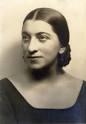
Malka Lee, born Malka Leopold, was an american Jewish Yiddish poet. Born in 1904 in a Galician shtetl, Lee left home at the early age of 16 she left home and traveled alone to america, where she attended Hunter College and the Jewish Teachers Seminary. She wrote poetry and stories about her experience as an immigrant and about her life in the Old and New Worlds. One of the most influential female Yiddish poets in America in her lifetime, she won the Hayim Greenberg Award of Pioneer Women of America in 1965 (Swartz).
Lee’s writing illustrates a lot about her immigrant experience, both about her journey to America as a young woman and about her adult life. Much of her writing, while about different time period and countries, centers around themes of gender. There are two seemingly conflicting gender themes within her writing. One theme is of the men holding power over the women, a dynamic only magnified by her status as a woman traveling alone to a new country. The second theme is of women fighting for more ambitious futures and for opportunities rarely given to women.
In most immigrant stories, authority figures take advantage of immigrants. Sometimes this takes the form of financial exploitation, sometimes of political threats. In Lee’s story, the usual power dynamic between authority figures and immigrants is only magnified by the fact that she is a woman. In her story “Through the Eyes of Childhood”, the watchman on the boat threatens her just because he can. He takes her book of poems and threatens to turn her in for her “revolutionary secrets” in her writing, and seems to relish the fear in her eyes because can prevent her safe arrival in America. Similarly, the watchman takes advantage of the polish mother and daughter next to the narrator on the boat because he can do whatever he wants because he has power over their safe passage (Lee, “Through the Eyes of Childhood”).
Throughout her writings, Lee describes the power dynamic between men and women. As a female immigrant traveling by herself, she is often at the mercy of the men she meets. Sometimes she experiences this as threatening, and she worries about whether these men will hurt her. Other times, she experiences their interactions as positive, but the power dynamics continue to be glaringly present.
As a female immigrant traveling alone, the narrator knows that people will take try to advantage of her. When the man she meets on the boat first tries to talk to her, she doubts his intentions. She continues to be wary of him and “Only when he reassured me and I began to trust the honesty in his good-natured eyes did I tell him why I wanted to throw my poems into the sea.” A woman traveling by herself, the narrator intuitively doesn’t trust anyone. She only confides in him about the watchman once she believes him to be “good-natured.”
Upon first arriving in New York, the narrator of the story cannot find find her uncle and so is taken to a HIAS house where she is told she will meet him. When one of her friends thinks they’ve been taken to a brothel, she describes how “Out of fear we broke into a chorus of weeping. And before anyone could stop me, I grabbed my basket and fled down the circular staircase from the third floor. As I rushed down the stairs, I saw a tall man. I stopped and my pleading eyes turned to him for help, begging him to save me from being put in a brothel.” Immigrants were often taken advantage of because of their precarious financial situation and their often weak language skills. Through this scene of her story, Lee shows how this weak position was amplified for woman. She was afraid of being sold to a brothel, a scenario more likely for women than for men. When the narrator learns that the man is in fact her uncle here to help her, she was so relieved she believed it to be a gift from god: she “cried for joy, thanking God this was not a brothel but a house where brought families together.”
“Through the Eyes of Childhood” contains many scenes that the narrator presents as being positive interactions, but when observed more closely, the men still have power over the narrator. Even the when the men are trying to be nice to her, they are clearly in positions of power over her. For example, the kind professor that she meets on the ship asserts power over her when he looks out for her. He becomes a guardian figure, comforting her, bringing her books and telling her stories. He becomes her “protector” by transferring her to a better part of the ship. Similarly, the helpful sailor asserts his power when he offers to help her if she go out with him – he sets the terms. In the same scene where she meets her uncle at the HIAS house, she describes him as the knight in shining armor that saves the day. With “bright eyes” he swoops in and saves her, the damsel in distress (Lee, “Through the Eyes of Childhood”).
While some parts of Lee’s writing portray the women as weak and under the power of men, others show women as fighters, both for themselves and for those they care about. In Lee’s poem “To My Mother,” she describes how her mother’s presence remains within her. Her mother’s influence throughout her life set her up for success in the future. She writes that her mother’s “every word is implanted in me, the ripening years deepened my perceptions.” Her mother prepared her for all that was to come, and anything that she herself could not achieve, she fought to allow the third generation of women to achieve: “that which I did not complete I wove into my children.” She took all of the goodness that her mother passed on to her and “decanted it into golden goblets,” a metaphor for keeping the lessons that her mother taught her so she could pass them on. The poem portrays women as possessors of knowledge and passion which they then pass on to their daughters, a description that paints them in a much more powerful light than that of the powerful men and weak women (Sheva Zucker).
A similar portrayal occurs in “Through the Eyes of Childhood” when the narrator’s mother decides to send her to America, despite the ticket being intended for her father. Her mother made the decision to send her because “there was no future for me in our little village” and her mother “believed in [her] talent and understood [her] need to study.” Two things are notable in this scene. First, that the mother is the person making the decisions, when it was often the father who did so. This is even more powerful because the decision affects the future of the daughter and her passions, rather than those of a son. Secondly, it is notable that she went so that she could “study,” a word that among yiddish speakers is usually reserved for men.
Works Cited
Lee, Malka, and Margie Wolfe. “Through the Eyes of Childhood.” Found Treasures: Stories by Yiddish Women Writers, edited by Frieda Forman et al., Second Story Press, 1997.
Swartz, Sarah Silberstein. “Malka Lee.” Jewish Women: A Comprehensive Historical Encyclopedia. 1 March 2009. Jewish Women’s Archive. (Viewed on October 8, 2017) <https://jwa.org/encyclopedia/article/lee-malka>.
Zucker, Sheva. “Candles of Song: Malka Lee.” Candles of Song: Yiddish Poems about Mothers Malka Lee, Lilith Magazine, 2011, lilith.org/print/?pid=4933.
