
Downtown to Uptown, A Double Entendre
By Reva Greenbaum
Introduction
Anzia Yezierska’s Yiddish New York journey is perhaps the most unique and triumphant of the authors we have explored in my opinion. Unlike others, Yezierska conquered the streets of New York mostly by herself, working her way up in life without much help or support of her family. As a child, Yezierska sold herring on the streets of the Lower East Side to help bring in money for her family when no one else was making income. At the age of seventeen, after fighting with her father about a bad business deal, she finally mustered the strength to move out on her own and follow her dreams of becoming a school teacher. She later began at Columbia University around 1901 where she invented a high school diploma in order to get closer to her dreams. Overall, New York symbolizes Yezierska’s resilience and independence. The places in New York City most dear to her story — Hester Street, the Clara de Hirsch House, and Columbia University — each symbolize a stepping stone in her journey to success.
Hester Street
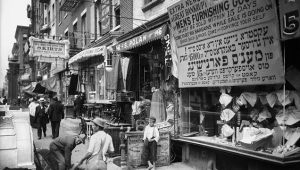
Yezierska’s narrative (written in “Bread Givers” from the point of view of a fictional character, Sara) starts in Hester Street, laying the groundwork for Yezierska’s character and empowerment. Hester Street, the epicenter of European immigrants, symbolizes Yezierska’s strength and motivation. Yezierska makes Hester Street out to be a pretty tough place to live. In “Bread Givers” she describes a day in which she has sold herring out on Hester Street. Her character Sara narrates, “It began singing in my heart, the music of the whole Hester Street. The pushcart peddlers yelling their goods, the noisy playing of children in the gutter, the women pushing and shoving each other with their market baskets- all that was only hollering noise before melted over me like a new beautiful song. It began dancing before my eyes, the twenty-five herring that earned me my twenty-five cents. It liften me in the air, my happiness” (Yezierska, p. 22). The vivid description of the people and noises of Hester Street expresses the culture of the location. It’s a fast-paced environment, constantly full of business and desperation for goods and/or money. The twenty-five cents was like winning the lottery to Yezierska.
Once Yezierska makes it to Hollywood, she spends a lot of time reflecting on who she was, the girl from Hester Street. In “Red Ribbon on a White Horse” Yezierska writes, “Without [the letters from Hollywood], I was again the oddity of Hester Street, an object of pity and laughter” (Yezierska, p. 30). Yezierska seems to allude with the description of pity and laughter that those living on Hester Street were look down upon. Hester Street very clearly makes up a large part of Yezierska’s identity. She writes, “What’s wrong with looking like Hester Street? I am Hester Street. Why should I be afraid to be what I am” (Yezierska, p. 56). Yezierska very firmly identifies with her background and, in my opinion, wholeheartedly embraces it. She never hides this fact of her life. In fact, her openness about her upbringing got her to where she needed to be. Hester Street is very central to Yezierska’s identity and the source of her strength.
208 2nd Ave — the Clara de Hirsch Home for Working Girls

At the Clara de Hirsch Home, Yezierska obtains her first ever private room, symbolizing her independence. In “Bread Givers” it’s not actually specified that the Home was the specific place in which Yezierska lived. It was the book “From Hester Street to Hollywood” that relayed this information. The author writes, “It was 1900 when Yezierska left home… She found safe haven at the Clara de Hirsch Home” (Cohen, p. 33). Cohen solidifies that Yezierska lived independently in the Home, but later even specified when this occurred, which correlates with Yezierska’s description of her first move in “Bread Givers”. Cohen writes, “Yezierska applied to be a boarding trainee at the Home in February 1900… and indicated that she lived in Elizabeth, New Jersey and had been in New York City for one day” (Cohen, p. 35). In “Bread Givers”, Yezierska talks about the single room she rented immediately after leaving her dad’s failing business in Elizabeth, New Jersey.
The Home was not notorious for its prime living conditions, however, it was what the small and overheated room represented that made the Home such a stepping stone in Yezierska’s story. Sara narrates, “It was a dark hole on the ground floor, opening into a narrow shaft. The only window where some light might have come in was thick with black dust. The bed see-sawed on its broken feet, one shorter than the others. The mattress was full of lumps, and the sheets were shreds and patches. But the room had a separate entrance to the hall. A door I could shut” (Yezierska, p. 158). What meant the most to Yezierska was that door, the door that would shut her away from the rest of the world and allow her to be her own person. She writes of Sara’s first moment in the room, “At last alone, in my room. I let go everything, the weight of my body falling against the closed door. The aloneness was enough for me, and in a moment it sank me to sleep” (Yezierska, p. 160). Yezierska finally moved away from her family, and the Home is where she sought solace. The Home represents the beginning of Yezierska’s personal success.
Columbia University
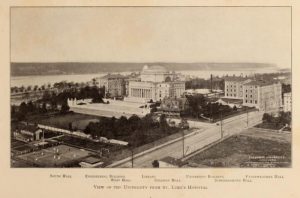
Columbia University, 1901
Yezierska’s time at Columbia University marks the most exciting part of her journey: opportunity. Columbia ultimately got Yezierska to where she wanted to be in her life– educated and self-sufficient. There’s not a lot written about her acceptance or really her education at Columbia University. It’s sort of hard to know exactly what’s truth and what’s myth in relation to this time period in her life, which Columbia Women Film Pioneers Project warns. Yezierska’s profile on the page begins by saying, “There is a good deal of inaccuracy and mythologizing about the life of Anzia Yezierska. Some of this misinformation was generated by the public relations offices of Hollywood; other misrepresentations resulted from Yezierska’s own obfuscation, especially concerning her age” (Erens). Yezierska’s upbringing paired with her own discretion creates conflicting stories about her time at Columbia as well, some sources citing her education at Columbia’s Teachers College while others asserting that she attended Columbia College itself. Nevertheless, her time at Columbia was marked both by fear and excitement. Sara narrates, “That burning day when I got ready to leave New York and start out on my journey to college! I felt like Columbus starting out for the other end of the earth. I felt like the pilgrim fathers who had left their homeland and all their kin behind them and trailed out in search of the New World” (Yezierska, 209). This passage stood out to me mostly because I think that this is the happiest readers ever see Sara. Yezierska’s analogy of starting Columbia to Columbus beginning his trip displays how positively she feels about school. A Cengage learning page writes of her, “A settlement worker helped her get a scholarship to Columbia College’s domestic science teacher training program; Yezierska invented a high school diploma to enter. These early experiences formed her fictional voice of the feisty immigrant waif who pulls herself up from poverty through wit and hard work” (Drucker). Drucker asserts that her fight and admission to Columbia is symbolic of Yezierska’s hard work in life, which is why Columbia is such a sentimental spot on Yezierska’s New York road map.
Bibliography:
Drucker, Sally Ann. “Anzia Yezierska.” Heath Anthology of American LiteratureAnzia Yezierska – Author Page. Cengage Learning, n.d. Web. 28 Apr. 2017.
Cohen, Sarah Blacher. From Hester Street to Hollywood: The Jewish-American Stage and Screen. Bloomington: Indiana U, 1986. Print.
Yezierska, Anzia. Bread Givers: A Novel. New York: Persea, 2010. Print.
Yezierska, Anzia, and W. H. Auden. Red Ribbon on a White Horse. New York: Persea, 1981. Print.
Erens, Patricia Brett. “Anzia Yezierska.” In Jane Gaines, Radha Vatsal, and Monica Dall’Asta, eds.Women Film Pioneers Project. Center for Digital Research and Scholarship. New York, NY: Columbia University Libraries, 2013. Web. September 27, 2013.
