
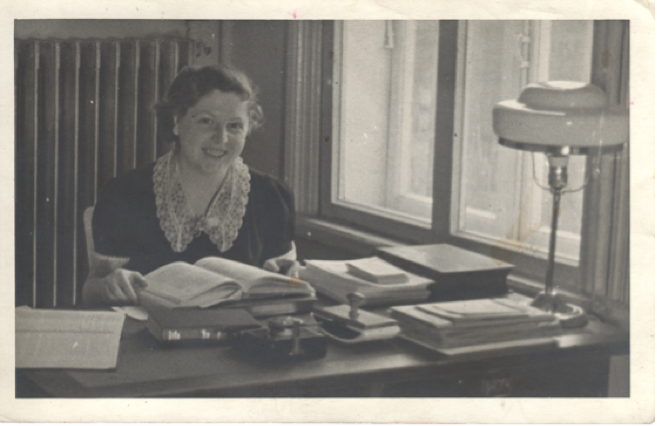
In Lucy S. Dawidowicz’s memoir, From That Time and Place, she chronicles her journey from New York to Vilna, Poland. The memoir is as much a story of Dawidowicz’s career as it is a memoir of a lost city and center of Jewish, Yiddish life, desecrated following World War II. It is because of this compelling story of remembrance that the reader might lose sight of her brilliant illustration of Yiddish history in New York City – and yet, it is painted vividly in her work, too. Through a close-reading of her journey through New York City, the reader can better understand the world of Dawidowicz, and the Jewish, Yiddish world in the melting pot of America in the first half of the 20th century.
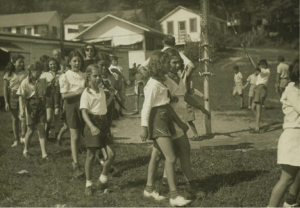
Dawidowicz’s parens were shopkeepers, owning a women’s hat shop in Glendale, Queens, and a candy store in the Bronx. In 1927, her family bought a four-family home in a developing section of the Bronx. Yet, in the years of the Great Depression, the bank foreclosed the house, and the Dawidowicz family moved to a dismal apartment in the East Bronx. Until high school, Dawidowicz attended a high school that was a subsidiary of the Sholem Aleichem Folk Institute, with about 2,000 other Jewish children. The Sholem Aleichem Folk Institute was a larger, umbrella organization that provided educational opportunities for Jewish children of Yiddish background or interest. It was founded in 1918, accumulating a great deal of support and national participation during the 1930s, lasting until the 1970s. The Institute organized Yiddish-speaking afternoon and Sunday schools for both elementary and junior high school students. The institute also owned Camp Bairberik in Rhinebeck, New York, and maintained a publishing house called Farlag Matones. Sholem Aleichem Folk Institute was known to be less focused on socialism, and instead, emphasized humanistic values that could utilized in modern Jewish life.
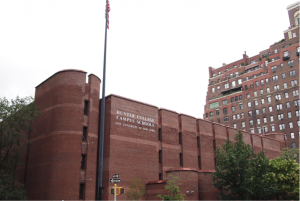
It was at Hunter College High School, however, where Dawidowicz discovered her passion for literature, and most importantly, poetry. Of her time at Hunter College High School, and it’s curriculum, she says: “English courses mattered most to me, and they nurtured my love for literature, poetry especially…Reading spurred me to writing, especially to poetry. I was soon admitted into the school’s literary clique, and joined the staff of the school’s Argus, the school’s literary journal…” Hunter College High School was, and continues to be, one of the city’s most elite private high schools. Established and 1869, then called the Female Normal and High School, the program was initially designed to prepare women to go into the teaching profession. It was located originally on 68th Street and Lexington Ave, and later relocated to 71 Eeast 94th Street. Over the course of time, the high school developed into a school for gifted young women, eventually admitted boys in 1974.
The Sholem Aleichem Miltshul
Dawidowicz’s time was divided between her secular high school and her Yiddish high school, where she learned on weekends, called Sholem Aleichem Mitlshul on East 15th Street. Here, learned about Yiddish authors and was taught by leading Yiddish historians and scholars. Dawidowicz describes her immersion into Yiddish culture: “We became accustomed to knowing the most celebrated Yiddish poets and novelists of the time, because their children were out classmates. Yiddish literature had become, as it were, familiar and personal.” Thus, it was at her Yiddish school where her love of literature and her Jewish heritage synthesized.
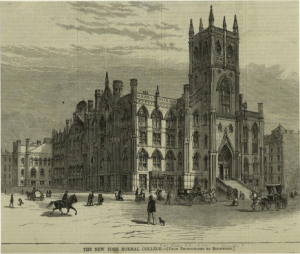
Dawidowicz continued her education at Hunter College, enrolling in September of 1932, amidst the Great Depression. Hunter College was founded in 1870 as a public institution and women’s college, located on Park Avenue since its incarnation. It was a groundbreaking school, created without restrictions of entry based on women’s race, religion or ethnicity, during a time when most women’s colleges had such admissions restrictions. During the 1930s, the school began construction and expansion into the Bronx. After graduating, and struggling to find a job, Dawidowicz’s mother floated the idea of studying for a master’s degree – a step towards her teaching degree.
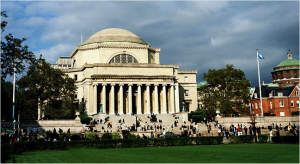
Thus, Dawidowicz enrolled in Columbia University, taking courses on philosophy, art and literature. The university was founded in 1754 as King’s College, renamed Columbia after the Revolutionary War The school is located on the Upper West Side of Manhattan, in Morningside Heights.
Despite her attendance at such an esteemed institution, Dawidowicz quickly became disillusioned with her studies: “Keats and Wordsworth no longer interested me. I needed a job and this ethereal pursuit of aesthetics no longer interested me.” Consequently, when a former teacher of Dawidowicz suggested Jewish history, she took interest – though she was apprehensive, feeling underprepared due to her prior focus on English literature. Dawidowicz then integrated her expertise in literature with that of her interest in Jewish history and proposed a topic of study to her advisor at Columbia: the Yiddish press in England. In February 1937, she reentered Columbia, immersing herself in the world of nineteenth century English history, and it’s relevance to European Jewry.
New York Public Library at 42nd Street

The New York Public Library at 42nd Street became Dawidowicz’s home – her place of study. The New York Public Library was founded in part by governon Samuel J. Tilden who donated much of his fortune to the library in hopes of creating a cultural center for the city. While the Astor Library and Lenox Library both had considerable cultural prominence in the city, neither were public. At the beginning of 1892, the two preexisting libraries experiences financial turmoil, and attorneys and trustees decided to collapse the two libraries into one, and form a new, singular entity; thus, the New York Public Library was created. In March of 1901, Andrew Carnegie donated a large sum of money to create a city-wide network of libraries.
Shortly afterwards Dawidowicz immersed herself in her studies, she was approached by Dr. Max Weinrich, a director of YIVO in Vilna. In 1938, when the European turmoil and horrors had quieted, at least for a moment, Dawidowicz embarked to Poland by ship to work for YIVO.
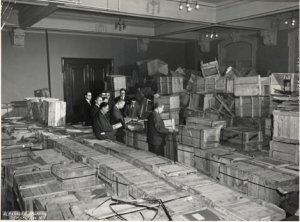
What unfolds next is a series of bittersweet events: pushed out by war and danger, Dawidowicz returns home – happy to be back in New York, but pained, watching from afar as her European friends find their homes demolished and heritage under attack. Moreover, the New York branch of YIVO flourishes into a center for Yiddish culture and life – yet, only because of the morbid circumstances of World War II rendering the Polish headquarters of YIVO inaccessible.
In September 1940, the American branch of YIVO began to operate as the YIVO headquarters, as the Polish brand was indefinitely closed because of the war. The August, the Polish YIVO Director, Max Weinreich and his son Uriel moved to New York, proposing that Dawidowicz become his secretary, though she was, at the time, living in Albany, spending “half a year at a tedious civil service job.” She thus returned to New York, to the new YIVO headquarters, eager to provide continuity between the YIVO of Vilna and that of New York. At the time, YIVO was located at 425 Lafayette Street, around the corner from Cooper Union. Its center section was occupied by the offices of HIAS, which used the south wing as a temporary shelter for new immigrants. The building had been erected in the mid-nineteenth century to house the Astor Library, the first free reference library in New York, named after John Jacob Astor, whose will had provided for it.
Eventually the space on 425 Lafayette Street became inadequate – the size of the YIVO staff and their resources outgrowing the available space. Thus, YIVO purchased a four-story building on 531 – 55 West 123rd Street, between Broadway and Amsterdam Avenue. The building was formerly the Jewish Theological Seminary, though that also out grew the space and moved to larger, brick building on Broadway.“ Just as the Seminary, in an earlier time, had moved uptown to assert its Americanness and its separateness from Eastern European orthodoxy of the Lower East Side, so the YIVO’s uptown move symbolized its distinctiveness from the immigrant Yiddishist institutions in their shabby downtown quarters.” (235) In addition to its new building, YIVO was gaining unprecedented notoriety among intellectual circles. Dawidowicz fondly remembers the 1945 YIVO Conference at Hunter College, which was closed with a keynote speech from Abraham Joshua Heschel. Moreover, in 1947, YIVO worked with the U.S. Army to recover formerly Nazi-confiscated materials from the headquarters in Vilna. Moreover, it continued to publish scholarly work by Yiddish and Jewish intellectuals. It also revived the Yiddish-language scholarly journel, YIVO-bleter, and issued an English-language Annual of Jewish Social Science. YIVO was building a new name for itself – a new name for Yiddish culture, and for American Jewry.
Yet, the growth of YIVO and Yiddish culture in New York hardly reflected the horrors occurring overseas in Europe. Throughout her memoir, Dawidowicz mentions attended meetings, vigils, and memorial services held by different Jewish organizations, such as the Jewish Labor Committee’s meeting in Carnegie Hall to honor the fallen Jews of the Warsaw Ghetto.
After more than five years at YIVO, Dawidowicz began to feel restless. She returned to Columbia in 1945 to study Jewish history with Professor Salo W. Baron – a signal to her boss and dear colleague Weinreich that she was “unwilling to serve the life term of my discipleship he demanded.”[1] While completing her master’s degree in Jewish History, Dawidowicz applied to work for the Joint Distribution Committee (JDC), which took her on as an education officer. It was through the JDC was Dawidowicz embarking on her next overseas journey. On September 30, 1946, Dawidowicz sailed from New York to occupied Germany to work among Jewish survivors in displaced persons camps.
She spent two years there, returning in 1947 to work for the American Jewish Committee as a researcher. After almost twenty years at the AJC, she joined the faculty of Yeshiva University as a professor of Holocaust studies.
“Columbia University.” Wikipedia. Wikimedia Foundation, 23 Apr. 2017. Web. 24 Apr. 2017. <https://en.wikipedia.org/wiki/Columbia_University>.
Dawidowicz, Lucy S., and Nancy Sinkoff. From That Place and Time: A Memoir, 1938-1947. New Brunswick, NJ: Rutgers UP, 2008. Print.
“History of The New York Public Library.” The New York Public Library. The New York Public Library, n.d. Web. 24 Apr. 2017. <https://www.nypl.org/help/about-nypl/history>.
“How Does Hunter College Rank Among America’s Best Colleges?” U.S. News & World Report. U.S. News & World Report, n.d. Web. 24 Apr. 2017. <https://www.usnews.com/best-colleges/hunter-college-2689>.
Hundert, Gershon David. “Preface to the Print Edition.” YIVO | Preface to the Print Edition. The YIVO Encyclopedia of Jews in Eastern Europe, n.d. Web. 24 Apr. 2017. <http://www.yivoencyclopedia.org/about.aspx>.
“Hunter College Campus Schools.” Hunter College Campus Schools – History. Hunter College, n.d. Web. 24 Apr. 2017. <http://www.hunterschools.org/history>.
“LUCY S. DAWIDOWICZ.” Jewish Women’s Archive. Jewish Women’s Archive, n.d. Web. 24 Apr. 2017. <https://jwa.org/encyclopedia/article/Dawidowicz-lucy-s>.
Muraskin, Bennett. “From Yiddishland to America.” Jewish Currents. Jewish Currents: Activist Politics & Art, 14 June 2015. Web. 24 Apr. 2017. <http://jewishcurrents.org/from-yiddishland-to-america/>.
Posted in Spring 2016, Visiting Scholars by Ryan McGrady. “Announcing a New Visiting Scholars Position at Hunter College.” Wiki Education Foundation. N.p., 01 Mar. 2016. Web. 24 Apr. 2017. <https://wikiedu.org/blog/2016/03/01/vs-hunter/>.
“Remembering the Holocaust: Lucy Dawidowicz.” Open Road Integrated Media. Open Road, 21 Mar. 2013. Web. 24 Apr. 2017. <http://stage.openroadmedia.com/blog/2013-03-21/Remembering-the-Holocaust-Lucy-Dawidowicz.aspx>.
“Sholem Aleichem Folk Institute (SAFI).” Guide to YIVO Archives. YIVO Institute to the Jewish Research, n.d. Web. 24 Apr. 2017. <http://www.yivoarchives.org/index.php?p=collections%2Fcontrolcard&id=33733>.
“Sholem Aleichem Folk Institute/Workman Circle Shuln.” Chapter Five : Yiddish Schools. University of Texas, n.d. Web. 24 Apr. 2017. <http://www.laits.utexas.edu/gottesman/sholworkman.html>.
“Welcome to Hunter College.” Hunter College. Hunter College, n.d. Web. 24 Apr. 2017. <http://www.hunter.cuny.edu/abouthunter+>.
“YIVO.” The Milstein Online Archives of the New York Jewish Community. YIVO Institute for Jewish Archives, n.d. Web. 24 Apr. 2017. <http://www.milsteinjewisharchives.yivo.org/site/?p=agency>.
Zumoff, Barrett. “The Secular Yiddish School and Summer Camp: A Hundred-Year History.” Jewish Currents. Jewish Currents, 02 Dec. 2016. Web. 24 Apr. 2017. <http://jewishcurrents.org/the-secular-yiddish-school-and-summer-camp-a-hundred-year-history/>.
