
On the second day of the Naomi fellows’ trip to Buenos Aires – exploring a ‘Yiddishland’ which was completely new to all of us – we visited the YIVO’s Argentine counterpart, Fundación IWO. Before we arrived, Silvia Hansman, the director of IWO’s library, archives and collections, had generously prepared a selection from across the institute’s wide-reaching materials. The materials ranged from hundred-year-old banners made for synagogues in Argentina’s rural north, to posters for Buenos Aires’ vibrant Yiddish theatre in the early twentieth century. We followed Silvia from box to box, folder to folder, listening as she explained histories of the Argentine Yiddishland in which we were just beginning to orientate ourselves.
Each of us was drawn to a different piece of archival material, reflecting both our research interests and our personal proclivities. Yasha, a fellow undertaking a masters in Jewish Studies, was keen to seek out materials relating to Soviet and Communist Yiddish culture, while Saski, an MFA student with an interest in the history of puppetry, was curious to see whether there were any marionettes in the collection. It was fascinating to watch as we discovered new manifestations of the Yiddish cultural phenomena which had interested us for so long. This, on only the second day of our visit, was a precursor of many revelatory moments to come.
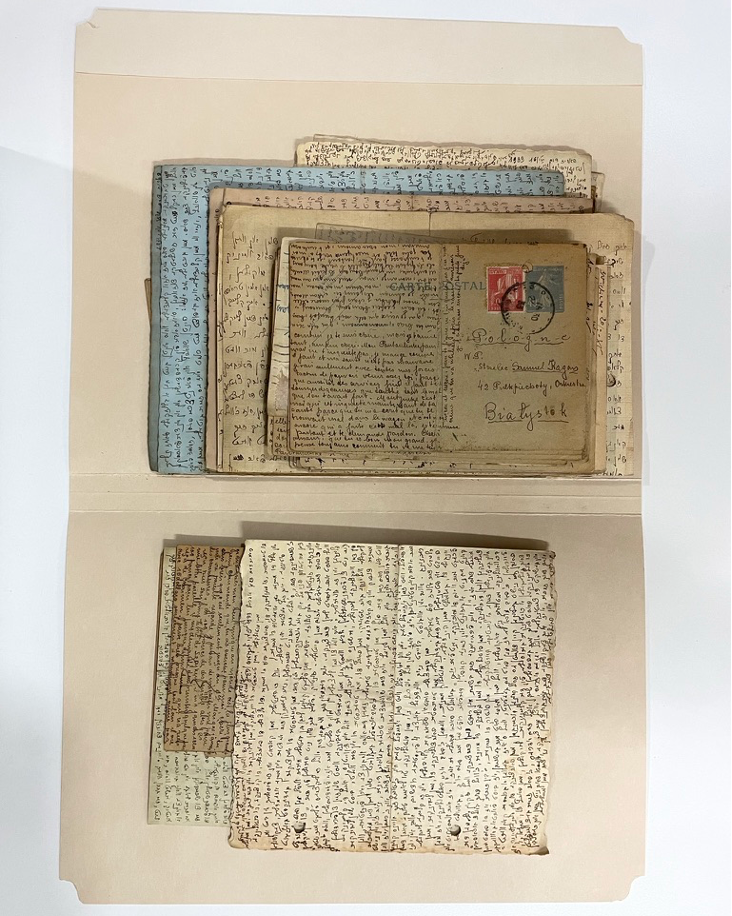
I was transfixed by a collection of correspondence. The letters were addressed between various cities and Białystok, and were written in what Silvia described as a “secret love language” mixing French and Yiddish. One or both of the correspondents had evidently settled in Argentina, leaving their letters to the IWO for safekeeping. What caught my attention about the letters was the multiplicity of cultural contexts in which they coexisted – Argentine, Yiddish, French, Polish… They were a condensed manifestation of the intertextuality of Yiddish culture.
In many ways, my archival fixation was irrelevant to the rest of our research trip, which centred around the history of Argentine Jewry, Jewish sex work in Buenos Aires, and the lasting influence of Yiddish culture in Argentina. And yet, the impression the letters made has stayed with me long after the trip concluded. It is just this kind of ephemera which I find so moving within the world of Yiddish research. In the context of such geopolitical unlikelihood, apparently insignificant pieces of personal evidence become representative of cultural histories and transnational phenomena far beyond the relationships in question. For this reason, this is one of the lasting impressions I have taken away from our visit to the far-away (and surprisingly close) Yiddishland of Buenos Aires.
