
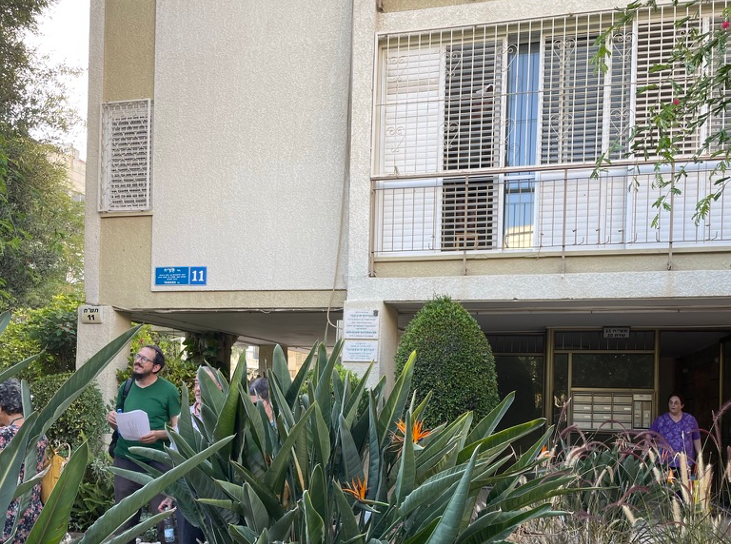
One of the most memorable moments of the Naomi Prawer Kadar Yiddish summer course was our visit to Avrom Sutzkever’s apartment. On what would have been his 110th birthday, the TAU Yiddish students gathered outside Sutzkever’s apartment to meet with his daughter, Mirele. Dr. Roskies, one of the teachers for the Advanced literary seminar, reminisced about his meetings with Sutzkever, and spoke with Mirele about the poet’s practice on Moshe Sharett Street, and the inspiration he drew from Tel Aviv. Later, students sung Sutzkever’s poems, and recited translations of his work into their various native languages.
This last part of the student presentation was particularly impressive: hearing Sutzkever’s work in Polish, Ukrainian, and German – languages which would have comingled with Sutzkever’s Yiddish in pre- and inter-war Central and Eastern Europe. Throughout the visit, what struck me as particularly special was the opportunity to hear Sutzkever’s words against the soundscape of modern-day Tel Aviv. At first, the sounds of car-horns, vacuum cleaners, and loud roadside conversations irritated me, inducing anxiety about missing a crucial word or reminiscence. But as the visit went on, I realised how interesting it was to hear Sutzkever’s poems in the context in which he wrote so many of them – however much it might have changed over the intervening years.
When the readings were over, Mirele thanked us for visiting, visibly moved by the recitations. Before leaving, we asked a passer-by to take a photograph of the cohort with Mirele in front of Sutzkever’s old building. As we dispersed – some of us in search of falafel, others a sunset trip to the beach – we floated on a shared sense of excitement at having the opportunity to engage so closely with a figure who had inspired us for so long. Yiddish words we had once admired at a distance had suddenly become intimately familiar.
