
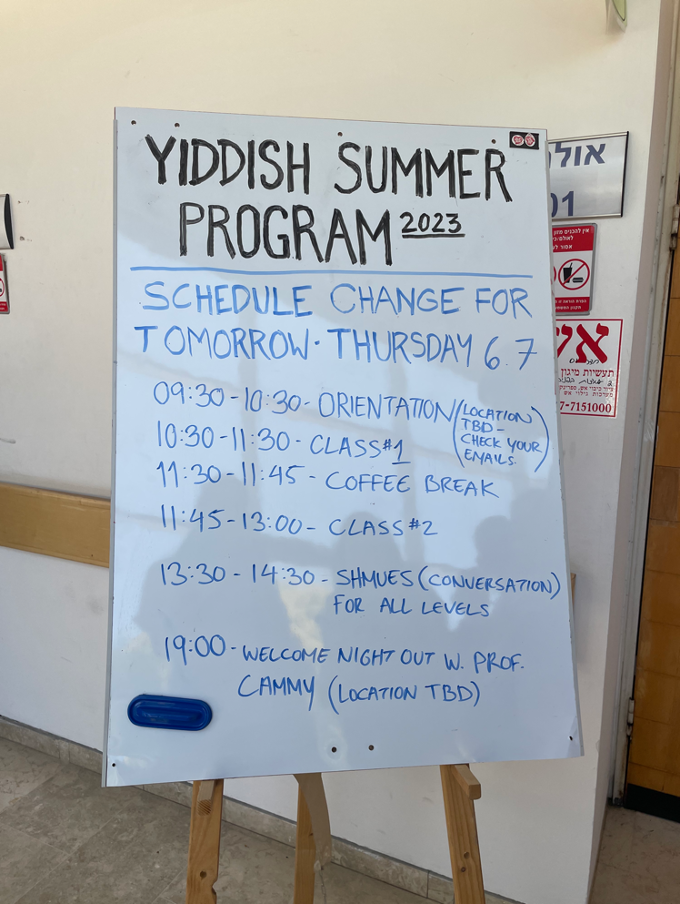
In the last week of the Naomi Prawer Kadar Yiddish summer course, I sneaked into Advanced Shmues. I was an Intermediate I student, but my friends on the Advanced program had been singing the praises of their conversation teacher, Motl Gordon, for nearly a month, and I was keen to meet him before the course ended. But it wasn’t just my friends’ glowing praise that drew me to Motl’s class – I was fascinated by the story of how he ended up teaching it in the first place.
Born in St. Petersburg to a secular family, Motl found his calling as a rabbi through the world of Yiddish language instruction. According to an interview with The of Times Israel, Motl decided to dedicate himself to both Torah study and Yiddish study after attending Shabbat services in Mea She’arim as a student on the Tel Aviv University summer course. Eventually, he was appointed as a Rabbi to Muscovite Jewish community Sredi Svoich (‘Among Our Own’), where he established a flourishing congregation. The day after Russia’s full-scale invasion of Ukraine began, Motl fled Moscow and relocated his family to Jerusalem, where he has been providing a support network for the numerous Russian Jews who have recently fled Putin’s Russia. In light of his recent move, he was also able to take the job teaching Yiddish conversation at TAU.
In Motl’s class, we were asked to write four questions we would like to ask the other students. He encouraged us to come up with unusual questions we would not normally ask in a typical language class – questions which would help us get to know one another. I was paired with Motl, who asked me, “פאר וואס האסטו מורא” – “what are you afraid of?” I told him that I was always afraid of the first few weeks after moving to a new city – when everything is unfamiliar and you don’t know anyone. I told him that I remembered being afraid of moving to Moscow, where I had studied abroad for a year during my undergraduate degree. “איך בין מאַסקים” Motl said, “I agree.” He said that those first weeks in a new place were always the hardest.
It occurred to me only afterwards how surreal and meaningful it was to be having this conversation in Yiddish, a language which had paved the way for Motl’s flight from Moscow, and had helped him lay the foundations of his new life in Israel. Over the course of my time in Tel Aviv, I had been able to see Russian friends I hadn’t seen since before the war, some of whom I hadn’t seen since before the pandemic. They, too, had left Russia in February 2022, and had eventually gathered the funds and resources to repatriate.
Not long after the course ended, I met a couple of old friends from Moscow for coffee in Florentin. I mentioned that I had met Motl, and described how moved I had been to converse with him about such complex feelings in Yiddish. They told me that they knew about Motl, and that a number of their friends followed his Telegram channel – he was popular in their secular anti-war circle. His channel, my friend explained, was part of how his community was reconnecting with their family’s relationship to Judaism – a relationship which had been complicated and often almost severed by decades of Soviet repression.
Sitting at that café in Florentin, I was struck by the power of Yiddish conversation in today’s world. In this context, Yiddish felt particularly urgent – a way of uniting Jews across geographical, religious, and political borders.
