
From the building he owned at 169 Rivington Street at the Lower East Side, Abraham Hochman worked vigorously on his impressive array of occupations. Hochman earned his reputation among Jewish immigrants as well as non-Jews in the city of New York at the turn of the twentieth century by juggling between publishing on astrology and fortune-telling in the popular Yiddish press, actively promoting the wedding hall he owned, and offering husband finding services to women who lost contact with their husbands through his prediction talent.[1]
For my contribution to Mapping Jewish New York, I selected a picturesque advertisement from 1905 depicting Hochman’s foretelling services as well as an enthusiastic appeal written by Shimon Rozenblitte, a Jew from Łańcut in Galicia, who was also Hochman’s staunch admirer.
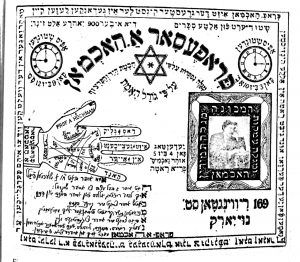
Figure no. 1: Hochman’s advertisement from the Yiddish press in New York (1905)[2]
In this over-detailed add Hochman positions himself as an expert in the realm of psychic services.[3] At the center to the left Professor Hochman’s hand map is portrayed claiming that “luck is drawn on your hand” (דאָס גליק איזט געצייכענט אין אייער האַנד) The acrostic at the bottom of the image to the left is Hochman’s list of expertise and services: the second letter presents his ability to “rightly read all your faces and palms” (the first presents Hochman as ‘the giver-of-good-advice for your destiny”); it seems that the fourth letter (though it was too hard to decipher the entire sentence) stresses the scientific veneer Hochman aspired to, as it mentions that in his craft he uses “also mathematic” technique.[4] He completes the acrostic with some of the supposedly popular reasons among his customers, which include travels, business, love etc.
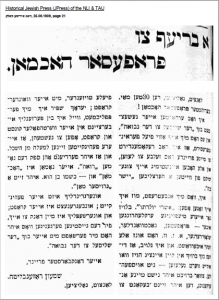
A letter to Professor Hochman
Łańcut, Galicia, May 30
Famous Professor Hochman,
I have received your invaluable book “The Key to Prophecy.” I found it so interesting that I recommended my friends to read it, and everyone unanimously send you from a far a sincere YA)Sh(ER)-KOYEKh.
As for myself, I must openly tell you: “Ashrei Yoladeto.”
Only with your profound explanations of prophecy, sleepwalking, sleep-talking, and so forth you completely astonished us. I believe this book should not be missing in any home in which Yiddish is a spoken language. You do not need my recognition as you are known to thousands with your miraculous craft; Because I was personally convinced of your precious art and craft, I feel obligated, I would swear, [to tell you that] your talent is beyond comprehension. You undoubtedly deserve the name of a “seer.” Your name is Hochman – and it suits you. You are a “great man.”
Thorough is your talent; limitless is your craft; and there is no limit to my gratitude to you for the spiritual pleasure you have granted me with your book “The Key to Prophecy.”
Your most grateful friend,
Shimon Rozenblitte
Łańcut, Galicia
Moving to my main source, A Briv tsu profesor Hochman, a letter by Shimon Rozenblitte to a Yiddish newspaper in 1909[5]:
After reading Hochman’s “Key to Prophecy” Rozenblitte decided to write to Dos Iddishe Folk, a New York based Yiddish newspaper expressing his great appreciation to the known figure. I chose this letter firstly because it was interesting to situating Hochman outside the limits of New York City, showing some degree of popularity in the Alter Heym. But what makes this letter even more interesting (despite its quite generic style of writing) is reading it together with Portnoy’s note about Hochman’s business strategy for periods when fewer people were interested in his varied talents: “when business flagged, he contracted journalist friends and pulled psychic stunts to attract customers, who reported no them assiduously in the Yiddish press.”[6] Thus, we can stretch our imagination and bring an additional reading of the letter, now seeing Rozenblitte as a hired fan or even as a fictional character created to attract customers!
[1] Eddy Portnoy, Bad Rabbi: And Other Strange but True Stories from the Yiddish Press (Stanford: Stanford University Press, 2018), 78-79.
[2] Ibid., 77.
[3] I will focus on the inner frame. I have found the ad in Eddy Portnoy’s Bad Rabbi: And other Strange but True Stories From the Yiddish Press book, and as he already translated the outer frame where we can find an inscription arguing that “Hochman is the greatest artist of mind telling. No one in the world even compares to him. He tells everyone the absolute truth and future.”
[4] As Eddy Portnoy mentions: “[. . .] shtetl superstitions simply migrated in various forms to cities, where, in an attempt to slap a veneer of sophistication on their ancient crafts, occultists often presented themselves as scientists or professors,” in Portnoy, Bad Rabbi, 74.
[5] “Briv tsu profesor Hochman,” Dos Idishe Folk, June 26, 1909, 21.
[6] Ibid., 75.
