
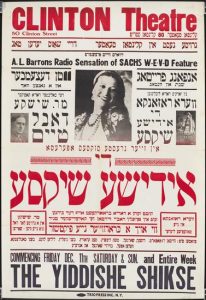
(1940)
Source: Museum of the City of New York
Translation:
Clinton Theater, 80 Clinton Street
Three shows every day Great guest in Clinton Theater
Louis Weiss presents
December 11thAnd a whole weekThe Beloved Radio ComedianMr. ShishkeDavelTaim |
Starting FridaySaturday and SundayNew York’s Radio DarlingVera RozankoThe JewishShikse |
In very great success operetta
The
Jewish Gentile (f)
|
Mr. Shishke in a big laugh role with new jokes–spraying
|
Come see a radio broadcast on the stage Also personally see Rabbi Zaidman the [קאלעלישקער] preacher As well as a new Broadway picture
|
Vera Rozanko and new Soviet songs
|
Together with: Dreyman Rappaport, Jack Shargel, Moshe Lipshitz, Sam Kravitz, Benny Gitlitz, Lillian Lux, Bessie Mogulesko, Helen Appel, Birdie Shargel and others
This is a poster for the Yiddish production, “The Yiddishe Shikse,” performed at the Clinton Theater in 1940, featuring Vera Rosanko and Mr. Shishke (radio comedian and star of Double Time). This folk musical originally opened at the Bronx art theater in 1935.
Louis Weiss, who ran the Clinton Theater and the Hebrew Actors’ Union for many years, put on this particular showing of ‘The Yiddishe Shikse.’ He formatted the Clinton Theater’s schedule in a unique way by bringing in a different star attraction each week for a condensed showing of a play or musical; he gave two shows a day and three on Saturday and Sunday.
This play was written by Vera Rosanko’s husband, Israel Rosenberg, a prominent Yiddish playwright in Canada and later New York in the first half of the 20th century. Rosenberg was born in 1895 in Lublin, Poland to an Orthodox family (his father was a Rabbi) and after emigrating to Canada and then to New York City in 1921, he acted in and penned many Yiddish musical comedies, melodramas, and operettas. He married Vera Rosanko in 1912.
Rosanko, born Shifra Viner in 1893, partly grew up in a Ukrainian village, after being sent there by her father, where she was not aware of her Jewishness until her father brought her home several years later. As a result of her time there, she picked up an extensive repertoire of Ukrainian and Russian songs.
When she later emigrated to Canada, and then New York, she began advertising her actress/singer persona as ‘Di Yiddishe Shikse’–the Jewish gentile woman–because she often donned Ukrainian folk costumes and performed Ukrainian and Russian songs in her appearances. She was said to have a wavering soprano voice.
She often performed in productions written by her husband, and starred in a WEVD radio feature he wrote for many years. In 2013, their daughter Betty Perlov published a children’s book titled Rifka takes a bow about growing up as their daughter in the Yiddish theater scene.
Sources:

