
By Rachel Taratuta-Titus
In 2011, Lenny Leibowitz directed an Off-Broadway production of Joseph C. Landis’ translation of The Dybbuk at the Marvell Repertory Theater Company’s Abingdon Theater. Leibowitz, a graduate of Columbia University, served as founding artistic director alongside managing director Amy Estes of the Marvell Repertory Theatre.1 Their mission in founding this theater company in 2010 was to give “NYC area theatre actors and audiences the kind of full-immersion theatre experience that a rotating rep can provide… the development of new plays and musicals and the advancement of the art form.”2 The Marvel Repertory Theatre is distinguished as being New York’s “only professional theater company producing new and classic plays in rotating repertory.”3 In addition to the The Dybbuk, Leibowitz has directed such plays as Professor Bernhardi (by Arthur Schnitzler), Spring’s Awakening (Wedekind) and Blood Wedding (Lorca).4

In his review for Backstage,5 Ron Cohen praises Leibowitz’s adaptation of The Dybbuk, saying “the ambition is impressive and the results are equally so in Marvell Rep’s mounting of The Dybbuk, a seminal work of classic Yiddish theater.” Even critics, such as Oscar E Moore, who do not appreciate the original written play and view it as little more than shund theatre, say, “never has so much been done with so little” and regard this adaptation as “an amazing accomplishment.”6 Ron Cohen comments on the “artful use of basic stagecraft,” the ability of the actors to set the mood without the need for over-the-top special effects such as “spooky videos to announce a ghost.”7 The production additionally connected with the audience through the use of live musicians, Tareq Abuissa on cello and Alex Spangher on bass, who performed to an original score by Adam Knauss.8 Tijana Bjelajac created the set, a simple backdrop with chairs, tables, and a Torah ark.
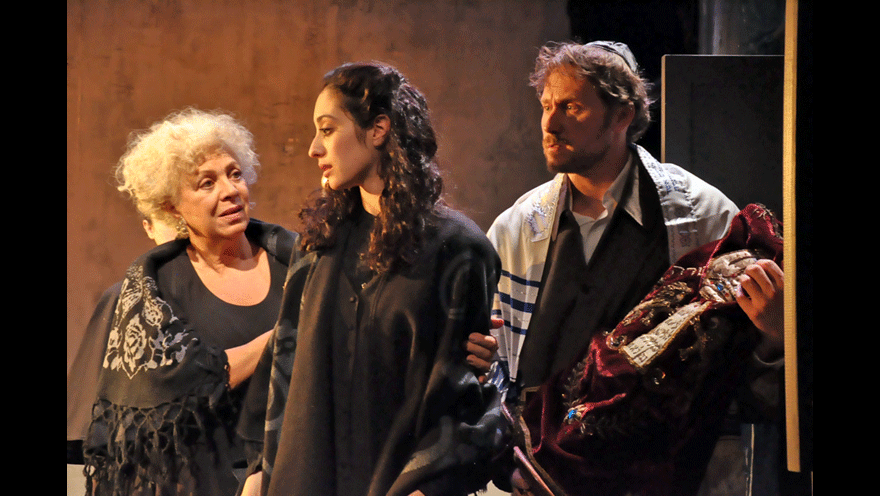
An image from the production (shown below) indicates that Bjelajac incorporated candlelight into the set design (much like the set designer of the 1937 film adaptation), to emphasize the distinction between light and dark, where light could represent the eternal bond between Khonnen and Leah and dark could represent prevalent social limitations. The costume choices similarly reveal this light-dark symbolism, since costume designer Susan Nester dressed the actors primarily in black, white, and grey costumes.
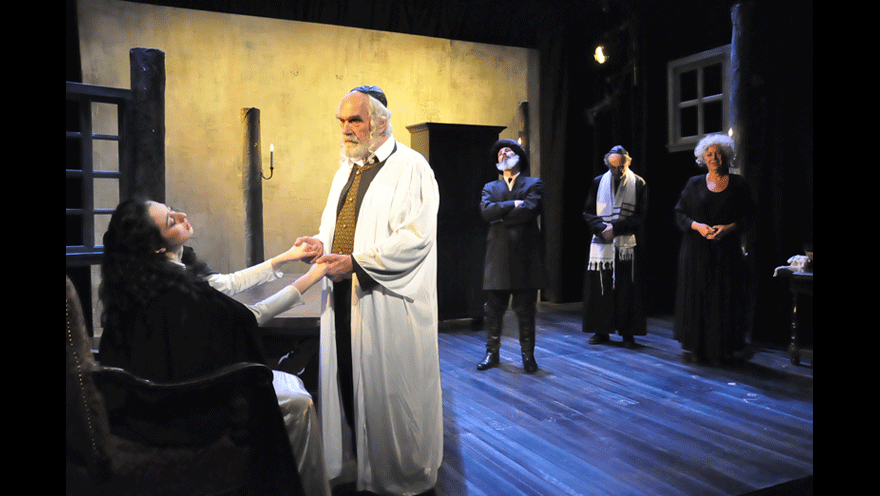
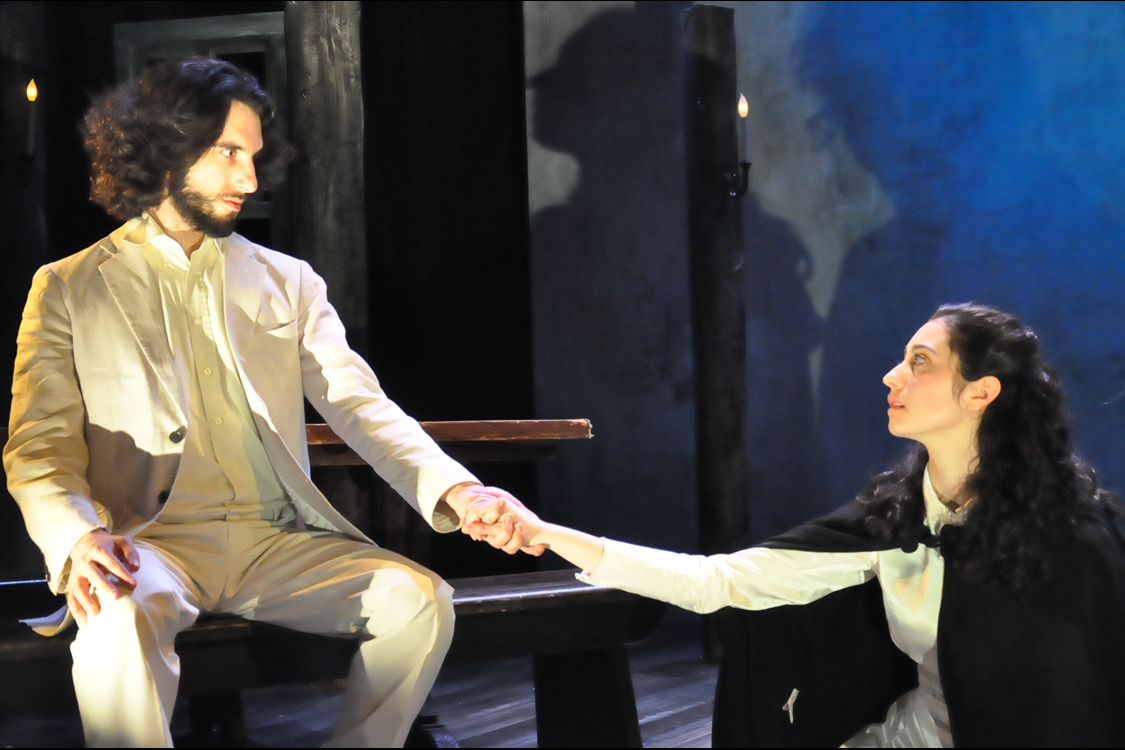
This production had a twenty-two person ensemble, with Rachel Claire cast as Leye, Perri Yaniv as Khonnen, Marc Geller as Reb Sender, and William Metzo as Reb Azrielke. Interestingly, a female actress, Loni Ackerman, plays the role of the messenger in this production. In the original written play, as well as in the 1937 film adaptation, a male actor performs the role of the messenger. Oscar E. Moore praises Leibowitz for his conscious decision to a cast a woman in this role, arguing that “empowering a woman in this world where men dominate is a daring choice that pays off” while also praising Ackerman for her powerful stage presence, “as if in a trance, as if channeling the messages that she is delivering Ms. Ackerman is stoic and in control as she delivers the words- almost omens of things to come- appearing as an other worldly figure that never intrudes but whose presence is always felt.”9 In a less enthusiastic but largely positive review of the female messenger, Ron Cohen argues, “Loni Ackerman acquits herself well as a mysterious messenger” in “the most problematic role.”10 Ackerman11 herself spoke about the role (and her costumes) in a joking way: “I was probably the only Messenger ever dressed by Anthropologie and Neiman’s.”12 By incorporating a consistently strong, clairvoyant female messenger in his adaptation of The Dybbuk, Leibowitz provides an alternative female perspective to supplement the role of Leah, a victim of male oppression (her father forces her into an undesirable marriage) who eventually exerts free will in her final decision to join Khonnen in death.

While Leibowitz was directing The Dybbuk in 2011, the Marvell Repertory Theater was simultaneously presenting three other plays, Frederico Garcia Lorca’s Blood Wedding, Ingmar Bergman’s Nora, and John Millington Synge’s In the Shadow of the Glen, all four of which feature strong female leads.13 Lora’s Blood Wedding, which debuted alongside The Dybbuk, bears remarkable resemblance to The Dybbuk in terms of its focus on the female experience in a (potentially) repressive society:
Her blood is hot for a man she used to know but life has thwarted their affair. He has a wife and child. She is torn between her duty and her desire and it is driving her mad. What makes the story so compelling is the fact that there are no real villains here. There are human beings caught up in a whirlwind of passions they can neither control nor understand.14
This review15 of Blood Wedding describes the plight of a young bride that mirrors the story of Leah in the The Dybbuk in several ways. Much like the protagonist of Blood Wedding, Leah is stuck between “duty and desire” in her respect for her father and her love for Khonnen. Additionally, there are no “real villains” in The Dybbuk (it can be argued that Sender only wants what’s best for his daughter and the dybbuk himself is in love with Leah). Lastly, Leah’s demon possession could be viewed as a form of “madness” akin to that of the young bride in Blood Wedding. The fact that Leibowitz chose to direct both plays simultaneously indicates his interest in showing how females find love in the face of social limitations. Through Leibowitz’s directorial choices, it also becomes apparent that the themes presented in The Dybbuk, such as the tension between passion and duty and the all-consuming, “possessive” nature of love, transcend Yiddish Theatre and apply to many cultural traditions.
Image Sources
Figure 1. https://www.facebook.com/lennyleibowitzactingcoach/. Accessed July 16, 2021.
Figure 2. http://lennyleibowitz.com/wp-content. Accessed November 3, 2014.
Figure 3. http://lennyleibowitz.com. Accessed November 3, 2014.
Figure 4. http://marvelrep.org/. Accessed November 3, 2014.
Figure 5. http://www.perribazyaniv.com/uploads/5/9/8/9/5989685 /7513891.jpg. Accessed November 3, 2014.
Works Cited
“A Blood Wedding: The Dybbuk”. TalkEntertainment.com. Accessed November 3, 2014.
Cohen, Ron. “The Dybbuk.” Backstage.com. March 17, 2011. Accessed July 30, 2021.
“Lenny Leibowitz.” lennyleibowitz.com. Accessed November 3, 2014.
“Lori Ackerman: Theater to Her Toes.” Woman Around Town. Accessed November 3, 2014.
“Marvel Rep to Present 22 Actors Over 6 Weeks in 4 Plays/3 Productions.” The AndyGram. January 26, 2011. Accessed July 30, 2021.
Nassour, Ellis. “Veteran Actresses Loni Ackerman and Lorraine Serabian in Rep and with a Vengeance.” TotalTheater.com. March 2011. Accessed July 30, 2021.
Siegel, Barbara, and Scott Siegel. “Blood Wedding.” TheaterMania. March 11, 2011. Accessed July 30, 2021
Footnotes
- “Lenny Leibowitz.” lennyleibowitz.com. Accessed November 3, 2014.
- “Marvel Rep to Present 22 Actors Over 6 Weeks in 4 Plays/3 Productions.” The AndyGram. January 26, 2011. Accessed July 30, 2021.
- Nassour, Ellis. “Veteran Actresses Loni Ackerman and Lorraine Serabian in Rep and with a Vengeance.” TotalTheater.com. March 2011. Accessed July 30, 2021.
- Lenny Leibowitz.
- Cohen, Ron. “The Dybbuk.” Backstage.com. March 17, 2011. Accessed July 30, 2021.
- “A Blood Wedding: The Dybbuk”. Talk Entertainment. Accessed November 3, 2014.
- Cohen.
- Talk Entertainment.
- Ibid.
- Cohen.
- “Lori Ackerman: Theater to Her Toes.” Woman Around Town. Accessed November 3, 2014.
- Ibid.
- Talk Entertainment.
- Siegel, Barbara, and Scott Siegel. “Blood Wedding.” TheaterMania. March 11, 2011. Accessed July 30, 2021.
- Siegel.
