
By Joshua Jacobs
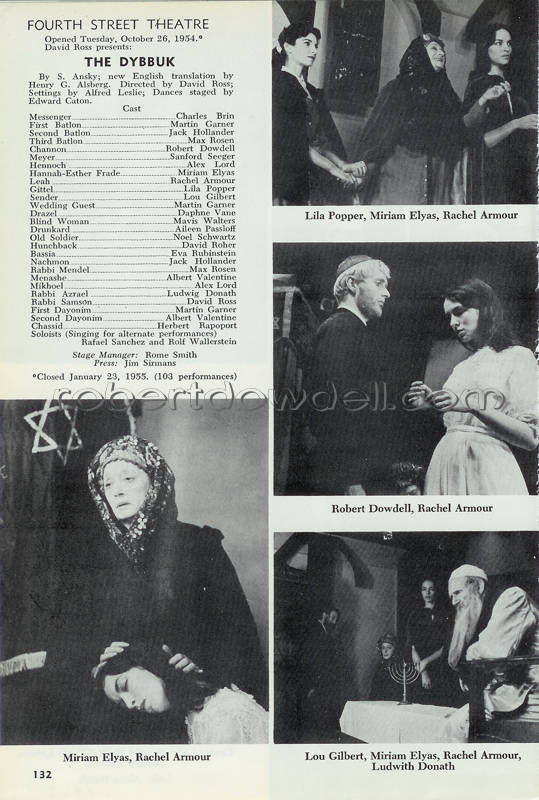
A respected and temperamental off-Broadway producer and director, David Ross, leased the Fourth Street Theatre in mid-1954 in which to put on a number of play productions.1 The first of these plays was Ansky’s The Dybbuk, with a new translation by Henry G. Alsberg, which ran from October 26, 1954 to January 23, 1955, a total of 103 performances. 2

The theater, still located at 83 E. 4th St. in Manhattan, was a former synagogue in its first year operating in its new role as a performance space. The 100’ x 25’ area with a stage in the center offered a set of challenges, as the theater-in-the-round seating meant the cast had to enter and exit the stage by walking down an aisle through the spectators.3
The original cast included Rachel Armour and Robert Dowdell as Leah and Channon respectively, with Miriam Elyas playing Hannah-Ester Frade and Ludwig Donath as Rabbi Azrael.4 Rabbi Shlomo Carlebach served as Chasidic adviser to the show as well, during which time the famous musical rabbi picked up a guitar for the first time.5 The role of Channon was taken over partway through the play’s production and played by Peter Mark Richman, who went on to a long television and film career.6 Long-time Broadway actor Morris Carnovsky also played a role in the production.7

The performance space itself proved to play a significant role in the show. In her description of the performance, poet Denise Levertov described the space as “a little cellar-like,” requiring that “the actors were obliged to climb onto the stage, like boxers, from the aisles. It was another world, and given with complete intense conviction.”8 Louis Scheaffer of the Brooklyn Daily Eagle referred to the space as an “oblong-shaped theater, in which the audience sits on two opposite sides of the centrally located stage.”9
This production, which had come after numerous other iterations of The Dybbuk in New York, was described by saying that the “brooding ominous personality is lost in English translation, but enough certainly comes through in the worthy revival at the 4th St. Theater for a flavorsome, exotic evening.”10

Of the performers, praise is offered for the performance of “Ludwig Donath, resembling an Old Testament patriarch has both majestic authority and genuine humanity as the wise rabbi,” and is also described in the New York Times as “Mr. Donath has the voice, the authority, the kindness, the sternness, the humility: be it ideal. And when is presiding over the performance, The Dybbuk retains all its reverence and beauty.”11 Appropriately, Donath reprised his role of Rabbi Azrael in an adapted segment directed by Sidney Lumet in 1960, created for Play of the Week, an American anthology series of televised staged plays.12 Rachel Armour has mixed reviews of her performance, as in the first two acts she is described by the Times as “colorless,” though in the third act “she catches a good deal of the other-wordliness of the fable and plays with strength and insight.13 In the Brooklyn Daily Eagle she is praised as “vivid.”14
Though the space might have made for an awkward show, and the first two acts were not as strong as the final one, “The Dybbuk [was] well worth the visit.”15
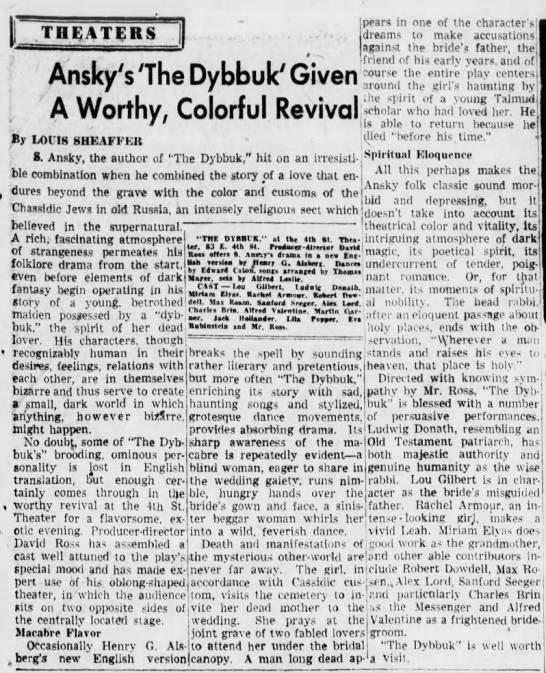
Image Sources
Figure 1. http://robertdowdell.net/DybbukAd1.jpg. Accessed July 30, 2021.
Figure 2. http://robertdowdell.net/DybbukTheatreWorld54closeup.jpg. Accessed July 30, 2021.
Figure 3. http://robertdowdell.net/DybbukTheatreWorld54.jpg. Accessed July 30, 2021.
Figure 4. https://bklyn.newspapers.com/image/54530444/. Accessed July 30, 2021.
Works Cited
Alsberg, Henry G. “Dybbuk Analyzed: Play’s Translator Claims Spirit More Believable Than Hamlet.” New York Times. October 31, 1954. Accessed July 30, 2021.
Atkinson, Brooks. “‘The Dybbuk’; Ansky Play, in English, Opens Downtown.” The New York Times. October 27, 1954. Accessed July 30, 2021.
“Dybbuk Review.” robertdowdell.com. Accessed October 31, 2014.
“Extensive Biography.” Peter Mark Richman. Accessed July 30, 2021.
Green, David B. “This Day in Jewish History / Carlebach, A Song of Love and Predatory Lust.” Haaretz. October 20, 2014. Accessed July 30, 2021.
Hamrick, Craig. Big Lou: The Life and Career of Actor Louis Edmonds. Universe Star, 2004.
Levertov, Denise, et al. The Letters of Denise Levertov and William Carlos Williams. New Directions, 1998.
“Play of the Week: The Dybbuk. IMDb. Accessed July 30, 2021.
“Re: Performance – The Dybbuk: 1954.” Peter Mark Richman message to the author. October 31, 2014. E-mail.
Scheaffer, Louis. “Ansky’s The Dybbuk Given a Worthy, Colorful Revival.” The Brooklyn Daily Eagle. 27 Oct. 1954: 13. Accessed July 30, 2021.
Theater World. http://robertdowdell.net/BDDybbuk.htm. Accessed July 30, 2021.
Footnotes
- Hamrick, Craig. Big Lou: The Life and Career of Actor Louis Edmonds. IUniverse Star, 2004.
- Alsberg, Henry G. “Dybbuk Analyzed: Play’s Translator Claims Spirit More Believable Than Hamlet.” New York Times. October 31, 1954. Accessed July 30, 2021.
- Ibid.
- Theater World. http://robertdowdell.net/BDDybbuk.htm. Accessed July 30, 2021.
- Green, David B. “This Day in Jewish History / Carlebach, A Song of Love and Predatory Lust.” Haaretz. October 20, 2014. Accessed July 30, 2021.
- “Extensive Biography.” Peter Mark Richman. Accessed July 30, 2021.
- “Re: Performance – The Dybbuk: 1954.” Peter Mark Richman message to the author. October 31, 2014. E-mail.
- Levertov, Denise, et al. The Letters of Denise Levertov and William Carlos Williams. New Directions, 1998.
- Scheaffer, Louis. “Ansky’s The Dybbuk Given a Worthy, Colorful Revival.” The Brooklyn Daily Eagle. 27 Oct. 1954: 13. Accessed July 30, 2021.
- Ibid.
- Ibid.
- “Play of the Week: The Dybbuk. IMDb. Accessed July 30, 2021.
- “Dybbuk Review.” robertdowdell.com. Accessed October 31, 2014.
- Sheaffer.
- Ibid.

