
By Agi Legutko
The first Dybbuk production in New York was staged by famous Yiddish theater actor and director Maurice Schwartz in 1921.

Maurice Schwartz, born Avrom Moishe Schwartz in 1888 in the village of Sudlekow, now in Ukraine, emigrated to the United States in 1902. He was a founder and leader of the Yiddish Art Theater, established in 1918 in New York, which produced works of high artistic quality, in opposition to the popular, the so-called shund theaters. Director, actor, and theater manager, he devoted his life to the Yiddish theater and died in 1960 in New York.1
According to Martin Boris, the author of the only existing biography of Maurice Schwartz, Schwartz was deeply fascinated with An-sky’s play, The Dybbuk, having read about the sensational production by the Vilne Troupe:
Schwartz knew, as he knew theatre intimately, that he had to have The Dybbuk for his splashy grand opening of the Yiddish Art Theatre. Every instinct told him this would be his greatest triumph ever. An-sky was dead, but Maurice negotiated with Chaim Zhitlowsky, An-sky’s authorized agent in America, for the five-year royalty arrangement. “I devoted myself to the production with great energy. I wanted to be as successful as the Vilna Troupe had been, perhaps even more so” ([Maurice] Schwartz, [Letter of] 14 Jan. 1942). His players, over 20 in number for this lavish but tasteful production, caught his fervor and gave their utmost during the rehearsals. The composer Josef Cherniavsky wrote a hauntingly beautiful score. The set designer, Alex Chertov, did exceptionally in his first professional assignment. Celia Adler took the role of Leah, the possessed bride. Schwartz played two distinctly different roles, as the young sweetheart Chonon, who dies in Act One, and Azrielke Miropoler, the sage rabbi, who doesn’t appear until Act Three. “I liked both roles, but the role of Chonon was more important to me. It’s a truly tragic role that contains the poeticism of Shakespeare. ([Maurice] Schwartz, [Letter of] 14 Jan. 1942).
Opening on September 1, 1921, The Dybbuk had to face enormous competition not only from shund theatre, but also from its mainstream counterparts, the Broadway stage and the movies, to where much of the Yiddish public was going for its amusements. . . . The New York Times, in its first full-length review of a Schwartz production, went overboard with praise. Wrote its reviewer: “The trial before the rabbis is the strongest and most compelling scene that has been seen on this stage, which has witnessed many remarkable scenes . . . The first act in the old synagogue has a Rembrandtesque quality that is extraordinarily vivid” (Block 21 Sept. 1921). 2
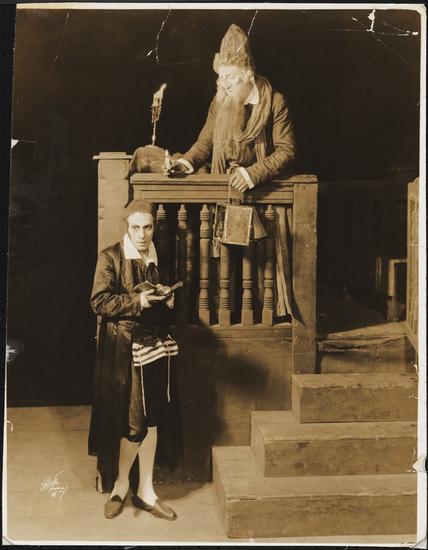
At the Yiddish Art Theatre, the play was an important artistic and commercial hit and ran for 18 weeks. Much of the handsome profit went to repay Meyer Golub. Although most Yiddish drama critics applauded Schwartz for his first presentation of the season, there were those die-hard anti-Schwartzites who found serious fault, comparing unfavorably his version with the Vilna Troupe’s. Too realistic, they declared, and not as moving (Zohn 149).
Certainly Schwartz could have milked The Dybbuk for many more weeks, likely for the entire season on weekends, the big money-making days, “but it’s simply repugnant for me to run the play for so long, even though in the middle of the week, we took to playing repertory. We longed for fresh material, a new play, a new role [. . .], to experience the fervor of a theatre premiere” (Schwartz 14 Jan. 1942). Though he played to sold-out houses, Maurice dismantled the sets and plunged into the next production. He had a comfortably fat bank account and was driven to try something daring and original. During the week, while The Dybbuk continued to draw well, he presented a Moshe Nadir work, The Last Jew. The production received terrible notices. Alter Epstein of the Day was especially caustic: “Perhaps the author wants to tell us something in dramatic form. Perhaps some theme enchanted him, but he wasn’t able to turn it into something important, worthwhile” (11 Nov. 1921).3
The Yiddish Art Theater (see the MYNY story) was located at the Irving Place Theater at 118 East 15th Street, New York.
The cast of the first production:
THE DIBBUK (Der dybuk) (1 September 1921),
By S. Ansky.
| First “Batlen” Second “Batlen” Third “Batlen” The “Meshulach” Chonon, A Talmud Student Mayer, A Sexton Chana-Esther Henech, A Talmud Student Leah Frade, Her Nurse Gittel, Leah’s Companion Usher Sender, Leah’s Father Basseh, Leah’s Companion Menasseh, Leah’s Bethrothed Nachman, His Father Mendel, His Tutor Azrielkek Miropoler, A Sage Michiel, His Attendant Shimshin, A Rav (chief rabbi) |
Alexander Tanenholtz A. Lutzky Jehudah Bleich Julius Adler Bar Galilee Hyman Meisel Anna Appel Irving Gonikman Celia Adler Bina Abramowitz Bessie Mogulesky Joseph Rosenberg Jechiel Goldsmith Sarah Jacknin Joseph Schooler Carl Fell Jacob Sobel Maurice Schwartz Israel Schein Mark Schweid |
The alternative cast during the first 18 weeks of the play included (“Dybbuk” Oct/Nov 1921): Maurice Schwartz (Chonon/Azrielke Miropoler), Celia Adler (Leah), Jacob Ben Ami, Lia Rosen, Bina Abramowitz, Jechiel Goldsmith, Mark Schweid, Isidore Cashier, Anna Appel, Lazar Fried, C. Shneyer et al. Set design Alex Chertov. Music by Josef Cherniavsky. At the Garden Theatre, 27th Street and Madison Avenue.4
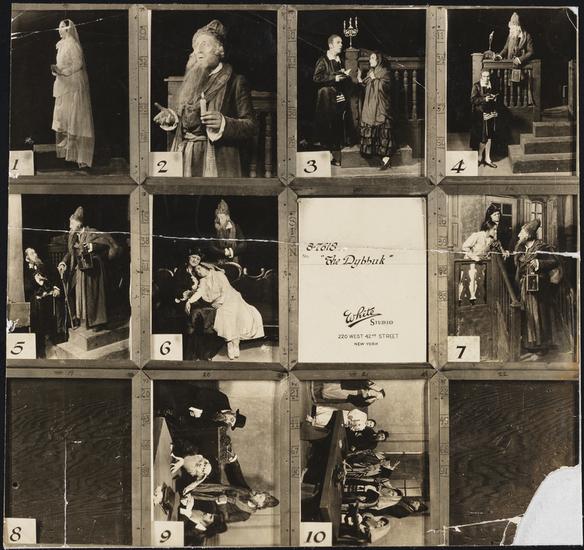
Maurice Schwartz returned to The Dybbuk on several occasions in the later years. As Martin Boris reports, Maurice Schwartz produced The Dybbuk in 1924, too:
He could use a certain winner with which to initiate the 1924-1925 season, one requiring little preparation. Schwartz opened a month later with The Dybbuk. Included in the cast were Ben Zvi Baratov, who’d proven himself in New York during the European tour, and Muni Weisenfreund, though there’d been so much friction and bitterness between them in England. Muni must have been floored to receive an offer for the season, but along with the contract came three new scripts with especially fascinating roles for him, parts he’d never played before and which would surely stretch his abilities. Unhesitatingly, Muni accepted. Maurice had calculated correctly: The Dybbuk did very well and he was able to return the $2,500 borrowed in England, and dig into the pile of debts before him like a mountain of paper.5
Schwartz also staged The Dybbuk in 1926, despite his earlier assurances that “milking” the play was beneath him. The play featured Maurice Schwartz, Lia Rosen, Jacob Mestel, Isidore Cashier et al.6
As Martin Boris asserts, “Kicking off the new year, Schwartz presented The Dybbuk. Whenever the company needed a financial boost, or had run out of new material, he would dig into his repertoire of sparkling diamonds, of sure money-generators. The effort was generally well-received, especially by Alexander Woolcott, the fabled critic: “The Yiddish Art Theatre production of The Dybbuk is alive to the tingling dramatic value of this extraordinary play” (6 Jan. 1926).7
In 1929, in his article written for the New York World, Maurice Schwartz stated that “The success of The Dybbuk in English proved that the better Jewish plays can be done in both Yiddish and English and be appreciated by Jew and non-Jew. New York, with its two million Jews, should be represented on the English and Jewish stages — but no melting pot pieces, no sketchy characterizations: only clear truths and not echoes of successful ideas, only originality and not imitation.”8
To celebrate the 30th anniversary of his theater in 1948, Maurice Schwartz staged two performances consisting of the first acts of four of his favorite plays: The Great Fortune, The Golden Chain, The Blacksmith’s Daughter, and The Dybbuk,9 thus demonstrating once again the significant influence An-sky’s Dybbuk had on Schwartz’s theatrical vision and professional life.
Nonetheless, Schwartz did not return to The Dybbuk after 1948, as if for him the play was closely associated with the world that was now gone. However, his adopted daughter, Francis (later called Risa), performed the only female role of Evelyn Forman, in Paddy Chayefsky’s The Tenth Man, an American version of An-sky’s Dybbuk that premiered in 1959. Her performance received raving reviews, “Raved Brooks Atkinson about the daughter of an actor he’d admired for decades: ‘Risa Schwartz is superb. She makes the transition from madness to sanity by effortless means, and her moments of sanity are full of passion and loveliness'” (Times 6 Nov. 1959).10
Risa Schwartz Whiting was shaped by her father, who thus passed his fascination with The Dybbuk to the next generation of actors.11
Maurice Schwartz’s Dybbuk in 1921 began a new era in Yiddish theater in New York. Ever since 1921, the New York stages have been repeatedly possessed by The Dybbuk, both in Yiddish and English.
Image Sources
Figure 1. http://www.museumoffamilyhistory.com/yt-pe-schwartz-maurice-01bfr.jpg. Accessed October 27, 2014.
Figure 2.https://collections.mcny.org/CS.aspx?VP3=SearchResult&VBID=24UAYWM38OJY&PN=51&IID=24U39YWS0B5. Accessed July 30, 2021.
Figure 3. https://collections.mcny.org/asset-management/24U39YWS61O. Accessed July 30, 2021.
Works Cited
Boris, Martin. Once a Kingdom: The Life of Maurice Schwartz and the Yiddish Art Theater. Accessed July 30, 2021.
Schwartz, Maurice. “The Melting Pot of the Theatre.” The New York World. December 16, 1929. Accessed July 30, 2021.
Schwartz Whiting, Risa, and Robin Whiting. “My Father, Maurice Schwartz.” Lives in the Yiddish Theatre: Tributes to a Bygone Era. Accessed July 30, 2021.
“Some of the Casts of Characters of the Yiddish Art Theatre Productions 1918-1958.” Museum of Family History. Accessed July 30, 2021.
“Who Was Maurice Schwartz?” Museum of Family History. Accessed July 30, 2021.
Footnotes
- Boris, Martin. Once a Kingdom: The Life of Maurice Schwartz and the Yiddish Art Theater. n.p. Accessed July 30, 2021.
- Ibid.
- Ibid.
- “Who Was Maurice Schwartz?” Museum of Family History. Accessed July 30, 2021.
- Boris.
- “Some of the Casts of Characters of the Yiddish Art Theatre Productions 1918-1958.” Museum of Family History. Accessed July 30, 2021.
- Boris.
- Schwartz, Maurice. “The Melting Pot of the Theatre.” The New York World. December 16, 1929. Accessed July 30, 2021.
- Boris.
- Schwartz Whiting, Risa, and Robin Whiting. “My Father, Maurice Schwartz.” Lives in the Yiddish Theatre: Tributes to a Bygone Era. Accessed July 30, 2021.
- Ibid.
