
By Agi Legutko
The Dybbuk in New York
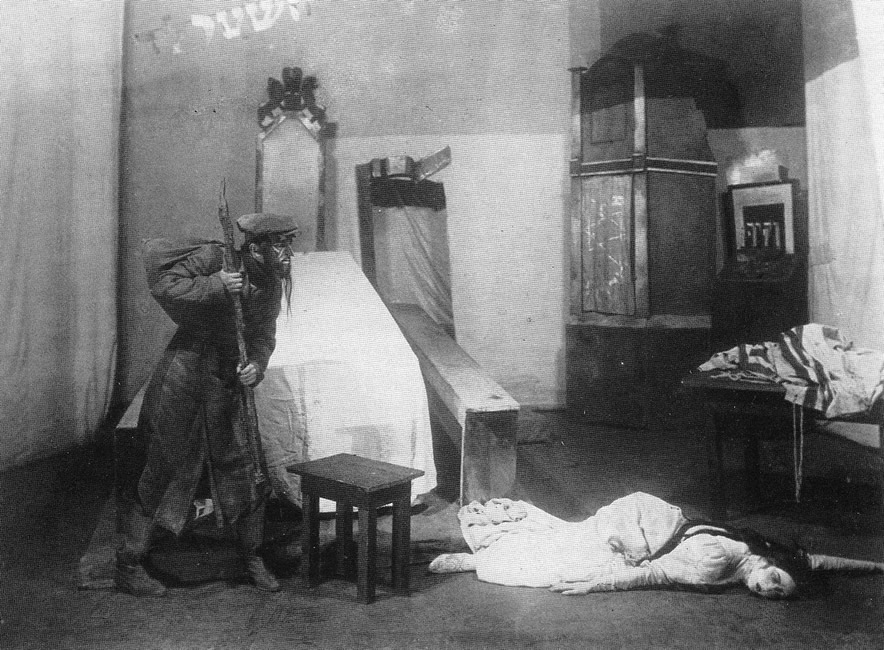
The Dybbuk, Or Between Two Worlds by S. An-sky premiered in 1920 in Warsaw, Poland, and immediately possessed the stages worldwide. In 1921 The Dybbuk had its New York premiere and since then has returned to the city at least twenty times. The posts listed below, created by Columbia University students and featured on the Mapping Yiddish New York website under the “Dybbuk in New York” category, document these returns:
Dybbuk Arrives in New York: Maurice Schwartz’s Production in Yiddish Art Theater (1921)
Dybbuk in the Neighborhood Playhouse (1925)
The Dybbuk Comes to Broadway: Habimah’s Dybbuk at the Mansfield Theater (1926)
Puppets and Parody: The Dybbuk (1926)
Il Dybuk Performance at the Carnegie Hall (1936)
The First Film Adaptation of The Dybbuk in New York (1938)
The Dybbuk, Or Between Two Worlds (1948)
The Dybbuk Becomes Operatic (1951 & 1952)
The Dybbuk at the 4th Street Theater Produced by David Ross (1954)
Neither Rest Nor Harbor: The Dybbuk and Modern Dance (1964 &1969)
Pearl Lang’s The Possessed (1975)
The Dybbuk at the Public Theater, New York Shakespeare Festival Production (1977)
A Dybbuk by Tony Kushner (1997)
Warlikowski’s Adaptation of The Dybbuk (2004)
Analyzing The Dybbuk Puppet Show (2004)
Leibowitz’s Production of The Dybbuk (2011)
Queens College Production of The Dybbuk (2012)
The Dybbuk Possesses the Stages Worldwide

Figure 1. S. An-sky in 1910.
Shloyme-Zanvl Rappoport a.k.a. S. An-sky (1863-1920) headed an ethnographic expedition in the years 1912-1914 in Volhynie and Podolie in Eastern Europe, which is said to have inspired his greatest work, The Dybbuk, Or Between Two Worlds (1914). An-sky tried to stage it for several years, in vain, and it was only at his funeral on November 9, 1920 that Yiddish theater director David Herman swore that the play would be staged “צו די שלושים” tsu di shloshim, 30 days after An-sky’s death.

Indeed, Between Two Worlds: The Dybbuk – as the play was originally called –premiered at the Elizeum Theater in Warsaw on December 9, 1920, at the end of the thirty-day mourning period after An-sky’s death.1
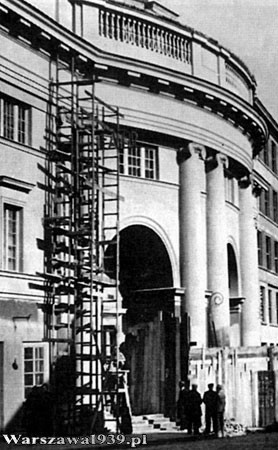
The Vilna Troupe (Vilner Trupe), established in 1915, was one of the four theater companies in Vilnius, Lithuania. It eventually moved to Warsaw and then performed around the world.

Luba Kadison, the daughter of Leib Kadison, one of the founders of Vilna Troupe, and who also performed in The Dybbuk as Leah in 1922, recalls that having seen their Dybbuk performance in Vienna, famous theater director Max Reinhardt said, “Das ist nicht theater, das ist ein Gottes Dienst.” (This is not theater, it is service to God).2

Figure 6. Luba Kadison as Leah in The Dybbuk in 1922.
As scholar Michael Steinlauf notes, the Vilna Troupe’s production of The Dybbuk was received with “wild and unprecedented excitement” and was instantly a great success.3
“The audiences were immediately possessed, or “fardibekt” [‘dybbuk-ed’], according to the Warsaw Yiddish daily, Der Moment:
Take a poll, and you’ll see that out of 5 Jews in Warsaw, 12 have been to The Dybbuk. You’ll probably give me a look and ask: how can that be? How is it possible that out of 5 Jews, altogether 12 should go see The Dybbuk? So you need to know that The Dybbuk is not something you go to once and it’s over. God forbid! With The Dybbuk, if you go once you go again, and if you go again, you go again. … And so it goes, easy as a psalm, at first you go three times a week, later you get used to it, and like a Jew to his prayers, you go to The Dybbuk three times a day. (Khad-Gadyo, “Der ‘Dibek’ un Fankoni,” Der Moment (6 March 1921), translation Michael Steinlauf).4
The play was soon translated in 27 languages and performed around the globe, starting in 1921 in New York (see the MYNY story). The 1922 Hebrew production of the play directed by Eugene Vakhtangov, student of the legendary Konstantin Stanislavski, (who also contributed to the final form of the play by suggesting the addition of the character of the Messenger), by the Habimah Theater company in Moscow with its famous expressionist interpretation became an icon in itself. Vakhtangov’s production, with its extensive emphasis on choreographed movement, “succeeded in transcending the meaning of the play far beyond [the director’s] conception. … Vakhtangov paradoxically released the spirit from the chains of the constraining form. The performers, along with the audience, in effect engaged themselves in a total emotional trance.”5 Not only was the production considered as Vakhtangov’s manifesto of his view on life and modern theater of fantasy realism, it also turned into Habimah’s signature piece that has been performed for over four decades in an intact form, literally thousands of times all over the world.


These two productions marked the beginning of The Dybbuk possessing the stages worldwide that has continued until this day. The stories featured on the Mapping Yiddish New York website explore the Dybbuk possessing the New York stages since 1920 to 2012.
Image Sources
Figure 1. https://upload.wikimedia.org/wikipedia/commons/thumb/3/32/An-ski_1910.jpg/250px-An-ski_1910.jpg. Accessed July 30, 2021.
Figure 2. https://upload.wikimedia.org/wikipedia/commons/e/e8/Dybbuk1920.png. Accessed July 30, 2021.
Figure 3. http://www.warszawa1939.pl/galeria-powiazany/karowa-18a/galeria-powiazana-1283. Accessed July 30, 2021..
Figure 4. https://yivoencyclopedia.org/popups/viewmedia.aspx?id=1000&article=298. Accessed July 16, 2021.
Figure 5. https://www.youtube.com/watch?v=SgyVuwUZQ2c. Accessed July 30, 2021.
Figure 6. https://i.embed.ly/1/display/resize?key=1e6a1a1efdb011df84894040444cdc60&url=http%3A%2F%2Fwww.museumoffamilyhistory.com%2Fkadison-luba-dyb.jpg&width=1000. Accessed July 30, 2021.
Figure 7. https://foto-history.livejournal.com/1032425.html. Accessed July 30, 2021.
Figure 8. http://max.mmlc.northwestern.edu/mdenner/Drama/images/new_ images/dybbuk/dybbuk2_lg.jpg. Accessed October 26, 2014.
Works Cited
Caplan, Debra. “The Sun Never Sets on the Vilna Troupe.” Pakn Treger, Summer 2014, pp. 12-14.
Caplan, Debra. “Nomadic Chutzpah: The Vilna Troupe’s Transnational Yiddish Theater Paradigm 1915-1935.” Theater Survey, vol. 55, special issue 03, pp. 296-317.
Khad-Gadyo, “Der ‘Dibek’ un Fankoni,” Der Moment (6 March 1921)
Legutko, Agi. Possessed by the Past: Dybbuk Possession and Modern Jewish Identity in Twentieth-Century Jewish Culture. (Forthcoming).
Levi, Emanuel. The Habima – Israel’s National Theater 1917-1977: A Study of Cultural Nationalism. (New York: Columbia University Press), 1979.
Luba, Kadison. On stage, off stage : memories of a lifetime in the Yiddish theatre. Cambridge, Mass.: Harvard University Library, 1992.
Orani, Aviv. “Realism in Vakhtangov’s Theatre of Fantasy.” Theatre Journal 36.4 (Dec 1984): 475.
Pascal, Julia. “Luba Kadison and the Vilna Troupe.” The Guardian, May 19, 2006. Accessed July 30, 2021.
Steinlauf, Michael. “Fardibekt! An-sky’s Polish Legacy.” In Steven J. Zipperstein and Gabriella Safran, Eds. Worlds of An-sky: A Russian Jewish Intellectual at the Turn of the Century. Stanford, California: Stanford University Press, 2006. pp. 232-251.
Footnotes
- Steinlauf, Michael. “Fardibekt! An-sky’s Polish Legacy.” In Steven J. Zipperstein and Gabriella Safran, Eds. Worlds of An-sky: A Russian Jewish Intellectual at the Turn of the Century. Stanford, California: Stanford University Press, 2006. pp. 232-251.
- Pascal, Julia. “Luba Kadison and the Vilna Troupe.” The Guardian, May 19, 2006. Accessed July 30, 2021.
- Steinlauf.
- Ibid.
- Orani, Aviv. “Realism in Vakhtangov’s Theatre of Fantasy.” Theatre Journal 36.4 (Dec 1984): 475.
