
PEOPLE’S THEATRE
201 BOWERY.
______________________________________________________________________
EDELSTEIN & THOMASHEFSKY, LESSEES AND MANAGERS. ROSENTHAL, REGISSEUR. FRIEDZEL, MUSICAL DIRECTOR.
Tuesday Evening the 7th of March, 1905
To Honor
Our Musical Songs
And
Composers
Mr. Louis Friedsel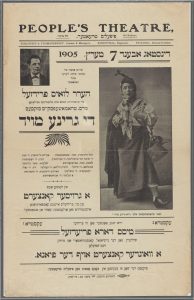
For a performance came your general desires
Miss Thomashefsky’s Success
The Green Maid
———————————————
Rachel Weinstein, Madame Thomashevsky
Reb Shlomo the Joyful, Mr. Bernstein
Zlote, Madame Abramovitch
Engelman, Mr. Meisel
Detective, Mr. Tiplitsky
Jake Wilson, Mr. Kessler
Avraham Weinstein, Mr. Young
Rubin, Mr. Rosenstein
Helena, Madame Godinsky
Dik, Mr. Gold
Marcus Weinstein, Mr. Zuckerman
A Waiter, Mr. Abramovitch
(Pictured: Miss Thomashefsky as the Green Maid)
———————————————
A Last Act
A Big Concert
With Mr. Friedsel’s own compositions, accomplished background orchestra, choir, and ensemble
———————————————
Extra! The Young Daughter of Mr. Friedsel Extra!
————Miss Dora Friedsel———–
Students From The National Conservatory of Music
Will Play A Wonderful Concert on The Piano
———————————————
Tickets can be received at the box office at People’s Theatre
Lipshitz Press, 180 Grand Street, New York
Image Source: Dorot Jewish Division, The New York Public Library. “Di grine moyd” The New York Public Library Digital Collections. 1905. http://digitalcollections.nypl.org/items/79cbc5d0-d1b1-0133-f5bc-00505686a51c
This picture is an advertisement for a play called “The Green Maid”, followed by a large concert at people’s Theatre in the Lower East side of Manhattan in 1905. This was a time when a lot of Yiddish speaking immigrants were immigrating to the Lower East Side from Europe. The Green Maid is a significant play because it probably portrays what life was like for immigrants coming to make it big in America. “Green” was a common theme at the time in Yiddish theatre and literature, and was used to describe someone who was an immigrant. Although I couldn’t find any information regarding this specific play, I can guess it is about an Yiddish immigrant who settled in America and worked as a maid to get by. Maid Thomashefsky (the main character) was played by Bessie Thomashefsky, who was born in Ukraine in 1873 and moved with her family to Baltimore when she was about ten (2). Upon her arrival, she only attended school for two years and then went to work in a sweatshop, going on to marry Boris Thomashefsky, a renowned Yiddish actor and one of the owners of People’s Theatre, thus creating for herself a successful career in Yiddish acting (2).
The common theme of financial hardship and backbreaking labor became the theme for many songs, poems, and plays. Another example of this theme is “Di Grine Kuzine”, where a person describes his/her “green” cousin becoming worn out from hard work in America. In this poster, the title “The Green Maid” seems to imply an immigrant woman who took upon herself a job as a maid. Conveniently located at 201 Bowery, People’s Theatre was located on the Lower side of Manhattan, where many of the Yiddish speaking immigrants settled. The People’s Theatre served the Yiddish community until the late 1920’s, until it became a Chinese Playhouse in the 1930’s (1). The area where People’s Theatre was located was known as the Yiddish Theatre District, and it was the center of New York’s Yiddish life in the 20th Century (1).
Sources:
- https://myny.ctl.columbia.edu/content/peoples-theater
- https://jwa.org/encyclopedia/article/Thomashefsky-Bessie
