
By Ruby Landau-Pincus
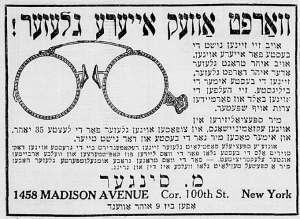
Image source: ActivePaper Archive
“Throw away your glasses!
if they are not the best for your eyes. If you wear glasses or you need glasses, these are the best for the cheapest prices. They help the eyes’ current and future problems for later in life.
We have specialized in eye examinations, and in adjusting eyeglasses, for the last 35 years. And we make only the best, but they’re not expensive.
Our special Soft-Light glasses are recommended by the biggest eye doctors as the best glasses for those suffering from headaches and strenuous work under electric light. — For those who wear thick, unsightly glasses, we have a special Thin-Light glass which is thin and light.
M. Singer
1458 MADISON AVENUE
Cor. 100th St.
New York
Open until 9 PM.”
This glasses advertisement from a 1928 issue of Forward is outwardly quite simple — a picture of a pair of pince-nez spectacles accompanied by a misleading tagline that can be found even in today’s clickbait — but gives us a look through the lens of the many Jews living in Harlem in the 1920s.
The part of this advertisement that feels the least current is the phrase referencing “work under electric light,” as it is hard to imagine work under any other kind of light today. Literally translated, this section refers to work “unter elektritsitet” — under electricity. While this is somewhat unclear in meaning, it is likely a reference to factory work, in which electric lighting, including the then-recent invention of the sodium lamp, made it possible to do detailed work long after dusk (DiLaura). This kind of labor was a reality for many Jewish immigrants. The majority of garment factories in New York were owned by Jews and had primarily Jewish employees. Although Jewish immigrant communities were able to form through the shared experience of this factory work, the working conditions were dangerous and exploitative (Sachar). These factory workers earned low wages, averaging $0.56 per hour (August 1960), the equivalent of $8.31 in today’s money, when accounting for inflation (CPI Inflation Calculator). Between eye-straining factory work and the low wages earned from it, inexpensive glasses were a necessity.
The East Harlem location of the store advertised is also quite telling. Harlem, known in recent decades for its black community, was once home to the second largest Jewish population in the United States. According to historians, the Jewish communities in West and East Harlem were quite divided along lines of class, with those living further eastward experiencing the greatest poverty. As the black population in Harlem rose, Jewish residents had mixed reactions. While some heavily enforced segregation, others were hardcore advocates of integration. Although no trace of M. Singer’s glasses shop remains in what is now the Mt. Sinai Hospital, hints of the Jewish history of Harlem are hidden in plain sight throughout the neighborhood. Many of Harlem’s churches were once synagogues, still visible in the Jewish symbols decorating the buildings (Cohen).
While I was initially drawn to this advertisement by the unusual pair of glasses it displayed, looking into the history behind it made me love it even more. I found learning the history of Jewish factory workers in Harlem to be absolutely fascinating, and it reminded me that even from a short, strange advertisement, we can learn so much about who came before us.
“August 1960.” Employment and Earnings, U.S. Bureau of Labor Statistics, Aug. 1960, fraser.stlouisfed.org/title/
Cohen, Marjorie. “Looking Back at Harlem’s History as a Major Jewish Enclave.” Brick Underground, 21 Dec. 2017, www.brickunderground.com/live/
“CPI Inflation Calculator.” U.S. Bureau of Labor Statistics, U.S. Bureau of Labor Statistics, data.bls.gov/cgi-bin/cpicalc.
DiLaura, David. “A Brief History of Lighting.” Optics & Photonics News (OPN), The Optical Society, Sept. 2008, www.osa-opn.org/home/articles/
Sachar, Howard. “Jewish Immigrants in the Garment Industry.” My Jewish Learning, My Jewish Learning, www.myjewishlearning.com/
Singer, M. “Throw Away Your Glasses!” ActivePaper Archive, The Yiddish Forward, 1 Dec. 1928, jpress.org.il/Olive/APA/NLI/?
