
Translation
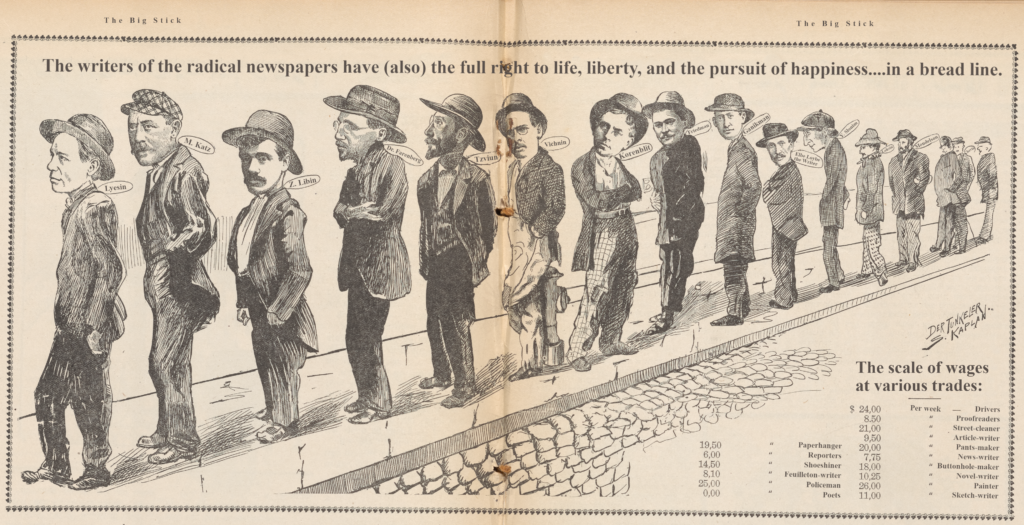
Description
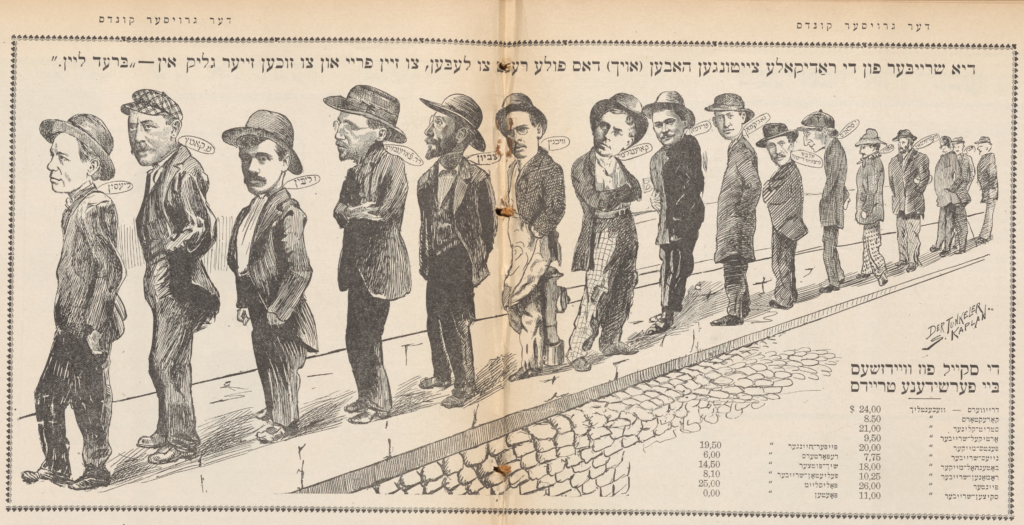
This cartoon originally appeared in the March 19th, 1909 issue of ”Der Groyser Kundes” (“The Big Stick”*), a Yiddish-language satire publication founded by Jewish humorist Yosef Tunkel. Like many notable Yiddish writers of the time, Tunkel was born in Eastern Europe, where he grew up immersed in Jewish folk culture, and immigrated to New York during the Great Wave of the early 20th century. However, from the outset Tunkel sought to distinguish himself from the New York Yiddish literary/journalistic community, which at the time was characterized by a hyper-focus on politics and a desire to modernize Yiddish culture, best represented by popular political newspapers like ”Forverts”. Finding these sorts of papers overly serious in their nature, Tunkel instead channeled his snarky wit and his formal training in caricature into satirical depictions of modern Yiddish culture, beginning with a periodical named “Der Kibitser” (“The Jokester”) in 1908 that would be renamed to “Der Groyser Kundes” in 1909. “Kundes” eventually found a sizeable audience of its own, and was placed in the hands of Tunkel’s collaborator Jacob Marinoff a few years later as Tunkel shifted his sights toward editing a prominent humor publication in Warsaw.
In this cartoon, which would have appeared in one of the first few issues of “Kundes”, several prominent New York Yiddish writers and journalists, spanning every type from “Forverts” contributors (e.g., Avrom Lyesin, seen at the front of the line) to Yiddish theatre mainstays (e.g., Zalmon Libin, two spots behind Lyesin), wait on the sidewalk in what is stated to be a bread line. A chart beneath the drawing illustrates just how destitute these writers really are by comparing their measly wages to that of more stereotypically “lowly” professions like street-cleaning, tailoring, and hanging up wallpaper, ending with a poet’s salary of $0.00 per week. Tunkel, credited here by his pseudonym “Der Tunkeler” (meaning “The Dark One”, a wry nod to his poor eyesight), contrasts the pretension he observed in early 20th-century Yiddish literature with the reality of poverty and hardship experienced by many Jews, Tunkel and his fellow writers likely included, who immigrated to New York during the Great Wave and experienced severe housing/employment discrimination.
*”Der Groyser Kundes” is translated here as “The Big Stick”. Though the literal meaning of this phrase is “the big prankster”, the word “kundes” can also be translated as “one who pokes (fun)”, and the paper was often referred to as “The Big Stick” in English-speaking contexts as both an allusion to the “poking” imagery and a reference to Roosevelt’s iconic maxim.
Image Source
Figures 1 and 2. https://digitalcollections.nypl.org/items/378378c0-e7f8-0139-6ce8-0242ac110004. Accessed April 27, 2022.
Works Cited
https://www.jewishgen.org/yizkor/bobruisk/byb537.html
https://web.archive.org/web/20060505151924/http://yiddishbookcenter.org/pdf/pt/47/pt47_kundes.pdf
